






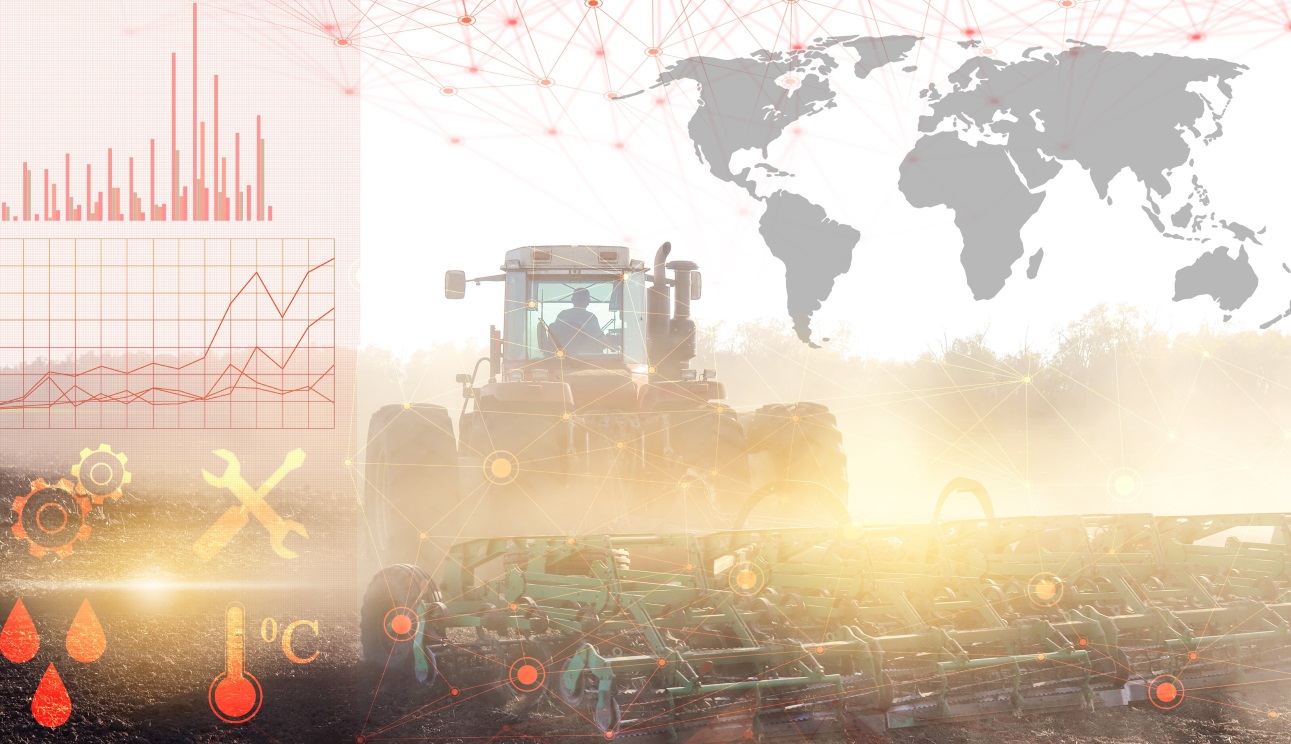
The agrifood space is using digital technologies and information architecture (IA).
Apps that tell smallholders if their crops are infested, chatbots that offer nutrition advice in refugee camps, and satellite images fused with drone-captured footage and crunched with weather forecasts to predict food security crises, are prevalent, FAO’s Assistant Director-General – Economic and Social Development Department, Maximo Torero Cullen, revealed.
Tools that analyse big data are also in use to optimise food chains, manage water resources, monitor forests, identify species, or alert and immunise farmers against natural disasters. Food production, food security and food systems in the context of AI are core topics in the agrifood landscape.
Detailing the future of AI in agriculture, technology company Intel details how the world will need to produce 50% more food by 2050. As such, AI can help farmers “get more from the land while using resources more sustainably”.
“AI holds the promise of driving an agricultural revolution at a time when the world must produce more food using fewer resources,” Intel confirmed.
Balancing benefits and ethics
Digitalization projects, such as Microsoft and Danone’s digital intelligence partnership, are spearheading the rapid progressive development of AI in the agrifood sector. Yet, consumer calls for full transparency and assurance of food safety and quality are simultaneously urging producers, brands and retailers to advocate and follow responsible AI.
In a bid to harness AI to make global food systems “more efficient, sustainable and inclusive”, the FAO Director-General has signed up to an ethical resolution on AI, called Rome Call for AI Ethics, endorsed by Pope Francis.
“Artificial Intelligence needs to be transparent, inclusive, socially beneficial and accountable,” Qu Dongyu, Director-General of the FAO relayed. The Rome Call for AI Ethics paper highlights the importance of implementing a “highly sustainable approach, which also includes the use of artificial intelligence in ensuring sustainable food systems in the future”.
Ethical resolution on AI
Human rights, inclusiveness and capability preparedness are the core drivers behind the ethical resolution on AI, Torero Cullen relayed.
The FAO can play a central role in human rights, FAO’s Assistant Director-General said, given its role to achieve the Sustainable Development Goal 2 of zero hunger. Ensuring human rights are upheld is vital, based on the “profound” changes that AI will bring. How AI can be researched and produced while safeguarding fairness and human dignity, security and privacy, is vital, particularly the importance of taking into account the needs of the most vulnerable.
Focusing on inclusiveness, in any “breakthrough” technology like AI, it is essential to find out how it benefits everyone, Torero Cullen stated. Therefore, it will be necessary to create regulatory environments to speed up AI adoption, but more importantly, to avoid exclusion and market power concentration, especially in the most vulnerable countries and regions.
AI will “transform” the globe and we “need to have our younger generation ready”. As such, capability preparedness is crucial and education needs to reflect this by developing curriculums.
The ethical resolution on AI is based on six key components, Torero Cullen further explained:
- Transparency: AI systems must be explainable;
- Inclusion: Considering everyone’s needs is crucial so that all individuals can access the best possible conditions to express themselves and develop;
- Responsibility: Those who design and deploy AI must proceed with responsibility and transparency;
- Impartiality: The avoidance of using bias to create or act in relation to AI;
- Reliability: AI systems must be able to work reliably;
- Security and privacy: AI systems must work securely and respect user privacy.
The economic development that results because of innovation like AI focuses on the welfare of people in terms of “higher incomes and better standards of living”. Yet, this may “not be equally distributed within nations and across nations”.
Detailing the “ethical dimensions of economic development”, Torero Cullen explains that this deals with the “promotion of morally desirable outcomes, such as equal opportunity”.
“It implies, more equitable distribution of income, elimination of poverty, hunger, and discrimination of all sorts based on caste, class and gender,” Torero Cullen added.

Accelerating agri-food
Global technology name Microsoft and food and nutrition company Danone are focusing their efforts on using AI to create a responsible food industry.
Teaming up with Danone for its latest AI Factory, Microsoft and the nutrition leader have unveiled their accelerator for funded European startups that have developed and marketed AI-based solutions.
Launching AI Factory for Agrifood, the duo will spearhead efforts on sustainable food and regenerative agriculture. AI Factory is Microsoft’s support program for start-ups specialising in AI and cloud computing. The AI Factory for Agrifood aims to encourage projects serving regenerative agriculture (soil health, animal welfare, support for farmers), sustainable food, waste minimisation, and supply chain optimisation.
“Our ambition is to help develop digital intelligence for healthy food and sustainable agriculture,” said Agnès Van de Walle, Director of the One Commercial Partner Entity at Microsoft France.
“We believe that artificial intelligence can contribute to the Food Revolution by improving our agricultural systems and our food’s value chains,” added Cécile Cabanis, EVP, CFO, IS / IT, Danone Cycles & Procurement.
Managing AI obstacles
Commenting on the main challenge relating to the use of AI in food systems, Torero Cullen set out how “allowing all farmers to have optimal access” to application resources is the biggest concern.
The agrifood environment needs to ensure all farmers have access to digital technology applications, IA and technology-led content, along with confirming necessary capabilities are present.
If these are “not taken care of then we will have [the] effects of power concentration, exclusion and control over voice and policies,” warned Torero Cullen.
As agriculture and rural areas become digital, it requires “revolutionary changes” in agricultural processes such as production, operations, processing, management, marketing, and rural governance, the FAO Director-General stated.
Highlighted as an “ambitious vision” with “the task ahead of us as a big one”, the organisation recognises that the solution requires adequate big data centre and cloud platforms.
“We are convinced that transforming our food systems to feed the world will be achieved with digital agriculture and SDG – Sustainable Development Goals – of 2030 Agenda is our common consensus endorsed by the General Assembly of the UN,” Qu concluded.
Transforming food revolution
In February 2020, the European Commission’s (EC) whitepaper on AI published its whitepaper, detailing potential policy options for regulating AI technology within the EU to build trust with consumers.
Describing AI as a “strategic technology that offers many benefits”, the Commission’s whitepaper emphasises that this is “provided it is human-centric, ethical, sustainable and respects fundamental rights and values”.
The paper is currently open for public consultation until 19th May 2020. Emphasising that “AI should work for people and be a force for good in society”, the Commission’s “broad” consultation brings together Member States civil society, industry and academics to create “concrete” proposals for a European approach on AI.
The approach aims to create policy means to increase investments in research and innovation, boost the development of skills and contribute to the uptake of AI by SMEs, along with proposals for core elements of a future regulatory framework.










