






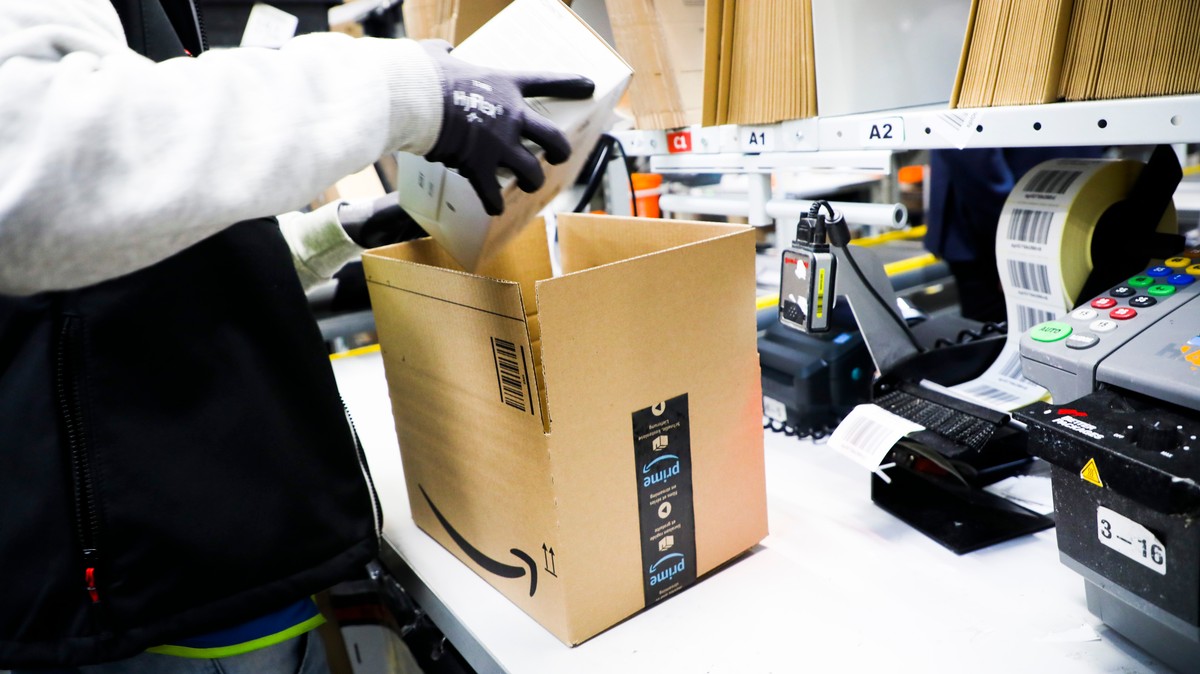
More than half of American households are Amazon Prime members, and, for better or worse, have come to rely on the service for many of their everyday needs. In the coming weeks and months as coronavirus continues to spread, many Americans, holed up in their homes and apartments for purposes of quarantine or social distancing, will rely increasingly on Amazon’s delivery services to fill all of their material needs. This will undoubtedly put increased strain on the workers who pack and deliver Amazon products, and leave them vulnerable to Covid-19.
Motherboard spoke to Amazon logistics and labor experts who say it’s only a matter of time before Amazon Prime’s signature two-day delivery promise faces serious delays, mistakes, and widespread shortages due to increased demands from consumers, pressure on workers to meet rising production quotas, restrictions on trade, and the possibility of fulfillment centers being shut down as coronavirus spreads. Amazon’s warehouse workers say they’re already seeing increased workloads, while fewer of their colleagues are showing up to work, according to labor organizers.
Already, Amazon’s white collar workers have been asked to work from home, but that’s obviously not an option for warehouse fulfillment workers and delivery drivers.
“It seems really likely that Amazon’s prime delivery system will falter,” Daniel Flaming, president of Economic Roundtable and an author of the 2019 report on Amazon’s economic impact on southern California, told Motherboard. “One day deliveries may not be made within one day. If the workers who do show up to warehouses are more stressed and given bigger routes and are possibly less experienced, incorrect deliveries will be made. The last mile segment of the delivery is very labor intensive.”
Flaming adds that we’re likely to see a close parallel of what happens in Amazon warehouses during the holiday rush: increased delays, mistakes, and bottlenecks. “It would seem to me most likely that we’d see a drop in reliability and timeliness.”
With the coronavirus crisis having already affected large swaths of American culture and the economy, there’s no real reason to think that the world’s largest retailer will be spared. Amazon is facing pressure from three different sides: Increased demand from consumers, the very real potential of coronavirus spreading through a warehouse, and supply chain interruptions.
Ports that receive goods from overseas have seen major slowdowns as the Chinese stall manufacturing. While Trump’s European travel ban does not currently include trade, imports from Europe could come to a halt if things change as they already are overnight. Already, Amazon is seeing shortages of basic supplies like toilet paper, hand sanitizer, and disinfectant wipes.
“There has been a tremendous slowdown at our ports. It was picking up again a little, but it’s going to drop off again,” Barbara Maynard, a spokesperson for the Teamsters International Ports Division, which organizes truck drivers and port workers who handle Amazon products, told Motherboard. “At any moment our borders and ports could be closed. There’s a tremendous amount of fear among workers we organize who handle Amazon products.”
On March 11, Amazon announced that it would provide all of its employees and contractors with two weeks of paid sick leave and unlimited paid time off, and establish a $25 million relief fund for its gig workers and contractors.
“The health and safety of our employees and contractors around the world continues to be our top priority as we face the challenges associated with COVID-19,” an Amazon spokesperson told Motherboard. “Leaders across Amazon are meeting every day to consider the evolving situation and are consulting with medical experts to ensure we are doing all we can to keep our teams healthy. We’ve taken a number of actions over the past few weeks and will continue to evaluate next steps should we see a much broader impact.”
But among labor experts and warehouse workers, there is widespread concern that Amazon has not done enough to protect its workers (and customers) from getting sick at some point in the supply chain. According to researchers, the virus can live on cardboard for up to 24 hours.
“What we’re seeing right now from Amazon is pretty bad,” Zachary Lerner, director of labor organizing at New York Communities for Change who organizes Amazon warehouse workers in Staten Island, told Motherboard. “Right now, they’re offering unlimited unpaid time off, but if workers need to make money, they will still go into work, which will spread coronavirus at the vector points. What they have put together right now doesn’t address worker or societal health. In order to address this any worker who is sick must be compensated with paid sick leave for the time they spend away from the job.”
“In the distribution centers, where people pick up their loads, there’s a lot of interaction between people within close range of each other”
“Given the demand on Amazon as it is now, the intense pace of work inside these facilities, and the delayed announcement about any paid time off, people who work for and live around Amazon, people have real reasons to be very worried—and very angry,” said Dania Rajendra, the director of Athena, a coalition of several dozen grassroots organizations that formed in late 2019 to challenge Amazon. “To whatever extent they’ve planned, Amazon management seems not to have taken into consideration the humanity and needs of the people who make Amazon successful.”
In a recent petition for paid sick leave and childcare accommodations during the pandemic created by Amazon warehouse workers in Queens, workers wrote, “we have seen an increase in the volume of such goods, placing a greater strain on workers. Yet despite larger workloads, Amazon continues to enforce and raise productivity quotas. At the same time, many workers have been shocked to discover the company has been illegally denying them paid sick leave.”
“It’s true that a lot of people will rely on Amazon and it will mean lots of pressure on the workforce delivery drivers who will be delivering hundreds packages a day,” said Tim Shadix, legal director at the Warehouse Worker Resource Center, which organizes Amazon warehouse workers in Southern California. “Workers have said before that performance pressures make it difficult for some people to follow safety rules and take bathroom breaks. You have to wonder how people will slow down and wash their hands, especially delivery drivers who are out in the field.”
Experts say that warehouse workers and last mile delivery drivers are particularly at risk because they’re in close contact with packages that have been in the hands of others at different stages in the logistics chain.
“In the distribution centers, where people pick up their loads, there’s a lot of interaction between people within close range of each other,” said Flaming, the president of the Economic Roundtable. “People are in close contact with packages that have been handled by many other people. They’re at risk of being caught up in a chain of infection.”
When an Amazon warehouse worker inevitably gets coronavirus, labor experts and organizers told Motherboard that it’s unclear whether Amazon will respond by pausing operations—which would disrupt the flow of goods to customers—or simply go on with business as usual. But that it’s likely Amazon will follow safety recommendations prescribed by the government.
“I think we would hope Amazon would follow what guidelines are recommended from OSHA and CDC, including a slowdowns or shutdown,” said Shadix, legal director at the Warehouse Worker Resource Center, which organizes Amazon warehouse workers. “I have no reason to think that Amazon would ignore the recommendations of health experts. We’ll have to wait and see what everyone does.”
Amazon told Motherboard that it has increased in intensity and frequency of cleaning at all of its worksite, requires employees to stay home when they are sick, and required that employees clean their work stations and vehicles with disinfectant at the start and end of every shift.
Edward Ongweso contributed reporting.










