







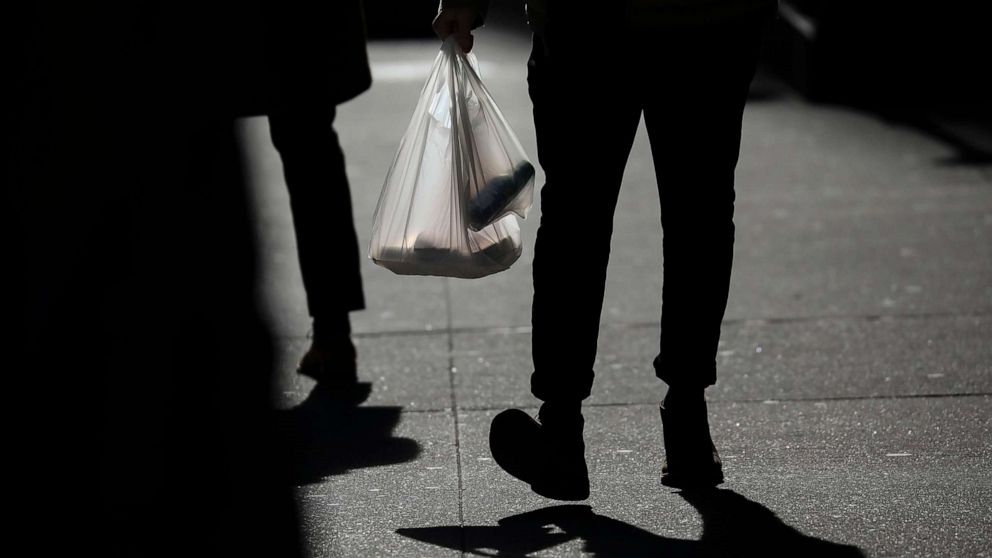

Bans on single-use plastic bags — one of the most pervasive sources of pollution — are taking effect in cities and states across the U.S. as efforts to combat global plastic production pick up.
But while the moves are being lauded by environmentalists and the local governments that support them, some are questioning whether the move will be effective, primarily because of the unintended environmental consequences associated with replacement materials such as paper, thick plastic and reusable bags.
Plastic bags were widely introduced to American consumers in 1979 and were marketed as preferable to paper because they are durable, waterproof and have many functions, according to the United Nations Environment Programme.
Until the early ’80s, paper bags were standard for carrying groceries. With the adoption of plastic bags by grocery chains Safeway and Kroger in 1982, plastic bags soon dominated supermarkets and convenience stores across the U.S. by the end of the decade, the UNEP states.
In the U.S., 380 billion plastic bags and wraps are used every year, requiring 12 million barrels of oil to create, according to the Environmental Protection Agency. Low-density polyethylene, the material from which plastic bags are made, is produced from crude oil or natural gas, making the petroleum-based plastic bags non-biodegradable.
While many plastic bags are recyclable and large retailers in some areas are required to accept them for reprocessing, many wind up tangled in trees and littering streets.
Plastic pollution costs some communities $1 million in annual fees to remove waste mostly made up of grocery bags, according to the EPA.
A worldwide effort
Across the globe, countries have increased their efforts to limit plastic bags and other plastic materials from being produced, distributed and ultimately released into the environment.
In the U.S., statewide bans against plastic bags are being put into place. Eight states have passed legislation banning single-use plastic bags, with three — California, Hawaii, and Oregon — currently in effect. Bans in New York, Maine and Vermont are scheduled as early as next month, while in several cities, restrictions have been implemented without the adoption of state-led legislation.
California became the first to introduce regulations banning single-use plastic bags in August 2014. Proposition 67, also known as SB270, officially passed in November 2016, prohibits plastic bags at groceries, chain pharmacies, and other stores.
Since the policy took effect, Californians Against Waste (CAW), a nonprofit organization that sponsored the bill, has reported a substantial reduction in plastic bag litter in the state’s rivers, beaches and landscapes.
During a 2010 annual beach cleanup, crews from CAW reported that 65,000 grocery bags were scattered along water bodies, a number that CAW says decreased by 72% in 2017. Mark Murray, executive director of the nonprofit, attributed the decrease to the ban.
Retailers in California have been in full compliance with the law, he said, and compared to the 13.8 billion grocery bags that were once distributed in the state each year prior to the policy, none are now distributed. Instead, paper and reusable grocery bags are supplied to customers for a fee.
The organization initially feared that restrictions would prompt a significant uptick in the use of paper bags, but data suggests the 10-cent charge has curbed any growth in paper bag generation.
California’s reported success with SB270 has sparked policies in states like New York, which is soon to follow suit on March 1. Similar to upcoming bans in Maine and Vermont, New York stores will be replacing plastic bags with paper bags that customers can purchase for a cost of no less than 5 cents.
Commissioner Basil Seggos of the New York Department of Environmental Conservation (NYSDEC) hopes that the ban will prevent 23 million single-use plastic bags used annually in the state from ending up in the environment and landfills. He expects the quality of life for New Yorkers to increase when harmful litter becomes eliminated.
Paper has been widely supported by legislators as a less environmentally damaging alternative to plastic bags. Terry Webber, executive director of the American Forest & Paper Association, a paper industry trade association, said paper is a renewable, recyclable and compostable resource that is made with wood fiber from sustainably managed forests.
As opposed to petroleum-based plastic bags, Webber claims two-thirds of the energy used to make paper comes from renewable biomass (residuals such as tree limbs and bark that are used as a renewable energy source to power paper mills). 90% of water used during manufacturing also returns to waterways, he claimed.
What the skeptics say
However, the shift from plastic to reusable and paper bags has been met with skepticism by some consumers, manufacturers and industry experts, who fear banning plastic will result in additional environmental problems and hurt consumers.
A 2017 study conducted by Recyc-Québec, a government recycling agency in Canada, looked at the life cycles of different disposable bags used within the province.
Results indicate that though conventional plastic bags tend to have higher environmental impacts when released into the environment, when compared to alternatives (such as compostable bioplastic, paper, thick plastic, and oxo-degradable plastic bags), they appear to have the least overall environmental impact (except as litter).
“Because of its thinness and lightness, being designed for a single use, its life cycle requires little material and energy,” the report says. “In addition, it avoids the production of garbage bags since it is commonly used for this function as well.”
The study, which looks at human health, quality of ecosystems, use of fossil fuels and abandonment in the environment, indicates that paper was the lowest-performing type of single-use bag with potential environmental impacts ranging 4 to 28 times that of a standard plastic grocery bag.
Also, reusables made from cotton, woven and non-woven polypropylene bags require tens to thousands of uses before they become more environmentally efficient than single-use plastic bags, the study says.
From Recyc-Quebec to the United Kingdom’s Environment Agency other studies highlight the necessity of prolonged use when using reusable bags in order for their environmental benefits to exceed that of single-use plastic bags.
Research conducted by Oregon’s Department of Environmental Quality (DEQ) suggests compostable materials can often result in greater environmental costs than non-compostable alternatives because of the impacts associated with extracting, processing, and manufacturing raw materials during onset production.
David Allaway, a senior policy analyst at DEQ’s Materials Management Program, said that in the case of 90% of manufactured items, most impact occurs when producing the product rather than when it goes to the landfill or gets recycled.
“The public believes materials come to us free of impact, and all we have to think about is compositing versus landfilling or recycling. In reality, it’s not quite true. By the time we buy this stuff most of the environmental impact has been done.”
Allaway points to the importance of assessing materials based on their intended purpose.
“I don’t think that a clear case can be made that either recycled paper or virgin plastic grocery bags are universally “better” or “worse” for the environment. Most life cycle assessments generally point to plastic grocery bags having fewer impacts than paper, but that isn’t always the case. Depending on which environmental issue you prioritize – litter, climate change, air toxins, marine debris, water consumption, etc. – you might favor one material over the other. There is no consistent or universal winner.”
For Sarah Nichols, sustainable Maine project director at the Natural Resources Council of Maine, the decision to ban single-use plastic bags was one she struggled with for the past six years.
Virgin plastic, she explained, is ultimately a byproduct of the fossil fuel industry and is kept a low-cost material, allowing it to be made abundantly. As fossil fuels are major contributors to climate change, Nicholas says she has come to believe banning plastic bags altogether is the right thing to do. Similar to California and Oregon’s bans, she believes people in Maine will not only adhere to the restriction, but reap its benefits.
“Every independent life cycle assessment that has looked at various bagging options has found that the common plastic grocery bag, when disposed of properly, has the least environmental impact,” Matt Seaholm, executive director of the American Recyclable Plastic Bag Alliance said. “Paper has its purposes and should be an option that consumers can choose from, but there is no doubt that it takes more material, energy and water to manufacture than plastic, and its weight and bulkiness necessitate seven trucks to transport the same number of bags that can be hauled in just one truck of plastic.”
And Adrian Hong, president of Island Plastic Bags, Inc. in Hawaii, believes grocery bags should be available for a fee rather than ultimately banned because of the impact on manufacturers.
“I don’t think replacing plastic with other materials makes the planet better off,” he said, “You have to look at the life-cycle of the materials to see what’s best.”
Advice for consumers
In Oregon, the Department of Environmental Quality received a steady stream of phone calls in the first few weeks after implementing the ban. As residents grew accustomed to the policy, calls slowly tapered off and officials noted an uptick in use of reusable plastic bags in supermarkets.
When it comes to single-use plastic bag bans, environmental officials advise consumers to make choices that limit the number of any disposable bags they use – whether that is paper or plastic. Recycling paper and properly disposing of plastic bags ensure litter and harmful toxins aren’t excessively released into the environment. On the manufacturing end, environmental officials argue that the responsibility to construct products more sustainably must fall on producers to create systemic change.
“The good thing is we’re entering a phase where people are starting to think about single-use, recycling, and the climate,” Matt Fletcher of the Michigan Department of Environment, Great Lakes, and Energy said. “That in itself is a victory.”
The EPA encourages consumers to reduce the number of bags they use, reduce the number of bags they throw away after one use, reuse bags, and recycle bags when they can no longer be used.
“The Agency promotes sustainable materials management (SMM), a holistic, systemic approach to using and reusing materials more productively throughout the life cycle of products and services in the U.S. economy,” the agency said in a statement.
Copyright © 2020 ABC News Internet Ventures










