

• Latest
  • Trending
  • All
Argonne National Laboratory Using 3D Printed PEEK Contactors to Recycle Molybdenum More Efficiently – 3DPrint.com

Argonne National Laboratory Using 3D Printed PEEK Contactors to Recycle Molybdenum More Efficiently – 3DPrint.com

March 18, 2020
Last Mile Delivery Market Worth Observing Growth | UPS, FedEx, SF Express

Last Mile Delivery Market Worth Observing Growth | UPS, FedEx, SF Express

April 23, 2024
Top 5 Spend Analysis Software ranked in 2024

Top 5 Spend Analysis Software ranked in 2024

March 1, 2024
How Tesla And BMW Are Leading A Supply Chain Renaissance With Blockchain

How Tesla And BMW Are Leading A Supply Chain Renaissance With Blockchain

January 19, 2024
LATAM Cargo strengthens European cargo links

LATAM Cargo strengthens European cargo links

April 14, 2020
Ford making reusable hospital gowns from airbag materials as efforts against coronavirus expand

Ford making reusable hospital gowns from airbag materials as efforts against coronavirus expand

April 14, 2020
Don’t Sweat NBC’s Decision to Cut Back on Television Ad Inventory

Don’t Sweat NBC’s Decision to Cut Back on Television Ad Inventory

April 14, 2020
Software firms sharpen focus on AI, big data as IT spending drops

Software firms sharpen focus on AI, big data as IT spending drops

April 14, 2020
Navigating turbulent times in your supply chain (TL:DR version)

Navigating turbulent times in your supply chain (TL:DR version)

April 14, 2020
Last Mile Delivery by Drones Market is Booming Worldwide

Last Mile Delivery by Drones Market is Booming Worldwide

April 14, 2020
AIR CARGO MARKET SIZE, SHARE, DEMAND, TREND, LATEST INNOVATIONS & APPLICATION ANALYSIS AND INDUSTRY GROWTH FORECAST 2027 – Science In Me

AIR CARGO MARKET SIZE, SHARE, DEMAND, TREND, LATEST INNOVATIONS & APPLICATION ANALYSIS AND INDUSTRY GROWTH FORECAST 2027 – Science In Me

April 14, 2020
Wheat procurement in Patiala: 6,500 coupons issued to farmers – cities

Wheat procurement in Patiala: 6,500 coupons issued to farmers – cities

April 14, 2020
Pandemic, Plastics And The Continuing Quest For Sustainability

Pandemic, Plastics And The Continuing Quest For Sustainability

April 14, 2020
  • Supply Chain
  • Logistics
  • Warehousing
  • Procurement
  • Shipping
  • More
    • Strategic Sourcing
    • Spend Analysis
    • Inventory
    • Contact Us
No Result
View All Result
United States International Supply Chain Commission
Home Procurement

Argonne National Laboratory Using 3D Printed PEEK Contactors to Recycle Molybdenum More Efficiently – 3DPrint.com

by usiscc
March 18, 2020
in Procurement
0
Argonne National Laboratory Using 3D Printed PEEK Contactors to Recycle Molybdenum More Efficiently – 3DPrint.com
501
SHARES
1.4k
VIEWS
Share on FacebookShare on Twitter

Just a few years ago, the FDA approved the first Molybdenum-99 (Mo-99) to be produced domestically without the use of highly enriched uranium (HEU). This medical isotope helps radiologists detect bone decay, heart disease, and some types of cancers that are difficult to find, and in 2018, the US Department of Energy’s National Nuclear Security Administration (NNSA) reported that Mo-99 was used in over 40,000 medical procedures daily in the US – a number that has likely increased. So a team of scientists from the DOE’s Argonne National Laboratory turned to 3D printing to try and get more out of this important isotope.

(Image: SHINE Medical Technologies)

“Every year, doctors rely on Molybdenum-99 to conduct millions of medical procedures to diagnose illnesses like heart disease or cancer. But producers of this medical isotope lacked an easy, cost-effective way to recycle it – until now,” Dave Bukey, the Integrated Communications Lead at Argonne, told 3DPrint.com.

Argonne, the nation’s first national laboratory, employs people from over 60 nations, and works to come up with solutions to important national problems in science and technology, often turning to 3D printing to solve them. The laboratory often works with researchers from other companies, universities, and agencies to help solve these problems, as well as advance the nation’s scientific leadership.

Mo-99 decays into technetium-99m, which is then used by radiologists to develop pharmaceuticals for medical procedures. It can be made from enriched molybdenum, but it’s definitely not cheap, costing roughly $1,000 per gram. But now, it’s possible to scale up recycling of isotopically enriched molybdenum, Mo-98 or 100, for the first time in the US, thanks to Argonne’s recycling method and some 3D printed parts.

This method was first pioneered back in 2015 by the laboratory’s Mo-99 program manager, Peter Tkac, and his team, and is faster, more reliable, and cost-effective.

Tkac said, “Our original method would have been very difficult to automate.”

The team’s original recycling process for enriched molybdenum was, as Bukey aptly described in an Argonne post, “tedious.” Along with other corrosive chemicals, used enriched molybdenum was converted into an acidic solution, then purified with test tubes and funnels in a lengthy, multi-step process.
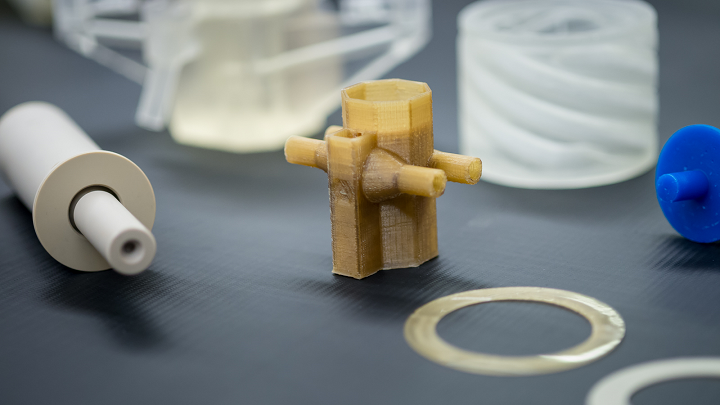
Argonne scientists 3D printed parts like these to accomplish the recycling milestone.

In 2016, Tkac and other researchers turned their attention to automating the process, together with aerospace engineer, 3D printing expert, and fellow Argonne employee Peter Kozak. Instead of relying on the funnels and test tubes, they instead used 3D printed acrylic contactors, which use centrifugal force (acts outward on a body moving around a center) to spin and separate the chemicals.

“We printed each contactor as one piece with streamlined features and fewer external connections. This allows us to push the liquid through the system as quickly and reliably as possible,” Kozak explained.

These 3D printed contactors made the recycling of enriched molybdenum more efficient and less expensive, according to the research team, which includes Alex Brown and Brian Saboriendo. An article published in the Journal of Solvent Extraction and Ion Exchange in December explained that this updated recycling process was better able to separate enriched molybdenum from potassium and other contaminants.
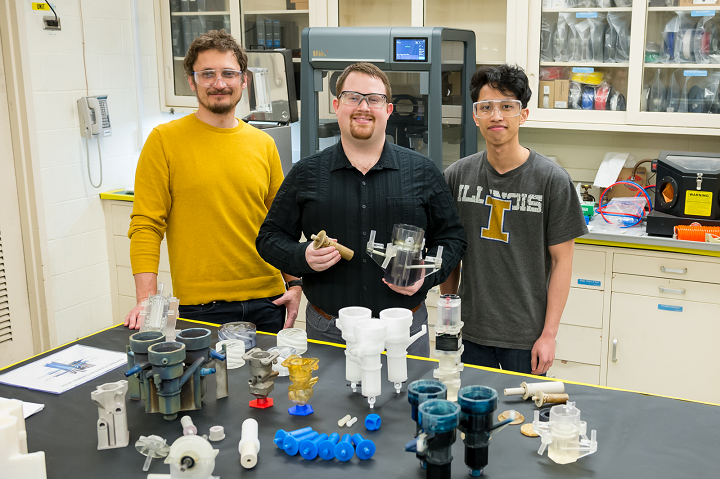
The laboratory’s new 3D printing approach makes its recycling method — pioneered in 2015 by Mo-99 program manager Peter Tkac (left) and others — faster, more reliable, and more cost effective. Also shown: Peter Kozak (center) and Brian Saboriendo (right). Not shown: Alex Brown.

However, the team did run into a problem – after about 15 hours of operation, the 3D printed plastic contactors were corroded by hydrochloric acid used in the recycling process.

Kozak said, “Our experiment was successful. But if you want to move into full production, you need material that will survive a lot longer than that.”

Tkac and Kozak soon discovered polyetheretherketone, or PEEK, which is more durable than the original acrylic plastic they were using, and also resists the Argonne recycling method’s organic solvents and mineral acids. However, PEEK does shrink during 3D printing, which causes the material to warp, so Kozak changed the temperature and speed of the 3D printer’s fan to compensate for this difficulty. This allowed the team to 3D print their contactors out of PEEK, which made them stronger and more flexible. Now, they can quickly, efficiently, and cost-effectively recycle enriched molybdenum, thanks to 3D printed PEEK parts that can stand up to the chemicals that separate the Mo-99 from other materials during the recycling process.

The DOE National Nuclear Security Administration’s Office of Defense Nuclear Nonproliferation and Office of Material Management and Minimization supported this important research.

Discuss this story and other 3D printing topics at 3DPrintBoard.com or share your thoughts in the Facebook comments below.

(Images by Argonne National Laboratory)

Share200Tweet125
usiscc

usiscc

  • Trending
  • Comments
  • Latest
Escape From Tarkov – How to Rotate Items

Escape From Tarkov – How to Rotate Items

February 5, 2020
Supply chain examination: Planning for vulnerabilities you can’t control

Supply chain examination: Planning for vulnerabilities you can’t control

December 7, 2019
Procurement Project Manager job with Camden London Borough Council

Procurement Project Manager job with Camden London Borough Council

February 17, 2020
Art Battle Wichita Falls III at The Warehouse, 1401 Lamar.

Art Battle Wichita Falls III at The Warehouse, 1401 Lamar.

0
Global Industry Analysis, Size, Share, Growth, Trends, and Forecasts 2016–2024 – ZMR News Reports

Global Industry Analysis, Size, Share, Growth, Trends, and Forecasts 2016–2024 – ZMR News Reports

0
PHOTOS: Ottawa firefighters respond to warehouse fire

PHOTOS: Ottawa firefighters respond to warehouse fire

0
Last Mile Delivery Market Worth Observing Growth | UPS, FedEx, SF Express

Last Mile Delivery Market Worth Observing Growth | UPS, FedEx, SF Express

April 23, 2024
Top 5 Spend Analysis Software ranked in 2024

Top 5 Spend Analysis Software ranked in 2024

March 1, 2024
How Tesla And BMW Are Leading A Supply Chain Renaissance With Blockchain

How Tesla And BMW Are Leading A Supply Chain Renaissance With Blockchain

January 19, 2024
  • Privacy Policy
  • Terms of Use
  • Disclaimer
  • DMCA
  • Contact Us

Copyright © 2024 United States International Supply Chain Commission (usiscc.org)

This website uses cookies to improve your experience. We'll assume you're ok with this, but you can opt-out if you wish. Cookie settingsACCEPT
Privacy & Cookies Policy

Privacy Overview

This website uses cookies to improve your experience while you navigate through the website. Out of these cookies, the cookies that are categorized as necessary are stored on your browser as they are essential for the working of basic functionalities of the website. We also use third-party cookies that help us analyze and understand how you use this website. These cookies will be stored in your browser only with your consent. You also have the option to opt-out of these cookies. But opting out of some of these cookies may have an effect on your browsing experience.
Necessary
Always Enabled

Necessary cookies are absolutely essential for the website to function properly. This category only includes cookies that ensures basic functionalities and security features of the website. These cookies do not store any personal information.

Non-necessary

Any cookies that may not be particularly necessary for the website to function and is used specifically to collect user personal data via analytics, ads, other embedded contents are termed as non-necessary cookies. It is mandatory to procure user consent prior to running these cookies on your website.

SAVE & ACCEPT
No Result
View All Result
  • Supply Chain
  • Logistics
  • Warehousing
  • Procurement
  • Shipping
  • More
    • Strategic Sourcing
    • Spend Analysis
    • Inventory
    • Contact Us

Copyright © 2024 United States International Supply Chain Commission (usiscc.org)