






You know that universal sign we give truckers, hoping they’ll sound their air horns? Well, you’re going to be hearing a lot less honking in the future. And with good reason. The absence of an actual driver in the cab. We may focus on the self-driving car, but autonomous trucking is not an if, it’s a when. And the when is coming sooner than you might expect. Already, companies have been quietly testing their prototypes on public roads. Right now, there’s a high-stakes, high-speed race pitting the usual suspects, Google and Tesla and other global tech firms, against small start-ups smelling opportunity. The driverless semi will convulse the trucking sector and the two million American drivers who turn a key and maneuver their big rig every day. And the winners of this derby, they may be poised to make untold billions, they’ll change the U.S. transportation grid and they will emerge as the new kings of the road.
It’s one of the great touchstones of Americana: the romance and possibility of the open road. All hail the 18-wheeler hugging those asphalt ribbons, transporting all of our stuff across the fruited plains, from sea to shining sea. Though we may not give it a second thought when we click that free shipping icon, truckers move 70% of the nation’s goods. But trucking cut a considerably different figure on a humid Sunday last summer on the Florida turnpike. Starsky Robotics, a tech startup, may have been driving in the right lane, but they passed the competition with 35,000 pounds of steel thundering down a busy highway with nobody behind the wheel. The test was a milestone. Starsky was the first company to put a truck on an open highway without a human on board. Everyone else in the game with the know-how keeps a warm body in the cab as backup. For now, anyway. If you didn’t hear about this, you’re not alone; in Jacksonville, we talked to Jeff Widdows, his son Tanner, Linda Allen and Eric Richardson – all truckers; and all astonished to learn how far this technology has come.
Linda Allen: I wasn’t aware ’til I ran across one on the Florida Turnpike and that just– it just scares me. I can’t imagine. But I didn’t know anything about it.
Jon Wertheim: No one’s talkin’ about it at work.
Jeff Widdows: Nobody, never, never.
Eric Richardson: I didn’t know that it’d come so far. And I’m thinking, “Wow. It’s here.”
He’s right. The autonomous truck revolution is here. It just isn’t much discussed – not on CB radios; and not in statehouses. And transportation agencies are not inclined to pump the brakes. From Florida, hang a left and drive 2000 miles west on I-10 and you’ll hit the proving grounds of a company with a fleet of 41 autonomous rigs.
Jon Wertheim: This is a shop floor? Or this is a laboratory
Chuck Price: It’s both.
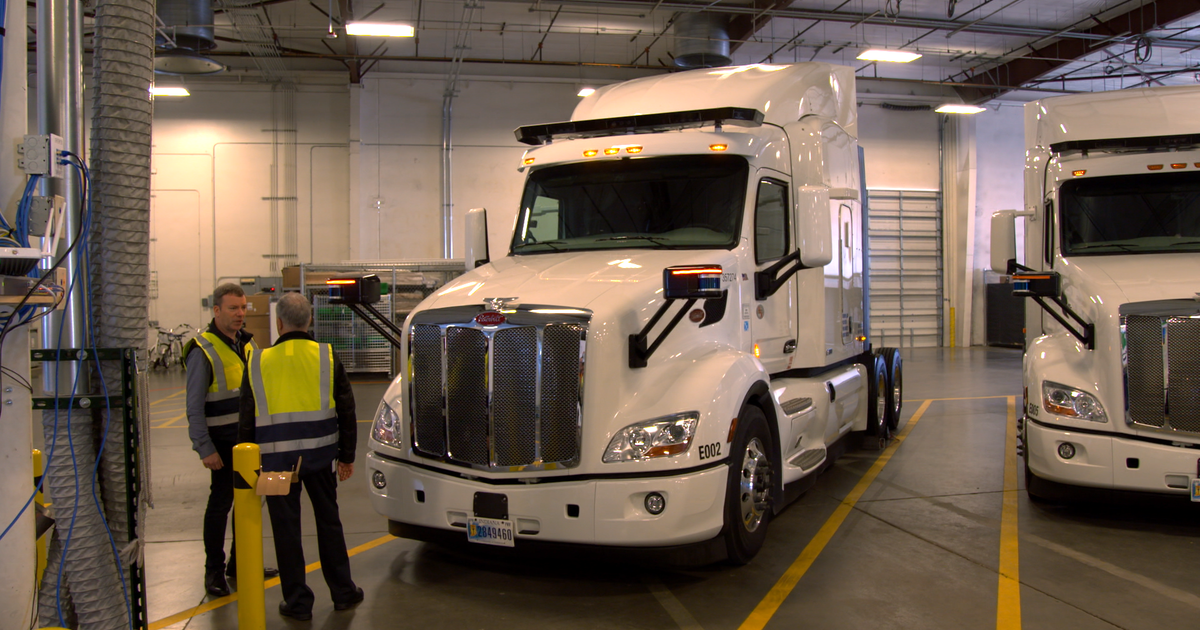
In the guts of the Sonoran Desert, outside Tucson, Chuck Price is chief product officer at TuSimple, a privately held, global autonomous trucking outfit valued at more than a billion dollars with operations in the U.S. and China. At this depot, $12 million worth of gleaming self-driving semis are on the move.
Jon Wertheim: Right now we’ve got safety operators in the cab. How far away are we from runs without drivers?
Chuck Price: We believe we’ll be able to do our first driver-out demonstration runs on public highways in 2021.
That’s the when. As for the how…
Chuck Price: Our primary sensor system is our array of cameras that you see along the top of the vehicle–
Jon Wertheim: Heard about souping up vehicles. This takes it to a new level.
Chuck Price: It’s a little bit different… yeah.
The competition is fierce, so much so their technology is akin to a state secret. But Price points us to a network of sensors, cameras and radar devices strapped to the outside of the rig, all of it hardwired to an internal AI supercomputer that drives the truck. It’s self-contained — so a bad WiFi signal won’t wreak havoc on the road.
Chuck Price: Our system can see farther than any other autonomous system in the world. We can see forward over a half mile.
Jon Wertheim: You can drive autonomously at night?
Chuck Price: We can. Day, night. And in the rain. And in the rain at night.
And they’re working on driving in the snow. Chuck Price has unshakable confidence in the reliability of the technology; as do some of the biggest names in shipping: UPS, Amazon and the U.S. Postal Service ship freight with TuSimple trucks. All in, each unit costs more than a quarter million dollars. Not a great expense, considering it’s designed to eliminate the annual salary of a driver; currently around $45,000. Another savings: the driverless truck can get coast-to-coast in two days, not four, stopping only to refuel—though a human still has to do that.
We wanted to hop in and experience automated trucking firsthand.
Jon Wertheim: I feel like it’s our turn on Space Mountain.
Chuck Price was happy to oblige. We didn’t know what to expect, so we fashioned more cameras to the rig than NASA glued to the Apollo rockets…
Maureen Fitzgerald: Is everybody buckled in?
ALL: Buckled in.
Maureen Fitzgerald: Three, Two, One….
…and we hit go.
TRUCK COMPUTER: Autonomous driving started.
We sat in the back alongside the computer. In the front seat: Maureen Fitzgerald, a trucker’s trucker with 30 years experience. She was our safety driver, babysitting with no intention of gripping the wheel, but there just in case. Riding shotgun: an engineer, John Panttila, there to monitor the software. The driverless truck was attempting a 65-mile loop in weekday traffic through Tucson.
The route was mapped and programmed in before the run, but that’s about it – the rest was up to the computer, which makes 20 decisions per second about what to do on the road. As we rolled past distracted drivers, disabled cars, slow-pokes and sheriffs, our safety driver kept vigil but never disengaged the driverless system.
John Panttila: Watching the front targets close in a hundred. Yep. Got to cut in right now. 55 mile an hour. Bad cut-off.
Jon Wertheim: This guy just flagrantly cut off–
Chuck Price: He just really cut us off.
Jon Wertheim: We did not honk at him. Did we disengage?
Chuck Price: We did not disengage. This vehicle will detect that kind of behavior faster than the humans.
Jon Wertheim: How far are we from being able to pick up the specific cars that are passing us? “Oh, that’s Joe from New Jersey with six points on his license.
Chuck Price: We can read license plates. So if there was an accessible database for something like that, we could.
Chuck Price says that would be valuable to the company though he admits it could create obvious privacy issues. But TuSimple does collect a lot of data, as it maps more and more routes across the southwest. Their enterprise also includes a fleet of autonomous trucks in Shanghai, as well as a research center in Beijing. The data collected by every truck, along every mile, it’s uploaded and used by TuSimple, they say only to perfect performance on the road. Maureen Fitzgerald is convinced that tusimple’s technology is superior to human drivers.
Jon Wertheim: You call these trucks your babies? What do your babies do well, and what could they do better?
Maureen Fitzgerald: This truck is scanning mirrors, looking 1,000 meters out. It’s processing all the things that my brain could never do and it can react 15 times faster than I could.
Most of her two million fellow truckers are less enthusiastic. Automated trucking threatens to jack-knife an entire $800 billion industry. Trucking is among the most common jobs for american’s without a college education. So this disruption caused by the driverless truck, it cuts deep.
Steve Viscelli: As truckers like to say, if you bought it, a truck brought it.
Steve Viscelli is a sociologist at the University of Pennsylvania and an expert in freight transportation and automation. He also spent six months driving a big rig.
Jon Wertheim: What segment do you think’s gonna be hit first by driverless trucks?
Steve Viscelli: I’ve identified two segments that I think are most at-risk. And that’s– refrigerated and dry van truckload. And those constitute about 200,000 trucking jobs. And then what’s called line haul and they’re somewhere in the neighborhood of 80,000-90,000 jobs there.
Jon Wertheim: So you’re talkin’ 300,000 jobs off the top– It’s a big number.
Steve Viscelli: It is a big number.
The Florida truckers we met represent 70 years experience and millions of safe driving miles. They say they love the job and when asked to describe their work they kick around words like vital, honest and patriotic.
Eric Richardson: It makes you feel like you could– should just poke your chest out with the responsibility (LAUGH) that you’re taking on kinda makes you feel like a– like you’re needed.
Asked about driverless trucks, they feel like they are being run off the road. But another issue troubles them even more.
Jeff Widdows: I think that companies need to keep safety in mind… You have a glitch in a computer at that speed–
Linda Allen: Yeah.
Jeff Widdows: (LAUGH) you can do some damage–
Linda Allen: There’s too many things that can go wrong.
Eric Richardson: One of them semis hits something that’s small, like a car or a passenger car, or anything like that, it’s a done deal. I mean…
Linda Allen: I was on 75– last month– through Ocala. And there was a bad accident So a state trooper came out. And he was hand-signaling people. “You go here. You go there.” How’s an autonomous truck gonna recognize what the officer is trying to say or do? How’s that gonna work?
Jon Wertheim: Sympathy, empathy, fear, code, eye contact– I don’t know how you create an algorithm that accounts for all that.
Linda Allen: You can’t.
Jon Wertheim: Does the public have a right to know if they’re testing driverless trucks on the interstate–
ALL: –absolutely–
Tanner Widdows: That’s– well, that’s our concern, is — who’s watching this? Who’s making sure they’re not throwing something unsafe on the road?
Sam Loesche: I think a lot of it– is being done with almost no oversight from– good governance groups, from the government itself
Sam Loesche represents 600,000 truckers for the teamsters. He’s concerned that federal, state and local governments have only limited access to the driverless technology.
Sam Loesche: A lot of this information, understandably, is proprietary. Tech companies wanna keep, you know, their algorithms and their safety data– secret until they can kinda get it right. The problem is that, in the meantime, they’re testing this technology on public roads. They’re testing it next to you as you drive down the road.
And that was consistent with our reporting.
Jon Wertheim: Do you have to tell anyone when you test?
Chuck Price: No, not for individual tests.
Jon Wertheim: Do you have to tell them where you test?
Chuck Price: We do not currently have to tell them where we test in Arizona.
Jon Wertheim: Or how– how often you test?
Chuck Price: No.
Jon Wertheim: Do you have to share your data with any state department of transportation?
Chuck Price: Currently, we’re not required to share data, we would be happy to share data.
Jon Wertheim: What about inspections? Does anyone from the Arizona DOT come by and– and check this stuff out?
Chuck Price: The DOT comes by all the time. We talk with them regularly. It’s not a formal inspection process yet.
CBS News
We wanted to ask Elaine Chao, secretary of the Department of Transportation, about regulating this emerging sector. She declined an interview, but provided us with a statement which reads in part: “The Department needs to prepare for the transportation systems of the future by engaging with new technologies to address… safety… without hampering innovation.”
To that point, Chuck Price is emphatic that driverless trucks pose fewer dangers.
Chuck Price: We eliminate texting accidents, no distraction–
Jon Wertheim: Because there’s no– no texting while driving when there’s a computer.
Chuck Price: There are no drunk computers. And the computer doesn’t sleep. So those are large causes of accidents.
He adds that driverless trucks are more fuel efficient in part because they can stay perfectly aligned in their lane and unlike humans, are programmed never to speed, but he admits the profit motive is significant.
Jon Wertheim: You think there’s a lot of money to be made here.
Chuck Price: There’s certainly a lot of money to be made. There’s a– there’s an opportunity to solve a very big problem.
Steve Viscelli says the industry may be imperfect, but he thinks the solution should not depend on driverless technology alone.
Jon Wertheim: What’s your response to the technology companies that say, “Look, I’m trying to do something more efficiently, and I’m going to improve safety. This is American enterprise. What are you gonna get in the way of this for?”
Steve Viscelli: I’d say that– that’s wonderful. (LAUGH) But that’s not your job. Right? Your job’s to make money. Policy is gonna decide what our outcomes are gonna be trucking is a very competitive industry. The low-road approach often wins
Jon Wertheim: We talk about the internal combustion engine replacing the horse and buggy, and Eisenhower’s Interstate System– when we talk about these transformational markers in transportation– Where’s driverless trucking gonna rank?
Steve Viscelli: It’s gonna be one of the biggest.
Produced by Michael Karzis. Associate producer, Megan Kelty. Broadcast associates, Annabelle Hanflig and Cristina Gallotto. Edited by April Wilson.










