






“We know that we cannot continue to use resources as if they were unlimited. We must think about the recycling of materials, the decreasing of our resources use, and we must concretely support the valorisation of materials,” said Willy Borsus, Vice-President of the Belgian Walloon Region.
Worldwide material consumption has expanded rapidly, as has material footprint per capita. In 1990, some 8.1 tonnes of natural resources were used to satisfy a person’s need, while in 2017, almost 12.2 tonnes of resources were extracted per person.
To ensure that current material needs do not lead to the overextraction of resources or to the degradation of environmental resources, we need to act urgently to improve resource efficiency, reduce waste, and mainstream sustainability practices across all sectors of the economy.
Circular economy
The concept of circular economy is at the forefront of global discussions. The International Resource Panel argues that a transformation from a linear economy—where products, once used, are discarded—to a circular one—where products and materials continue in the system for as long as possible—will contribute to a more sustainable future. Rethinking how we manufacture industrial products and deal with them at the end of their useful life could provide breakthrough environmental, social and economic benefits.
Breaking the link, or decoupling natural resource consumption from economic gains and environmental impacts, is key for a circular economy.
Belgium—a frontrunner
Belgium is already on its way to build a more sustainable society through circular economy. The federal government and the three autonomous regions—Brussels-Capital, Wallonia and Flanders—are all aligned in this effort.
“A transition to a low-carbon, climate-neutral and resource-efficient economy requires a holistic approach: it is not achieved by addressing challenges in silos. Science, technology and innovation must be put to work for this transition. Belgium is ready to play its role and to lead by example,” said Marie-Christine Marghem, Minister of Environment, Energy and Sustainable Development in Belgium.
“The circular economy will create economic activity. This is one of the reasons why we, the Brussels government, want to be among the pioneers: we want to show that it is possible!” said Alain Maron, Minister for Climate Transition, and Barbara Trachte, Secretary of State in charge of Economic Transition in a joint statement.
The United Nations Environment Programme (UNEP) and Brussels Environment (the environment agency of Brussels-Capital), together with Ecocity Builders and the World Council on City Data have developed a conceptual framework to track the city’s transition to a circular economy, including draft indicators (see the report for details).
With Brussels as one of its pilot cities, UNEP is also working on a methodology to measure the number of jobs created in a circular economy transition.
UNEP and Belgium, working together on a global level
Belgium is a strong political and financial supporter of the work of UNEP. It has unfailingly contributed to UNEP’s core fund, the Environment Fund since 1973 and consistently features in the top-10 list of contributors. Belgium is also one of the few Member States that make multi-year commitments to UNEP’s core funding.
“We have set ambitious goals through the 2030 Agenda. We need to solve complex interlinked issues covering the whole world: and Belgium is committed to achieve these. UNEP plays a crucial role—in bringing scientific evidence; in convening people; in leading the way for us… this is about our future generations, and UNEP is a core partner in this,” said Alexander De Croo, the Belgian Minister for Development Cooperation.
On the global level, Belgium supports UNEP’s work to accelerate the transition to resource-efficient and sustainable economies.
Towards zero waste
One of the aims of the circular economy model is zero waste, where all materials are kept in circulation. In 2016, Belgium ranked as number two in the European Union in recycling waste; almost 77 per cent of total waste in Belgium was recycled.
What happens to waste in Belgium?
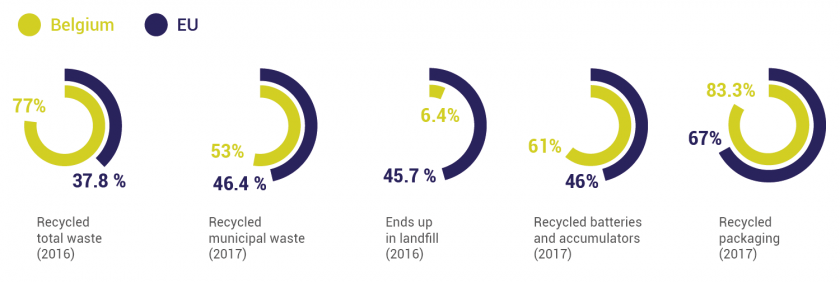
Nevertheless, Belgium has set itself higher targets. By 2050, the Flanders region wants to have a circular economy where nothing is wasted. In Wallonia, the organic waste will be separated from raw household waste throughout the region by the end of 2025. Other measures include the strengthening of the network of repair cafés and encouraging leasing of material goods rather than buying them.
Several “green deals”—voluntary agreements between private, public and government partners—have also been launched in Belgium to support sustainable development projects.
Circular construction
The building and construction sector provides good examples on how the green deals can promote sustainable development. Currently, the sector globally accounts for 36 per cent of primary energy use and 39 per cent of energy-related greenhouse gas emissions. It also uses large amounts of natural resources—and generates waste. The move from waste management to raw material management in the sector is an opportunity to turn environmental objectives into economic opportunities that will optimize the use of resources, create new jobs and add value for the inhabitants.
In Flanders, around 30 to 40 per cent of waste comes from construction. In 2019, Flanders launched the Green Deal on Buildings and Construction, through which construction companies, building material producers, local and regional authorities, private builders, researchers and other organizations work together to make circular construction a daily reality. More than 300 organizations have already registered.
In the Brussels-Capital Region, waste produced by the construction sector amounts to 628,000 tonnes out of 1,325,000 tonnes waste collected annually. The majority (91 per cent) of this waste is downcycled, meaning recycled into materials of lower quality and functionality. The online Brussels’ Sustainable Building Guide provides tips for dismantling, reusing and recycling/upcycling construction materials.
Local companies are also invited to submit circular projects under the “Be Circular, Be Brussels” initiative, setting out a strategy to transition from a linear to a circular economy by 2025. The initiative won the regional innovation award (2016) organized by the Assembly of European Regions, and the Eurocities 2017 Award in the category “innovation”.
As an example of actions taken in Wallonia, concrete and bricks from demolished buildings are being turned into eco-friendly road surfaces in the province of Namur.
Sustainable eating
What and how we eat is just as important to planetary health as to our own health. Cities have become increasingly important in reducing the emissions associated with food production and food waste, while making sure their population has secure access to sustainable, healthy and affordable food.
The Belgian city of Ghent in Flanders was one of the first European cities to launch its own urban food policy in 2013, called Ghent en Garde. Thanks to suburban farmers’ markets and a new logistics platform for professional buyers, local food is now booming. Surplus food has been distributed to people in need, which simultaneously alleviates poverty and reduces CO2 emissions. In 2019, the initiative was one of the winners of the United Nations Global Climate Action Award.
Flanders has also tracked its food waste since 2015, and initiated a Food Supply Chain Roadmap on Food Loss—a public-private partnership to reduce food losses by 15 per cent by 2020 relative to the baseline—while in Wallonia, an action plan focused on tackling food waste aims at reducing losses and waste at all levels of the food chain by 30 per cent between 2015 and 2025.
A revised food triangle now exists in Flanders, with dietary guidelines for a healthy and sustainable lifestyle. It takes both your health and the health of the planet into account, as it encourages people to eat more plant-based foods, and to not waste food.
Initiatives such as these ones are important, as globally, a study from the Food and Agriculture Organization of the United Nations revealed that about one third of the food produced for humans is wasted every year.
To find out more about food waste and sustainable diets, visit Think Eat Save, a partnership of the Food and Agriculture Organization and UNEP.











.png)