







Bitcoin’s (BTC) recent price drop has caught many investors off guard. However, a key metric showing worry among the network’s miners gave a warning several weeks ago.
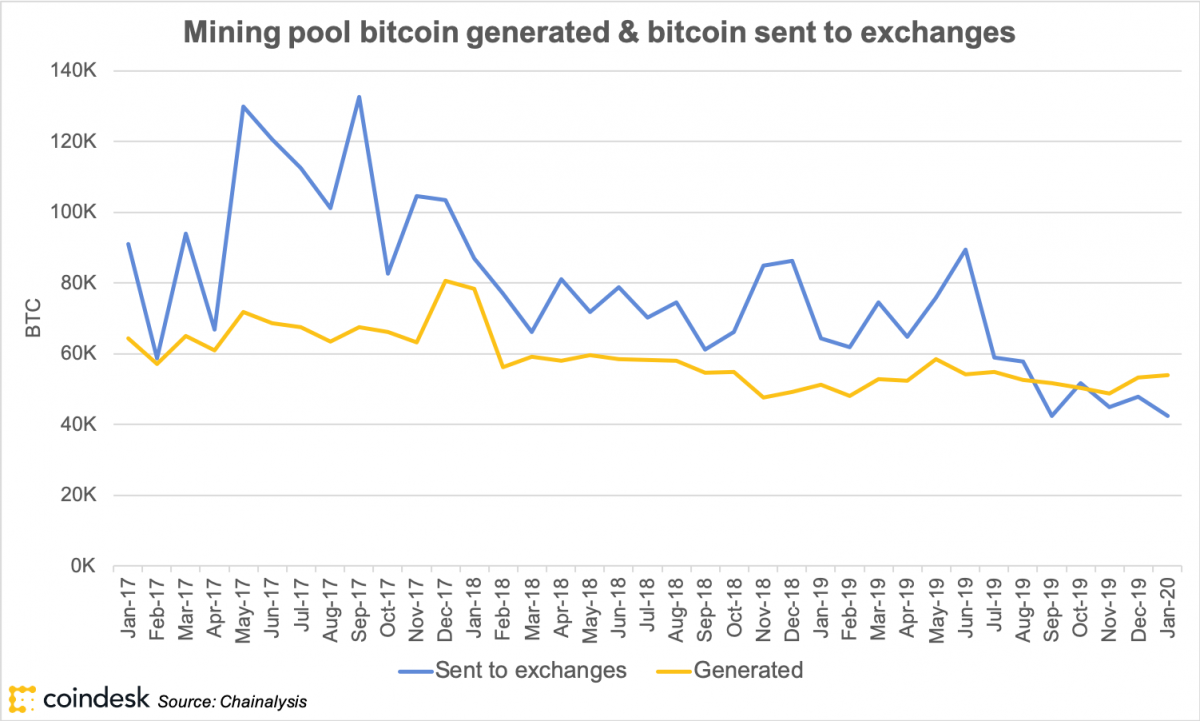
The miner’s rolling inventory (MRI) figure, created by crypto markets data company ByteTree to measure the changes in inventory levels held by these key market participants, remained below 100 percent in January, suggesting a lack of confidence in the 30 percent price rally that month.
An MRI above 100 means miners are selling more than they mine and running down inventory, while a below-100 MRI indicates hoarding – miners selling less than they mine and amassing inventory.
Conventional wisdom says that a seller always sells high. Thus, some investors may take a sub-100 MRI reading as a sign miners are anticipating a price rally and are therefore hoarding with an aim to liquidate at a high price at a later time.
Miners, however, operate on cash, notes Atlantic House fund manager and ByteTree founder Charlie Morris, and are always sellers in the market liquidating rewards (bitcoins) received for mining blocks to cover their operational costs.
A below-100 MRI level is not necessarily a price-bullish indicator, but represents fear among miners the market is too soft to sell into. On the other hand, an MRI above 100 reflects a strong market able to absorb miners’ selling pressure.
January’s MRI of 79 percent, the weakest in over two years, was essentially a warning sign that a bull trap was in the works. Bitcoin topped out near $10,500 in mid-February and has been falling ever since.
At press time, the largest cryptocurrency by market capitalization is trading at two-month lows under $7,800 and is just $640 away from turning negative on a year-to-date basis.
Miners generated 53,955 bitcoins and sent 42,451 bitcoins to exchanges in January, yielding an MRI of 79 percent, according to data from blockchain surveillance firm Chainalysis.
Historically, returns are poor when miners sell less than they mine, while returns have been strong when miners have sold more than they mined, according to Morris.
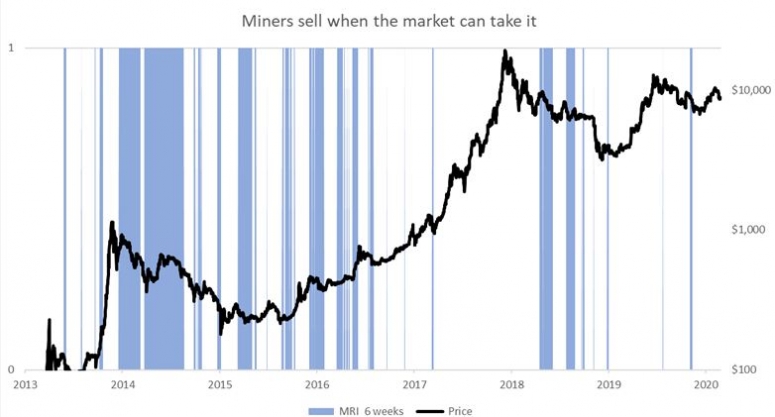
To put it another way, miners tend to build inventory during bear markets and run down inventory during bull markets.
Drawing parallels with central banks
While it may seem counterintuitive to read hoarding as a bearish signal, an analogy from the traditional financial system is instructive.
Central banks in countries running account deficits depend on hot money inflows to build foreign exchange (usually, U.S. dollar) reserves. For example, the Reserve Bank of India will buy dollars in the spot market when the Indian rupee is trending higher and is able to absorb the RBI’s bid for U.S. dollars.
Buying dollars during a downtrend in the rupee would be risky since that would only add to bearish pressures around the local currency.
Similarly, miners hoard or avoid selling when they feel the market lacks strength to absorb their offers. Selling into a weak market would lead to deeper price drop and, in turn, hurt profitability.
Miners influence the market
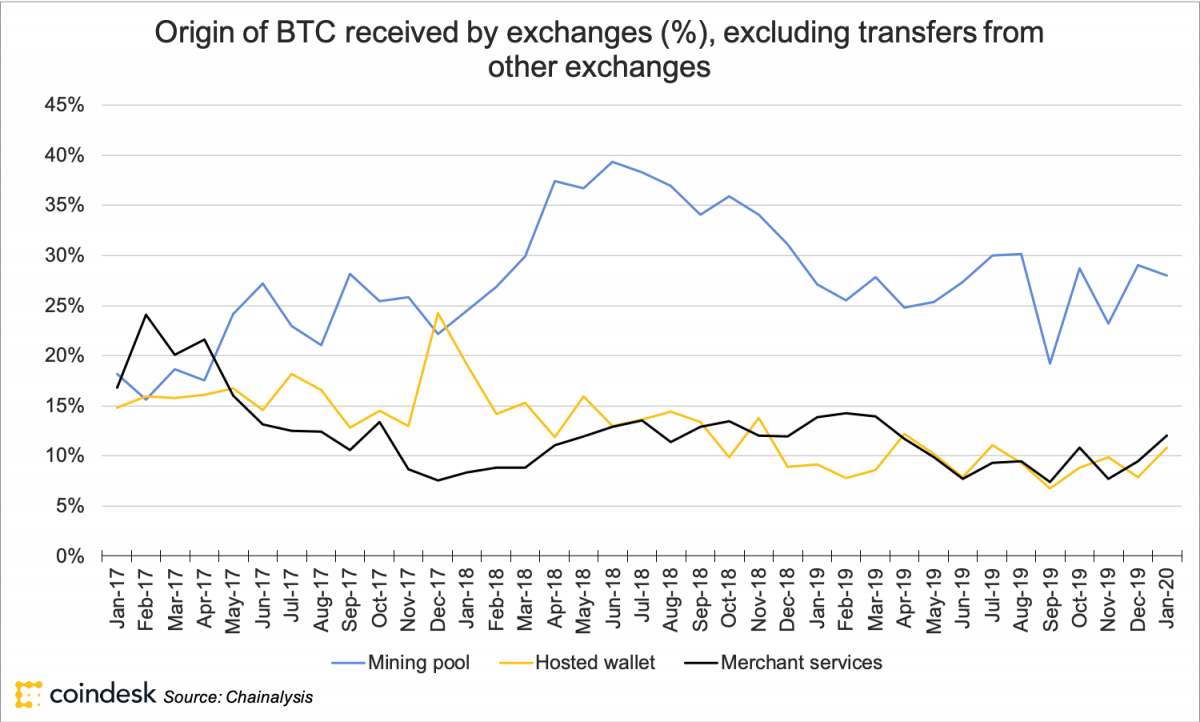
More than any other constituency in the market, miners have the biggest influence on price. Mining pools account for the highest percentage of total bitcoin flowing into exchanges, for example.
As of January, over a quarter of all BTC received by exchanges came from mining pools. Meanwhile, hosted wallets and merchant services – payment gateways or processors – accounted for just over 10 percent of the total BTC supply to exchanges.
Miners therefore have to be extra careful while offloading their holdings as their actions can translate into a big sell-offs.
Such was the case when weak miners, facing losses courtesy of bitcoin’s slide from $14,000 to $8,000 in the third quarter of 2019, began dumping their holdings in the fourth quarter, as noted by Adaptive Capital analyst Willy Woo. That precipitated a bigger drop to $6,500 by mid-December.
As it stands, widely used mining computers such as the AntMiner S9 and Avalon 851 are already struggling to generate daily profits, according to data from the mining pool Poolin. If the price slide continues, the small and inefficient miners may shut down operations and sell their holdings to mitigate losses.
A view from the trenches
However, some miners are still optimistic about future bitcoin prices and remain unfazed as they look to the anticipated halving event in May.
“In the medium and long term, we have a very positive view on the price,” Xiao Yang, chief executive at Chinese crypto mining and miner firm PandaMiner said in an interview. “Despite short-term volatility, we expect to see market demand at a relatively high level while it is getting harder to mine bitcoins from the supply side.”
As bitcoin prices see a sharp drop, some miners would consider turning to lending platforms to collateralize their bitcoins in exchange for cash. That would help to sustain their cash flow, which has been strained by recent low market price, according to Yang. This move is meant to help miners not be forced to sell their bitcoins at a low price when running out of cash.
Besides lower prices, the fast-growing hash rate has made it even harder for miners to hold their bitcoins; they need to borrow more from lending agencies, Yang added.
According to btc.com, the bitcoin mining difficulty growth rate is now at 6.88 percent, up from negative 0.38 percent on February 25.
Yang said another phenomena showing the mining industry is generally confident about future bitcoin prices are the new mining computers marketed by the likes of Bitmain and Canaan Creative. Bitmain has unveiled its latest product, the S19, on March 10, while Whatsminer will launch its new product in April.
Miners consider the drop in bitcoin prices, correlated to the U.S. stock market sell-off, as a temporary change in the market, according to Yang.
“We are still focused on long-term price increase and not too concerned about short-term market moves,” Yang said.
Disclosure Read More
The leader in blockchain news, CoinDesk is a media outlet that strives for the highest journalistic standards and abides by a strict set of editorial policies. CoinDesk is an independent operating subsidiary of Digital Currency Group, which invests in cryptocurrencies and blockchain startups.










