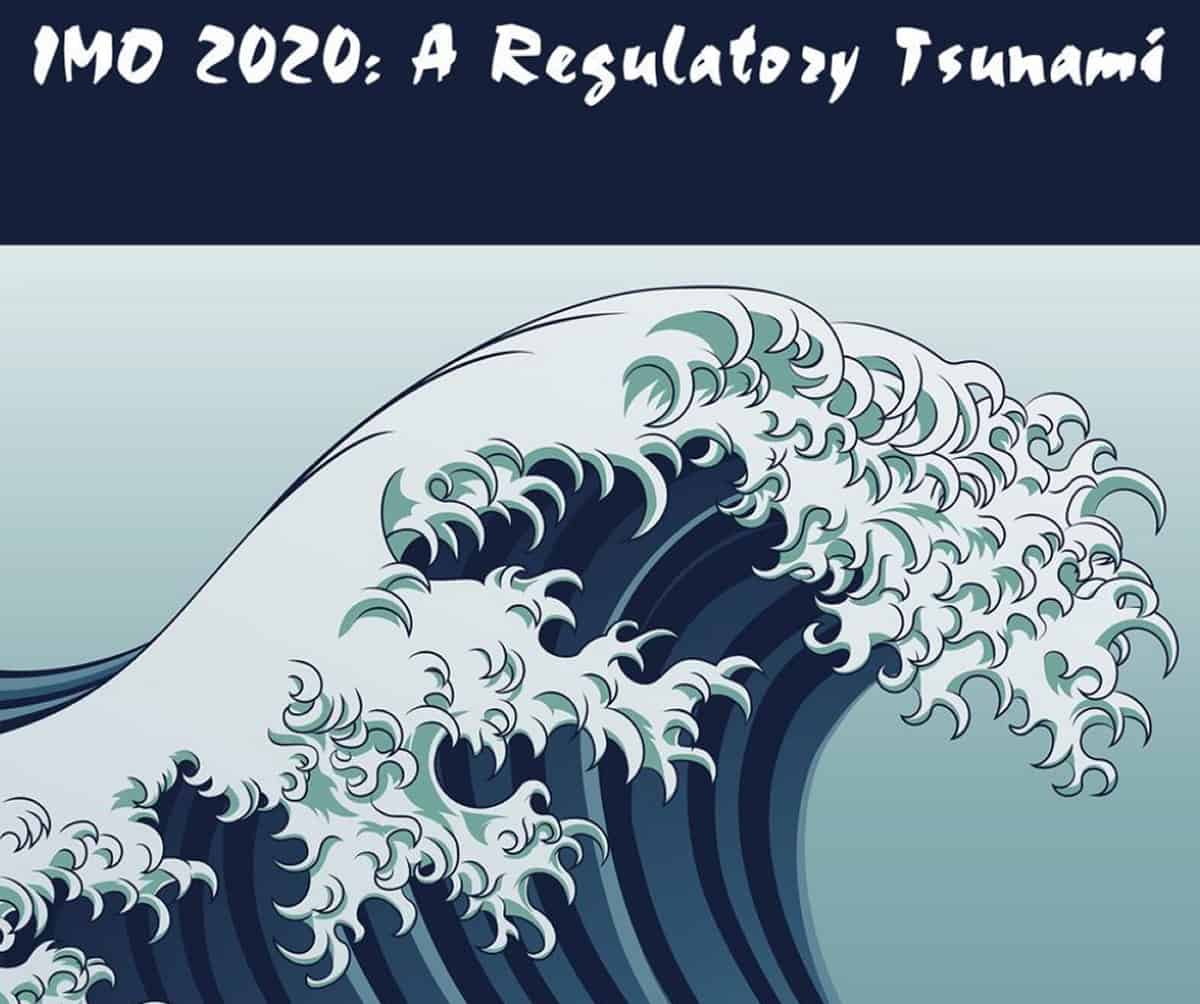







Judging a book by its cover, Pablo Rodas-Martini’s “IMO 2020: A Regulatory Tsunami” appears to be about the Jan. 1 rule mandating the game-changing global switch to low-sulfur marine fuel. It’s actually about something more interesting: the likelihood of a much broader, decades-long, environmentally driven revolution in marine fuel and propulsion that merely kicks off with IMO 2020.
The story opens with a fascinating bit of shipping trivia, a circa-1919 document presented to the U.S. Federal Trade Commission (FTC) that details the benefits of replacing coal with oil for vessel propulsion, and steam power with diesel engines. The rationale back then was almost entirely economic — lower operating costs, faster speed. Yet ironically, there was an environmental angle even a century ago, as burning heavy fuel oil was “clean” compared to burning soot-spewing coal.
There have been two major revolutions in ocean-shipping propulsion so far: first, the switch from wind to coal-powered steam engines; second, to oil-powered combustion engines. According to Rodas-Martini, “If we were to add the decarbonization of the shipping industry [on top of IMO 2020], which will take several decades, result in carbon-neutral fuels, and provoke the building of ships with potentially radical designs, we could certainly talk about a third revolution.”
IMO 2020 is “a secondary battle” in this third revolution, whereas the decarbonization of the shipping industry is “the entire war.”
And while shipping’s proposed switch to carbon neutrality remains hypothetical, it’s already having real impacts on industry fundamentals.
If you’re a shipping investor, it doesn’t matter whether you believe in human-induced climate change or not. Decarbonization is already dissuading equity and debt investors from giving their money to the industry, reducing growth capital. Simultaneously, it’s sowing confusion about which newbuilding designs will pass the future regulatory test — further curbing capacity growth.
IMO 2020
While shipping’s circa–2050 carbon-reduction strategy remains unwritten, IMO 2020 is already in full swing.
IMO 2020 market consequences are now rapidly unfolding, with the spread between 3.5% sulfur heavy fuel oil (HFO) and IMO 2020-compliant 0.5% sulfur fuel known as very low sulfur fuel oil (VLSFO) at around $270 per ton on a global basis as of Jan. 16, according to Ship & Bunker. Large tankers with scrubbers burning HFO are effectively earning over $21,000 more per day than those without scrubbers.
Author Rodas-Martini, a senior associate of SQ Consult, a Dutch company specializing in climate change and carbon markets, goes into great detail on the past and present of IMO 2020.
He recounts the legislative history of the regulation, which began with an International Maritime Organization (IMO) resolution back in 2008. People tend to forget how long this process has been gestating.
What people also forget is that IMO 2020 only applies to countries that have ratified the IMO’s MARPOL Annex VI Convention. Non-ratifiers include Greenland, Mexico, Argentina, Thailand, Colombia, Egypt, Ecuador, Oman and Yemen, among numerous others.
Nevertheless, the author believes “IMO 2020 will be enforced on the main shipping routes” and this process “will prove that regulation can work, even at the international level,” which has important implications for the third-revolution changes that could follow. “The message is clear: If IMO 2020 is possible, then other regulations are also feasible.”
Meanwhile, Rodas-Martini predicts trouble ahead for open-loop scrubbers (which discharge washwater into the ocean). “I foresee that the IMO will be forced to ban open- and hybrid-loop scrubbers in a few years due to environmental concerns,” he writes. “I can already see Greta Thunberg …. arguing that scrubbers are to the sea what fracking is to the land.”
Decarbonization and LNG
“IMO 2020 has put the issues on the table, has set the pace, a pace that will not stop from now on,” argues Rodas-Martini. “It has called attention to the role that shipping plays in world emissions. After IMO 2020, the shipping industry is no longer a sector hidden from the headlines. Shipping is not yet at the same level of awareness as trucks or cars, but it is coming much closer.”
Perhaps the most important takeaway of his book relates to how shipping could seek to manage this transition to carbon neutrality — and an ensuing paradox that has, to date, received little attention.
It’s widely believed in shipping circles that no matter the ultimate decarbonization solution — whether it is hydrogen, ammonia or something else — the IMO will accept the use of liquefied natural gas (LNG) as a transitional fuel.
LNG-capable newbuildings are already being ordered and there are expectations of a potential flood of such contracts in the coming years. LNG not only provides owners with a hedge against decarbonization regulation risks, it also helps them address IMO 2020 costs.
As Christos Begleris, co-CFO of Star Bulk (NASDAQ: SBLK), said during the Marine Money forum in New York in November 2019, “If you look at the Chinese yards, all of them are now developing new designs for LNG-propelled vessels.” Rodas-Martini notes that the Korea Development Bank and Korea Trade-Investment Agency have forecast that 60% of the world’s orders will be for LNG-powered ships by 2025.
Therein lies the paradox. “Since IMO 2020 is stimulating the retrofitting and mainly the construction of LNG-powered newbuilds, the regulation is helping a fossil fuel to strengthen its market position, and the larger the future fleet of LNG-powered vessels, the more difficult it will be to reach the full decarbonization of the shipping industry. … LNG [is] trying to pretend to be a clean fuel when, in the end, it will only undermine the growth of the real clean fuels.
“IMO 2020 will start with only fossil fuels as real alternatives, which means that LNG will grow at the expense of oil-derived fuels and, in principle, can gain market share every year from 2020 up to 2050 [and] become even before 2040 the top marine fuel in the world. … LNG is gaining momentum and IMO 2020 is helping much with that momentum.”
While insisting that he “welcomes the arrival of LNG to the shipping industry,” he balks at its “transitional” status. He foresees an “enormous risk that LNG, a fossil fuel cleaner than oil but in the end, still a dirty fossil fuel, may grow too much in a way that can hamper the development of the new carbon-neutral fuels,” with IMO 2020 helping LNG along its path, supporting “the pernicious strengthening of LNG … the hidden ‘villain’” of the story.
“An enduring legacy of IMO 2020 [is that it] could become an obstacle to decarbonizing the shipping industry,” he writes, although conversely, he maintains that IMO 2020 could also help the third revolution by confirming that the IMO is an effective vehicle for change.
For ship owners and shipping investors, all of this raises huge questions. What if the IMO actually decides in the next few years that accepting LNG as a transitional fuel will prevent the industry from meeting its 2050 decarbonization target? Does the threat of that decision enter the minds of owners, equity investors and debt providers, and put a crimp on LNG-capable newbuildings and further constrain future vessel capacity?
Another huge uncertainty involves whether the global decarbonization of shipping will actually happen. Rodas-Martini doesn’t think it will occur by 2050. He thinks 2060-65 is more realistic. But his book is infused with the belief, at least between the lines, that it will happen.
That sentiment is far from unanimous. If the IMO is too aggressive and the price tag of decarbonization is too severe, governments and powerful cargo shippers could protect their own interests. Shipping’s first revolution (sail to coal and steam) and its second (to oil and combustion engines) were “pulled” by economics. The third must inherently be “pushed” by environmental concerns and regulation via the IMO, a body that wields questionable global might.
The author concludes that “a portentous battle will take place” to decide the matter. It’s a fight that will almost certainly play a major role in shipping markets for decades to come. More FreightWaves/American Shipper articles by Greg Miller
“IMO 2020: A Regulatory Tsunami,” by Pablo Rodas-Martini (75 pages), Kindle edition is available here for $9.99.