







By Carolina Gonzalez and Jake Holland
Medill Reports
Well before the word “Brexit” went from idea to reality, some of the world’s biggest banks began to loosen their ties with London, once one of the unquestioned leaders in finance. But now that Brexit is a reality, will the city of Shakespeare, Big Ben and, yes, global finance, also lose its coveted status in Europe?
Brexit, the messy divorce between the United Kingdom and the European Union, has cast a shadow of uncertainty on pretty much every industry since the 2016 referendum. Financial services is no exception, and many banks operating in London moved sections of their business elsewhere to mitigate risk — even before the UK formally began its uncoupling from the EU in January 2020.
As of January 2019, these shifts accounted for at least 800 million pounds in assets, or about 10% of the United Kingdom’s total banking sector assets, according to a report by Ernst & Young. The firm said this was a “conservative estimate” based on already announced plans; some banks have not yet revealed what they are going to do.
The Global Financial Centres Index, a semi-annual report compiled by think tanks in China and the United Kingdom, lists New York as the most competitive global financial center. London came in second, with Zurich, Frankfurt, Paris and Dublin each rising in the rankings because of Brexit, according to the September 2019 report.
New York extended its lead over London from the previous rankings cycle some six months earlier, and other European cities like Paris and Luxembourg made large gains. Analysts from the study warn that if Paris were to make similar gains and London were to make similar declines, the City of Light could eventually overtake the British capital.
For many years leading up to Brexit, large banks like Credit Suisse and JPMorgan Chase had set up offices in London to be able to conduct business in other EU countries relatively easily.
That’s because of something called passporting, which allows firms authorized in one EU country to operate freely in another EU country. Until Brexit, a bank with a passporting stamp in London was able to conduct business in, say, Athens or Lisbon without much additional work, said Phil Levy, chief economist for freight forwarder company Flexport.
“Financial services are huge for the UK, and the City of London, it’s what they do” Levy said. “This financial passporting idea meant [banks] could go set up offices in the City of London and serve all of the European Union very easily. You didn’t need to have headquarters also in Frankfurt, or in Paris, or in Dublin.”
Passporting allowed companies to cut through red tape and reduce the hefty costs of financial transactions before universal regulation. But now that the UK has officially left, the legality of passporting rights in London are up in the air.
For the time being, passporting rights remain in effect as the UK and EU negotiate the terms of separation, which are set to conclude by December 2020.
Amid the uncertainty, banks didn’t want to risk keeping their EU headquarters in London. Morgan Stanley, for example, chose Frankfurt as its new EU base, and Credit Suisse made Madrid its main post-Brexit hub.
By relocating to countries whose passporting rights remain secure, the banks could continue to operate as usual within the European Union.
“When you get this globalization of banking activity … you have to figure out who’s going to regulate them,” said Stephen Nelson, a political science professor at Northwestern University. “The idea of passporting that evolved within the European Union context was to establish a baseline rule, so that you didn’t have a patchwork of different arrangements.”
Making London the finance capital of the world
London emerged as the dominant global financial center, despite being isolated geographically from the rest of Europe, in part because of aggressive deregulation of the industry in the 1980s. At the same time, globalization meant that more companies were looking for a foothold in Europe, and London’s easier policies gave them an incentive to settle there.
Nelson said London’s looser regulations remain attractive to foreign financial services companies, something that Londoners hope will still be the case even if the sector ends up losing its passporting rights.
“That’s a real incentive for [financial services firms] to establish a presence [in London], to get the passport stamp from a very lax regulator, and then go do stuff that they wouldn’t maybe be able to do if it were the Belgian regulators or the Swedish regulators or the German regulators,” Nelson said. “Firms like to avoid that, so they went to London.”
London’s emergence as an economic powerhouse has profound implications for the country’s economy post-Brexit. Financial services accounted for 15% of London’s economic output in 2017 and 6.9% of the United Kingdom’s economic output in 2018, according to a 2019 report by the House of Commons Library.
Even though negotiations are set to conclude by December, the COVID-19 epidemic has already pushed both parties to explore alternative routes like teleconferencing, according to a March 12 article from The Guardian.
If the two sides do not reach an agreement, trade law will likely revert to rules set forth by the World Trade Organization.
“They revert to ‘most favored nation’ tariff/fine limits that were negotiated around 2003,” Nelson said. “You lose the intra-EU agreements, and you lose passporting rights because there’s no international agreement for that. So, that’s the big cost, the loss of passporting rights.”
Nelson said some countries on the continent view Britain’s messy exit as an opportunity to better establish their banking centers and grab some of the financial services fees that London previously accrued.
The grass is greener on the other side
Each bank that chooses to move part of its operations elsewhere does so based on a variety of factors — like where the parent bank is based, what language its workers or clients speak and what the political situation of a chosen location looks like.
Some banks may relocate to Madrid because their business activities are more concentrated in Latin America, whereas others may go to Amsterdam because of its strong history with consulting, said Andreas Staab. Staab is the founder and managing director of the European Policy Information Centre, a consultancy agency.
Citi, for example, opened a new investment firm in Frankfurt and will also make its products and services available through its Ireland-based bank.
The New-York-based investment bank announced in March 2019 it would open a new investment firm in Frankfurt called Citigroup Global Markets Europe AG. In 2016, it consolidated bank branches in 22 European Economic Area countries to form an Ireland-based bank, Citibank Europe PLC. Both of these entities will be used to conduct business that the company may be unable to carry through its UK entities after Brexit is finalized.
Swiss investment bank UBS, on the other hand, has decided to move business to the German-incorporated subsidiary UBS Europe SE. At the same time, Deutsche Bank will move UK operations to Frankfurt, the site of its headquarters.
Barclays, a British multinational investment bank, expanded its existing subsidiary in Ireland. This subsidiary, Barclays Bank Ireland, will become the legal entity serving clients in the European Economic Area.
Despite moves by some financial services firms, Staab noted that some countries in Europe still rely almost entirely on British banks to access the EU market.
“London is the banker of Europe. You go to a small corner shop somewhere in Poland, and that little family receives financing from the Polish bank that is owned by a British bank,” Staab said. “London will lose some but probably not as much as a lot of people think.”
Looking ahead
During the negotiation period, the UK will fight to retain the perks that came with being a part of the EU, including financial passporting rights. Though the banks’ retreat from the UK and the continuing uncertainty around the legal rules post-Brexit spell trouble for the city, Staab doesn’t think London’s status as a global financial hub will fully go away.
“The vast majority, 90% of financing in Europe, goes through British banks,” Staab said. “It’s the biggest financial center in the world, and you can’t just completely get rid of it.”
Others point to the already-completed moves of dozens of banks as a harbinger for the weakening financial status of London. Nelson, the Northwestern professor, remains uncertain of what’s to come for the city and the country at large.
“The cost of what this is going to be, to me it’s unquantifiable,” he said. “I think banks don’t know. I think nobody knows.”
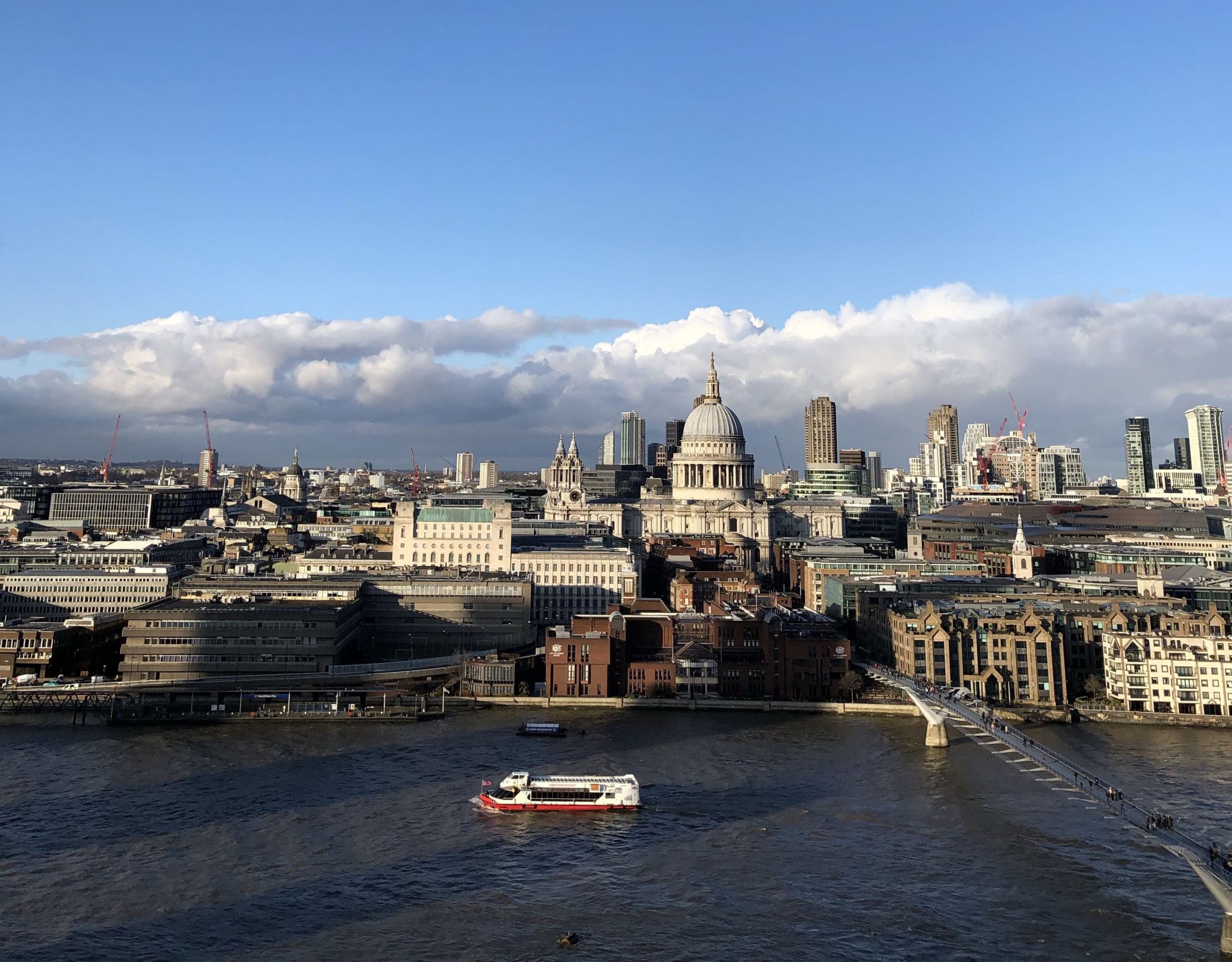
Photo at top: The London skyline. The future of the city as one of the financial capitals of the world has come into question because of legal questions posed by Brexit. (Jake Holland/MEDILL)










