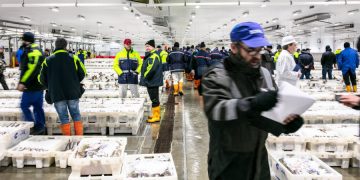







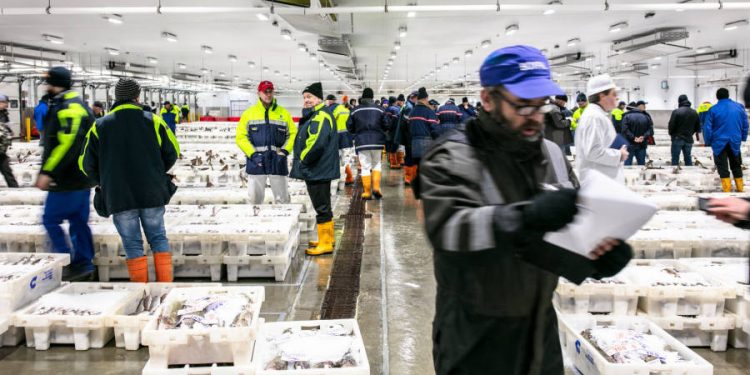
Bruno Margollé and his ancestors have fished for sole and cod in the English Channel since the 18th century, and like other EU fishermen who work in Britain’s waters today, he regards Brexit with trepidation.
Based in Boulogne-sur-Mer near the narrowest point of the Channel with his 24m fishing boat, Mr Margollé says any reduction in access beyond the median line separating the two countries’ territorial waters — a genuine risk if Britain and the EU cannot rapidly come to an agreement — would be a disaster for him and his three sons who share the business.
“It’s death,” he says. “I have no Plan B. I have €1m of debt. What am I supposed to do? Put a bullet in my head?”
If Brexit Britain were to close its own waters to foreign vessels, the impact would be immediate and severe on fishing communities such as those in Boulogne, adding to the pressures from climate change and warmer seas that fishermen say have driven away the cod and brought in more squid and spider crabs.


No one disputes that the fishing grounds are richer on the British side. French, Belgian and Dutch trawlers are usually out in force right up to the line six nautical miles from the English coast that is already reserved for British-flagged vessels. The majority of the EU catch is made in the North East Atlantic, and British waters are a crucial part.
Boris Johnson, the UK prime minister, fanned the flames last week by insisting that the UK will “take back control” and have full jurisdiction over the UK’s “spectacular maritime wealth”.
For EU fishermen, this is the stuff of nightmares. Ensuring that fishing rights do not die with Brexit is a priority for the bloc’s coastal states, not least France, in future relationship negotiations with Britain that will begin in the weeks after the UK leaves the EU on Friday.
EU diplomats fear that a post-Brexit negotiation covering everything from trade in goods to financial services — which accounted for 6.9 per cent of UK gross domestic product in 2018 — could become snarled up on fish. It is a sector that employs fewer than 180,000 people throughout the bloc but is the economic lifeblood of coastal communities, giving the industry added political leverage.
The price of fish and finance

0.04%
Fishing and aquaculture’s gross value added contribution to UK economic output (2018, provisional figure)
7.1%
Financial services and insurance’s gross value added contribution to UK economic output (2018, provisional figure)
The EU has explicitly linked the City of London’s future market access to Britain giving ground on fish. Ireland’s prime minister Leo Varadkar told the BBC on Monday that “you may have to make concessions in areas like fishing in order to get concessions from us in areas like financial services. That’s why things tend to be all in the one package”.
A dragged out fight over fish would ultimately be in neither side’s interests. But it may be extremely difficult to avoid: the UK and the EU have opposing positions, little room for manoeuvre and even less time.
Britain and Brussels will have only 11 months after Brexit day to negotiate a new relationship and avoid a hard exit when the country’s transition arrangements expire at the end of 2020.
Emmanuel Macron, the French president, has vowed that fishing will be treated “as an essential economic interest for our country that must be defended” in the talks. It is a position that has been adopted by the entire EU, which insists that “existing reciprocal access to fishing waters and resources” should be maintained.

Brussels insists that any move by Britain to reduce access to its fishing waters will be met with an overwhelming response: the loss of much needed market access rights for UK fishermen, and potentially even the breakdown of trade negotiations, creating the risk of a no-deal Brexit at the end of 2020.
For the EU, “everything in the future relationship negotiations is linked”, says one senior European diplomat. “It’s not just the French, there are seven or eight member states highly interested in this. The UK is going to have to compromise [on access for EU fishing fleets].”
For Britain, Brexit means escaping from the Common Fisheries Policy, a system that UK fishermen argue has cost jobs and livelihoods. Many in the industry argue that their sector was sacrificed to secure Britain’s place in the European Economic Community in 1973.
“We will make sure we don’t trade away Britain’s fishing rights as they were traded away . . . in the early 1970s,” Mr Johnson said on January 22.


Britain’s fishing fleet consists of 6,000 vessels and close to 12,000 fishermen. It caught almost £1bn worth of fish in 2018 but makes a negligible contribution to the UK economy. It is, however, of vital importance to some coastal communities, notably in Scotland.
Under the CFP, EU countries’ fishing fleets have full access to each others’ waters, with the exception of the first 12 nautical miles out from the coast. Some special access arrangements exist for the six-12 mile band.
The EU agrees annual limits, known as the total allowable catch, for the volume of fish that can be caught from each stock. National quotas for these are then divided up using a template based on historical fishing patterns.
But after Britain leaves it will become an independent coastal state, with an “exclusive economic zone” or EEZ, stretching out as far as 200 nautical miles. Where the EEZ bumps up against EU waters, a new median line could be drawn between the UK and EU. Some of the world’s most coveted fishing waters lie within that 200-mile British zone.

British waters are rich in staples of the European diet: herring, mackerel and sole as well as shellfish such as langoustine. EU boats annually land more than 700,000 tonnes of fish caught in UK waters, according to Britain’s Marine Management Organisation.
A political declaration on future relations, agreed by Mr Johnson and EU leaders last year, set a July deadline to negotiate and ratify an agreement on future fishing rights. Without a deal, EU boats will lose access to UK waters at the end of this year.
But the British government is in the grip of competing pressures from its own fishing sector, parts of which depend on the tariff-free access to the EU market that Brussels is threatening to revoke if a deal is not reached. Brussels insists the two issues are linked.


In Scotland, which accounts for 64 per cent of UK fish landings, hopes of a post-Brexit boost and an end to participation in the CFP are mixed with deep concerns about the potential loss of vital access to EU markets for some of the country’s highest-value catches.
Elspeth Macdonald, chief executive of the Scottish Fishermen’s Federation, the main industry body, says market access must not be tied to the negotiations over fishing rights — a link the EU is determined to maintain to pressurise Britain into doing a deal.
“By the end of this year, we should be going into . . . negotiations as an independent coastal state, negotiating access and fishing opportunities on an annual basis,” says Ms Macdonald, who says that any permanent concessions to the EU would be a “betrayal of the industry”.
The SFF is not demanding huge change overnight, but says there must be an immediate cut in the proportion of the UK quota taken by EU vessels and “year-on-year gains” for Scottish fishermen. And while access to EU markets is important, Ms Macdonald says, “the ability to determine access to our waters is the key goal for us”.
That stance is bad news for fish exporters like Andrew Charles, who runs the processing business his grandfather established from modest premises near Aberdeen harbour.


Mr Charles is sceptical that fishermen in France or Spain would tolerate continued British imports if they lost access to UK waters. And even if there are no blockades or protests, he says, the expected post-Brexit burden of export and import documents, environmental health certificates and inspections could make it no longer viable to sell high quality monkfish to the continent, a niche business that accounts for a fifth of company sales.
“I would have to close the export business unless I pay 25 per cent less for my raw material,” Mr Charles adds.
Many other exporters share similar fears. The UK runs a trade surplus with the EU27 on fish and some of Britain’s most lucrative species, such as scallops and Norway lobster, are caught almost exclusively for the EU market. About half of all UK fish production — combining what is caught and farmed — is exported to the rest of the EU.
Any retreat from his Brexit promises could be disastrous for Mr Johnson’s Conservative party, not least in Scotland. At the daily auction in Peterhead, the UK’s largest port for white and pelagic fish, Gary Mitchell, a wholesale merchant who makes most of his sales on the continent, says he “absolutely” trusts the prime minister to keep his word to liberate the sector from EU quotas and controls, and believes any disruption will be shortlived.


“The French, the Spanish, the Italians, they all want our fish, they need our fish,” Mr Mitchell says. “In any change in any industry you always get teething problems, but after a while I’m sure it will settle down . . . I’m trying to be as optimistic as I can.”
Expectations of a boon from Brexit are also high in the medieval English town of Rye, just across the Channel from Boulogne-sur-Mer. “On Monday mornings, boats turn up from Belgium and they will be here on the six-mile limit for days,” says Mick Caister, who owns the last wooden trawler in Rye. “If they were pushed further out, it would make a difference to us.”
Britain sees Norway as a model. Oslo holds annual negotiations with the EU on access to waters, management of shared stocks and exchanges of quota rights. In theory, EU access to Norwegian waters would lapse if the annual talks collapsed.
But such an approach would spell endless uncertainty for the EU, and Brussels is determined to lock in rights upfront. A core part of the negotiations will be how to share out fishing rights for the more than 70 types of fish that straddle the UK EEZ and EU waters.
UK officials are adamant that Britain will seek a relatively larger quota compared with its allowance under the CFP. But one EU diplomat says Brussels must demand nothing less than the “material status quo.”
Gerard van Balsfoort, chairman of the European Fisheries Alliance, says the EU industry is seeking “guaranteed access”. And it does not want “annual negotiations with the UK on relative quota shares and reciprocal access for shared stocks,” he adds.
As a result the risks of internal division are extremely high for both sides. EU leaders have agreed to make the bloc’s future economic relationship with Britain dependent on solving an issue — fishing rights — that is only of real relevance to about eight coastal states. Diplomats quietly question how well EU unity will hold up under the strain.
Michel Barnier, the EU’s chief Brexit negotiator, insisted in January that Britain had more to lose than the EU27 from the collapse of talks about future relations, but one of the immediate consequences of a no-deal scenario would be a loss of EU fishing rights in UK waters.
Expectations will weigh on both sides’ negotiating teams as they fight to secure rights without creating a confrontation that would wreak havoc on a fragile, interconnected industry.
“The market is important for the British,” said Frédéric Cuvillier, mayor of Boulogne and a former fisheries minister, when Brexit fever was at its peak last year and a no-deal exit seemed likely. “It’s all a bit stupid.”
Icelandic, Scottish and English fish are often trucked to Boulogne’s busy fish plants — the industry employs more than 5,000 people — for processing and onward distribution.
The Dover Strait is the point where France and the UK are closest in almost every sense. The English coast can be seen from the beach at Wissant between Calais and Boulogne, and the locals have a saying about the weather which translates as: “If you can see the cliffs at Dover, it’s going to rain. If you can’t, it’s raining already”.
“We’ve had hundreds of years of sometimes tumultuous relations,” says Mr Cuvillier. “Geography brings us closer and Brexit pushes us apart.”









