






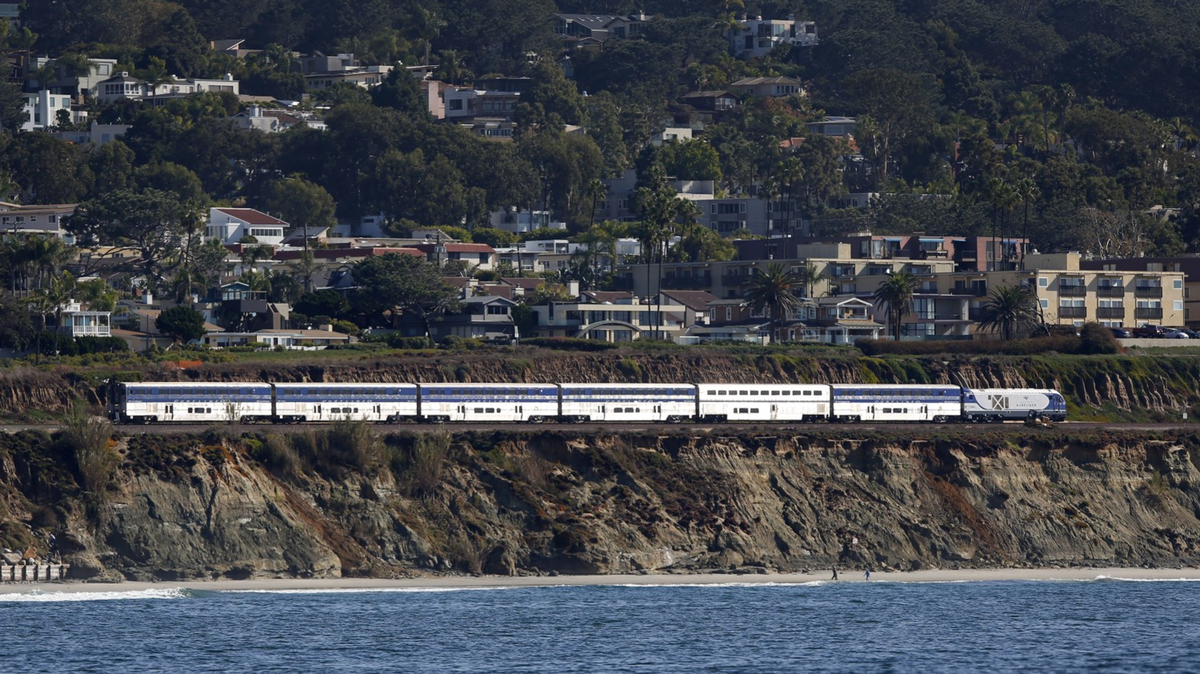
The Del Mar bluffs have been plagued by a series of collapses over the last 18 months that have left residents and officials increasingly concerned about the stability of the busy railroad perched atop the cliffs.
Top transportation officials are now gearing up for the largest bluff stabilization effort in nearly a decade. The San Diego Association of Governments and North County Transit District have already dedicated roughly $10 million to repair stormwater drainage structures, replace parts of sea walls and install additional steel and concrete support columns to hold back the earth.
In December, the two agencies penned a letter to the state saying they need another $100 million over the next four years to ensure the safety of bluffs.
Top state officials have recognized the need for stabilization projects and are now also calling to accelerate a long-envisioned plan to relocate the tracks inland — a project that could cost as much as $4 billion.
SANDAG Executive Director Hasan Ikhrata said that his agency could be ready to break ground on building an underground train tunnel through Del Mar in just three years.
“This is a high priority,” he said. “I’m shocked that we haven’t done it before. To keep spending money on temporary solutions isn’t a solution at all.”
Ikhrata added that, because of the massive price tag, such an aggressive timeline would only be possible with coordinated support from local, state and federal officials.
That might be more likely than it sounds.
State officials take notice
California State Transportation Agency Secretary David Kim traveled to San Diego last week to launch a new multi-agency collaboration, dubbed the LOSSAN San Diego Regional Rail Corridor Working Group.
The tracks in Del Mar are part of the 351-mile Los Angeles-San Diego-San Luis Obispo (LOSSAN) Rail Corridor — which carries about 8 million passengers and more than $1 billion worth of freight every year. The line is a key connection between factories in Mexico and markets in the United States.
“Erosion of the bluffs threatens the stability and viability of the route,” said Kim in an email. “I challenged the group to examine funding programs for the near-term stabilization of the Del Mar bluffs, as well as programs available for planning and constructing a long-term solution.”
Kim signed a letter supporting a SANDAG grant application to the Federal Railroad Administration seeking about $12 million for the bluffs, money he said the state would match.
“The state is committed to this project and this region, and we already have significant skin in the game,” he said.
The meeting brought together a broad array of elected officials and their representatives, as well as federal and state transportation officials, such as Christine Kehoe. The former member of the state Legislature who currently sits on the California Transportation Commission said she had long known about the instability of the Del Mar bluffs.
However, she said her sense of urgency increased dramatically after a failure in November that left a gaping hole just feet from the tracks. The event led to canceled routes and delays as officials scrambled to make emergency repairs.
“When I saw that photo in the paper after the Thanksgiving washout, then it was, like, this is serious,” Kehoe said. “I thought it’s an issue that needs to be addressed immediately if we’re going to maintain public confidence in our railroad.”
Also part of the working group is state Senate President Pro Tem Toni Atkins, D-San Diego, who secured last summer more than $6.1 million in funding to help stabilize the crumbling cliffs. She has pledged to keep such cash infusions coming for at least another four years.
“I am committed to working in partnership with all interested parties to find a feasible solution for the Del Mar Bluffs and the rail line,” she said in an email. “This will be a long-term undertaking, requiring a great deal of collaboration across our state and local transportation agencies.”
The new focus on Del Mar’s 1.7 miles of track along the LOSSAN corridor has come as something of a relief to local officials. Del Mar Mayor Ellie Haviland said she’s feeling “optimistic.”
“Getting all the right people around the table will ensure we keep moving forward on the difficult decision that we need to make to get this done,” she said.
“What I’m not excited about is seeing what’s going to have to take place on the bluff to stabilize it,” she added. “That’s not easy to watch, but we don’t have a choice. This is critical to our region.”
Construction on the bluffs
SANDAG has poured more than $15 million into stabilizing the Del Mar bluffs over the last two decades. The last major effort was in 2011 when the agency spent roughly $5 million largely to install solider piles.
There are now about 230 of the roughly 3-foot-wide columns inserted in the cliff side, some connected with steel cabling for added reinforcement.
To construct them, crews drill up to 60 feet into the bluffs, drop in a steel I-beam and then fill the hole with concrete. As erosion reveals the supports, wet concrete — known as shotcrete — is sprayed onto the cliff face to strengthen and mimic the look of the bluffs.
SANDAG plans to spend about $5.78 million starting in February to install new piles at 9th and 10th streets and near the south end of Stratford Court. The agency is also planning to reinforce sea walls at 13th, 12th and 7th streets.
At the same time, SANDAG and NCTD are also planning to spend roughly $4.5 million to upgrade many of the drainage structures.
Concrete collection basins and culverts along the bluffs capture rainwater and funnel it out to sea before it can eat away at the cliffs from the top. However, pipes can become clogged during rain storms, such as during the Thanksgiving collapse.
Transportation officials are now hoping to expand the capacity of those structures and in some places replace a number of them to allow stormwater to move more freely.
“We really need to go in and completely clean them out,” said John Haggerty, director of engineering and construction at SANDAG. “It’s anywhere from heavy maintenance to new construction on the top of the bluffs.”
The human factor
Urbanization appears to be greatly exacerbating the situation, from overwatering of lawns in the summer to rainwater in the winter rushing off roofs, streets and parking lots.
Officials estimate that more than 100 inches of water a year wash through the bluffs, compared to just 12 inches under natural conditions.
“Development to the east has created much more runoff than when the railroad was built in the early 1900s,” said Haggerty with SANDAG.
The results can be spectacular and often dangerous, such as when about a year ago a 55-foot-wide section of cliff came crashing onto the beach in Del Mar.
The situation is compounded when the network of culverts along the bluffs become blocked with debris and water floods over the face of the bluffs, such as over Thanksgiving when the city received nearly two months’ worth of precipitation in two days.
At the same time, ocean tides are eating away at the base of the cliffs, a situation expected to increase dramatically with sea-level rise from climate change.
“Wave erosion at the bottom of the cliff decreases overall cliff stability,” said Adam Young, a researcher at UC San Diego’s Scripps Institution of Oceanography studying cliff erosion in Del Mar and throughout California. “This instability allows elevated rainfall and groundwater conditions to trigger landslides in the upper cliff.”
The bluffs are currently eroding at an average rate of about a foot every two years, according to SANDAG officials. But cliff failures are more likely in some spots. While parts of the bluffs are made of robust mudstone, others are more prone to collapse, such as those filled with materials when the railroad was first constructed.
___
(c)2020 The San Diego Union-Tribune
Visit The San Diego Union-Tribune at www.sandiegouniontribune.com
Distributed by Tribune Content Agency, LLC.










