






Shortly after takeoff, Singapore Airlines flight attendants won’t be making the usual offering of Taittinger or Dom Perignon champagne. In India, crews from low-cost SpiceJet won’t hawk tandoori chicken or fish masala buy-on-board meals. Instead they will be mindful of the nearest fire extinguisher as they take to the aisles looking after a different kind of customer: cargo.
A shortage of air freight capacity is seeing airlines put cargo in empty passenger cabins, sometimes even removing seats to make way for more boxes. Oversight is evolving as aviation drops its arduous processes to have expediency that reflects the coronavirus crisis while acknowledging these new ways of carrying cargo need to mitigate risks like in-flight fires.
Passenger cabins do not have the fire suppression systems installed in cargo compartments, so some regulators are requiring cabin crew be onboard, transitioning their role from flight attendant to in-flight firefighter.
“The Civil Aviation Authority of Singapore has granted approval to Singapore Airlines and Scoot Tigerair to carry cargo in the passenger cabin of their aircraft when these aircraft are used for cargo flights,” says CAAS Director of Flight Standards Alan Foo.
Cabin cargo cannot include dangerous goods, which includes in-demand items like alcohol-based hand sanitizer and mercury thermometers. Nor can cargo block emergency exits. “Cabin crew are also required to be on board these flights to manage any in-flight emergencies,” Foo says.
Scoot started cargo-only 787 flights last month between Singapore and China’s Guangzhou and Nanjing. It used only the below-deck cargo compartments while waiting for CAAS approval for cabin cargo.

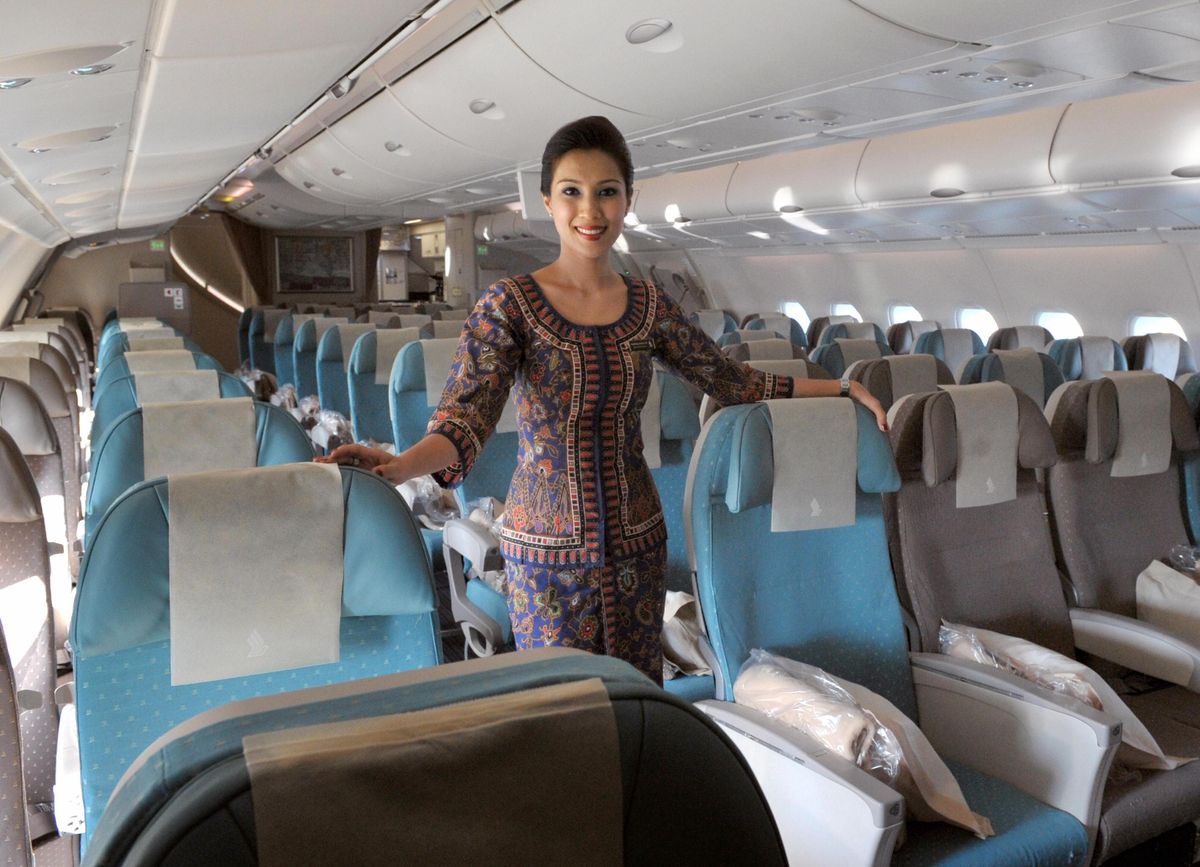
An air hostess poses in the economic class on June 2, 2009 in Roissy-en-France, northern suburb of … [+]
AFP via Getty Images
Airlines carrying cargo in the cabin should have an observer onboard, Boeing recommends. Airbus says this person should be supplementary to the flight crew, and IATA suggests flight attendants since they are already trained in emergency procedures, including in-flight fires. If airlines use other personnel, they should be briefed on all cabin aspects like cockpit communication.
India initially prohibited passenger aircraft from only carrying cargo, even if just in the belly and not in the passenger cabin. It quickly revised its stance and granted conditional approval to place cargo in the cabin.
“Operations without passengers and with cargo in the passenger compartment will require suitable number of crew member/personnel to survey and access all areas of the cabin during all phases of flight,” India’s Directorate General of Civil Aviation said in a memo. “Any fire that might occur must be discovered and extinguished immediately utilizing existing emergency equipment.”
SpiceJet carries cargo in passenger cabins, as well as using its dedicated freighter aircraft, which other Indian airlines do not have.
India allows cabin cargo only if seats and other interior elements remain installed. That provides a natural way to secure cargo as boxes can be placed in latched overhead bins, or put on seats with constraints. In-flight entertainment systems, in-seat power and galleys should be switched off so systems do not over-heat, IATA recommends.
Using long-standing approval to carry cargo in overhead bins and underneath seats creates upwards of four tons of capacity on an A320 and ten tons on an A330, according to Airbus.
But this COVID-19 crisis presents a new scenario of greater space availability and urgent need for it.
“There is no passenger onboard anymore, releasing a lot of space in the cabin, on the seats themselves. And one can even imagine removing the seats to free the floor area,” Airbus said in an April presentation.
Boeing’s guidelines cover cargo in overhead bins, closets and underneath seats. But they exclude the increasingly popular way to transport cargo: on seats.
“If airlines seek to carry cargo on passenger seats, Boeing recommends airlines coordinate with their regulatory agency,” Boeing said in a March memo to airlines. The Federal Aviation Administration has guidelines for cargo on seats, but it does not mention removing seats.
Non-hazardous cargo placed on seats is a minor design change in the view of the European Union Aviation Safety Agency. That means airlines do need regulatory approval as long as the loading is consistent with advice from aircraft manufacturers.
“The presence of on-board observers/flight attendants can be considered as a possible mitigating solution for problems of this type,” an EASA spokesperson says.
EASA conditions such operation being temporary during COVID-19, or up to eight months, and only “to transport medical supplies and other important goods.”
For longer and more extensive cargo operation, regulators, manufacturers and industry bodies are working to update and expand regulations and advice. “Airbus’ goal is to facilitate airline operations during this crisis time, but the safety of the flight is not an option and remains the first requirement,” the airframer said.
Aircraft certification does not require seats or the cabin floor be proven to support cargo loads. Going further and removing seats would constitute a reconfiguration and need regulatory approval.
“For a normal airworthiness approval to transport cargo in the cabin, a combination of various technical and operational measures might be necessary,” EASA says.
With wide open space in the cabin for cargo, there is greater risk of items moving and overwhelming a structural limit or pressurization panel. The aircraft’s center of gravity as well as weight and balance must be re-calculated. Aircraft manuals do not usually include provisions for an empty interior.
Passenger aircraft were initially needed for the urgent demand of large quantities of medical supplies. But as steady supply links are established and passenger flights show no sign of recovery, having cargo in the cabin is shifting from humanitarian needs to ordinary commercial opportunity. This is particularly important for export-heavy countries to minimize economic loss.
Air New Zealand is running cargo-only flights to Shanghai, taking exports out of New Zealand and bringing back medical equipment. Demand will grow for exports, particularly seafood. Air New Zealand is evaluating removing seats from a 777-200 to carry more cargo.
Korean Air is supplementing its fleet of 23 freighters with passenger aircraft deployed on cargo-only flights to Bangkok, Beijing, Ho Chi Minh and Qingdao. A spokesperson says cargo is only in the usual below-deck compartments.
In one of the world’s cargo hubs, Hong Kong Airlines wants to increase aircraft space utilization. “Currently, the uplifted cargo are stored in the bellies of our passenger aircraft. We will be extending the cargo storage to our cabins as soon as government and regulatory approvals are secured,” a spokesperson says.
Hong Kong Airlines is only considering placing cargo on seats while Cathay Pacific is said to be evaluating removing seats on 777s, but a Cathay spokesperson says nothing has been confirmed yet.
While boxes of face masks in the cabin take up large volume with little weight, seafood and other general cargo can be dense, which passenger cabins are not designed for.
“Boeing has No Technical Objection (NTO) to operating the airplane without passenger seats,” it told airlines. “This NTO does not represent or imply formal Boeing approval or certification. The [airline] operator retains the final responsibility.”
To give a sense of the volume opportunity in the cabin, a passenger 777-200 can accommodate 10 standard pallets in the below-deck cargo compartments, but a freight 777-200 can hold a further 27 pallets on the main deck.
A passenger aircraft will not be able to take pallets on the main deck without extensive and long structural modifications, which Air New Zealand and others are not planning to do.
But regulators are considering options to expand cargo capacity in the cabin. EASA will prioritize applications related to COVID-19 support. It recently approved a cargo seat bag. Airbus has a committee to support medium-term and wide-scale cargo operations in the passenger cabin.
There are different regional approaches to having cargo in the cabin. IATA does not recommend carrying any liquids in case there is spillage; passenger cabins are not meant to withstand significant leaks. India’s circular says liquids can be carried so long as there is a clean-up plan.
Cargo should not exceed the height of seats and it should not block aisles, IATA advises. That allows cabin visibility to identify and reach any smoke or fire.
But boxes were stacked up to overhead bins and spilled into the aisle on an A340 contracted by the French government from Portuguese charter company Hi Fly, according to photos from Valérie Pécresse, the president of the Île-de-France region.
An Airbus-operated A330 was also highly stacked with boxes in the cabin, but with restraints visible. Another Airbus-operated aircraft did not show restraints on cabin boxes, which seemed more densely packed than on conventional aircraft.
Airlines are often in accordance with IATA’s stacking suggestion, according to photos. But other elements of the loading process introduce risk. There are photos of airlines that have lined cabin walls with what appears to be bubble wrap, perhaps well-intentioned but a fire risk.
Some airlines have used conventional cargo loaders or baggage belts to reach passenger cabin doors. Employees are seen close to the edge with no safety restraints. IATA does not advise this since the service units, designed to reach hatches at lower heights than passenger doors, are not enclosed.

Airbus manually loads boxes of medical supplies at Tianjin, China onto an A350-1000 demonstrator … [+]
Airbus
IATA suggests boxes be carried to an aircraft via stairs, a potentially labour-intensive task but which operators are doing. Or boxes can be loaded at ground level to an enclosed catering or trash service vehicle that is designed to hydraulically elevate itself to reach the passenger cabin and have a safe passage between the loader and aircraft.
Cargo in the cabin raises old concerns. While passengers are fully identified and screened, cargo is not. There has been long-standing worry hazardous cargo is intentionally mis-labelled to avoid stricter carriage terms. IATA recommends only 100% verified cargo be loaded in the cabin.
Greater awareness now about potential in-flight fires comes despite some freight aircraft not having the same fire suppression on the main deck as in lower compartments. On those flights, it is the pilots who do double duty as fire fighters.










