









I have a good friend with whom I formerly worked at a big law firm. He is smart as hell and a terrific lawyer. He is now the General Counsel and EVP at a big company. But when we were practicing law together, he would often talk seriously and wistfully about leaving the practice of law to deliver the mail — this was before there was such a term as going postal. To this lawyer, let’s call him John, delivering the mail seemed preferable to practicing law, for the following reasons:
- He would be able to work in the fresh air, not the stale air of an office.
- He would get daily exercise by walking, as opposed to no exercise by sitting.
- He would work regular hours, five days a week, as opposed to essentially unlimited hours.
- There would be little to no pressure on him, as opposed to having to answer to clients and senior attorneys and billable hours.
- The whims of the economy and the fortunes of his firm and his billable hours and performance reviews would have no impact on his salary, unlike with the private practice of law.
John never left the law but I’m better he still daydreams of doing so, even if no longer to deliver the mail.
I’ve always understood John’s daydream, particularly this weekend. Mine is to be a paid dog walker. I love dogs and walking other’s dogs means you get many of the benefits of having a dog, without being tied down to one. You also get the fresh air and because I walk so much as it is, I feel like I’d be getting paid for doing what I already do, while getting the chance to do a lot more of it. Dog walkers in Seattle make $25+ an hour and that comes with little to no pressure and I would get to keep my own hours. I also would not be responsible for a growing law firm or clients who sometimes need help 24/7.
But back to reality. Who am I kidding. I love most of what I do and neither I — nor those who know me — can see me ever giving it up.
So why then did I just write the above? Because this last week has been as tough as any I’ve ever faced. This coronavirus scares the hell out of me and I am being perpetually asked about it, and not just by clients. I went to a charity auction on Saturday night and pretty much every person I know there asked me about it and once asked, I would have trouble shutting up. I have really strong views about it and my views on it are not at all pleasant. I am angry at the Chinese government for initially trying harder to hide it than to stop. I will never forgive it for arresting the first eight people caught writing about it. I am also angry at the Chinese government for refusing to allow Taiwan to participate in the WHO meetings on the coronavirus, cementing for me that it is still more interested in preserving its own power than in saving human lives. I also do not trust the numbers coming from China regarding the virus nor do I trust its competence or its willingness to get appropriate help to stop it. I am convinced this virus will spread around the world and thousands will die. And that is the sadness part. Above all else, I constantly think about the innocents in China and around the world who have died and will die from this horrendous virus.
And then on top of that come the clients, most of whom are at a loss as to what to do. They are angry and they are frustrated and they are lost. In the last week I’ve heard the following comments, most of which I think are based more on immediate frustration than on truth:
- I’m done with China. Forever. What was I even thinking?
- I’m done with sourcing overseas. I’m bringing it all back home.
- I have no idea whether anyone at the factories (that make this company’s widgets) will go back to work next week or at any time soon enough to keep my business afloat?
- I have no clue what to do. None. There are just so many unkowns. What is out there that we can predict with any real accuracy? So I’m just not going to change or even do a thing.
- I spent the last year diversifying my supply chain but now I realize it was all bull–t. Vietnam and Thailand are going to get hit with this thing before we know it. I should have followed my instincts and set up in Portugal but I didn’t want to pay the extra costs. What an idiot I was.
I could go on and on. But you get the point. The point is that companies that do their manufacturing in Asia are in turmoil right now and they (like me) are tending to see the glass as half empty there.
So it was with a touch of relief that I saw that Renaud Anjoran has written a article, What the Wuhan Virus Means for Importers of China Products. This is a big deal because I trust Renaud. I trust Renaud because he and his sourcing/quality control company are in Shenzhen and he knows what he is doing. Equally important, in a field where so many twist the truth in an effort to maximize their own profits, Renaud tells the truth as best he sees it. Do these things guarantee Renaud is always right? Of course not, but they greatly increase the odds of that.
Renaud starts his article by setting out the following facts:
- The coronavirus seems more contagious than SARS was in 2003. SARS was quite disruptive in South China, and about 800 people died.
- It is contagious during the incubation period (which was not the case with SARS), which might take longer than a week.
- Like SARS, this new coronavirus (2019-nCoV) evolved and adapted to human hosts. It was not very virulent at the beginning, but has gotten more dangerous over time. It makes the outcome nearly impossible to forecast!
- Many people have been infected (officially, 2,700) and very few have already recovered.
- Several large cities in Hubei province (total population is about 40 million) have been locked down — nobody can go in or go out without proper authorization.
- A specialized infection control center is being quickly built to respond to the high number of confirmed coronavirus cases.
- One large coastal city (Shantou, where a lot of export manufacturing is done) has said that nobody can come in. Other cities might follow.
- The coronavirus started infecting many people just before Chinese New Year. Many people left the Wuhan area and went to their home towns in other cities/provinces. Many went on holiday in Thailand, in Japan, etc. and there is no way to estimate their numbers. The mayor of Wuhan estimates five million people left his city before the lockdown!
- Right now is Chinese New Year and local governments are doing all they can to keep people in their homes. It is the best way to limit the outbreak in the short term.
- Face masks have been sold out for some time in China and in Hong Kong. Some Amazon sellers in the USA are getting out of stock, as people are buying them and shipping them to their family & friends in China.
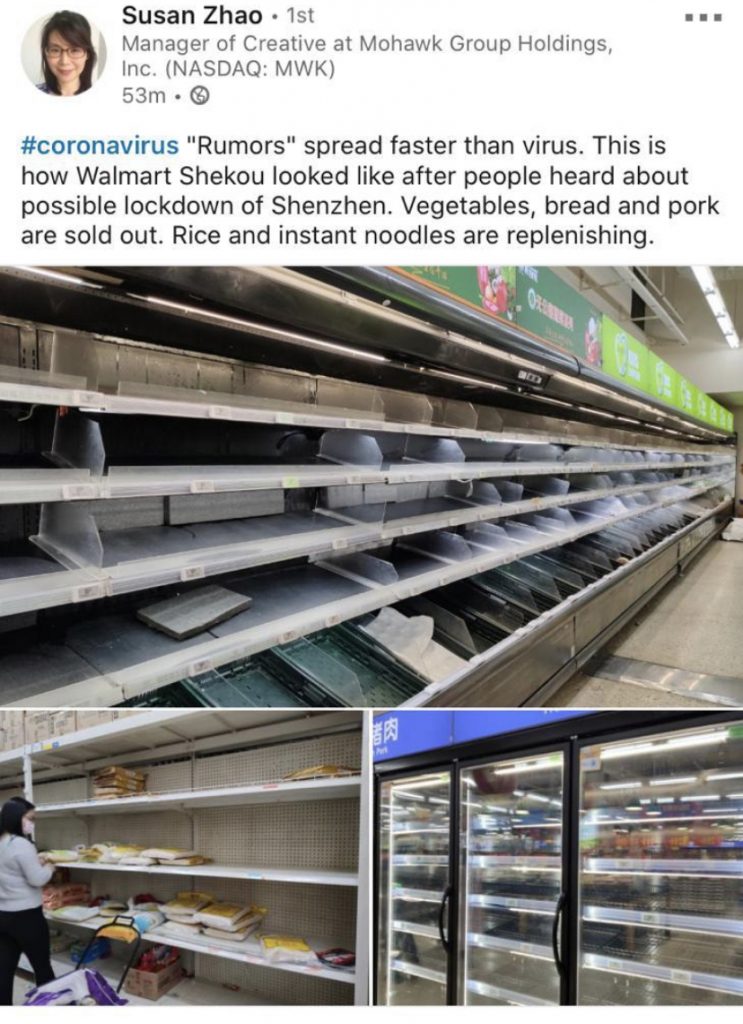
- Wild rumors are circulating everywhere in China. For example, I saw in Linkedin that people have emptied some supermarket shelves:
- Some journalists and some citizens are taking videos in Wuhan and reporting on the situation. It seems hospitals are totally overwhelmed, with dead bodies in the hallways and so on.
He then analyzes how he sees all this impacting China’s manufacturing sector and starts out by conceding that as of right now, “nobody knows. It’s all pure speculation.”
He then lists out and seeks to answer the following key questions:
1. Will workers come back? Many have returned to their hometowns for CNY. “They will probably wait longer before returning to work. If the situation gets worse, they might wait for months.” He calls the Wuhan area a special case and notes that factories whose management and/or the operators come mostly from that area “might not re-open.”
2. What will conditions be when production resumes? The Chinese government might impose new sanitary rules, especially in sectors like food and medical devices. “The government might postpone the opening of all offices and factories.” Even in the absence of Chinese government decisions, it will make sense to enforce certain rules like masks and gloves for all workers, regular disinfection of certain areas, etc. The governments of importing countries “might also impose strict rules for certain products” from China.
3. Will component suppliers keep delivering? “Your assembly suppliers might get back to work, but some factories in your supply chain might not re-open for several weeks . . . . or ever. Be ready to look for new sources.”
4. Is it desirable and realistic to start manufacturing in another country, to reduce exposure to China? “Many buyers are starting to think about this. Unfortunately, if you haven’t already taken a few steps in that direction (finding and qualifying suppliers, having them work on development and on a small order), it will take months.” If your orders are small and if you cannot pay a higher price, you will probably not find any good options in Vietnam, Thailand, or Indonesia. There has been a rush to those places from other buyers, and most manufacturers in those countries simply cannot take any more business.
5. Can we ship out the products that were completed before the Chinese New Year? Logistics should still function as usual in the next few weeks. This will probably not be a problem.
6. Will many factories NOT re-open after CNY? “That’s a possibility. If the owner or the key manager is sick/dead, it is usually the end for small organizations. If the death toll keeps rising sharply and if China’s economy takes a serious dive, many factories that could re-open might choose not to do so.”
7. How will this affect my employees on the ground? At this point, the best thing for you to do is to focus on prevention:
- Advise them to stay home and avoid going into public transportation, restaurants, and so on.
- Have them read this article (note that wearing a mask is far from sufficient if one wants to be safe).
- Ship some facial masks, medical gloves, and alcohol-based disinfectant to them if you can.
If an employee is infected, you are legally required to keep paying his or her salary. See BREAKING NEWS: China Issues New Employment Rules For Dealing with the Coronavirus. Avoid firing people so as to avoid having the rest of your employees “remember you are not an employer that can be counted on.” Push your foreign employees on the ground to take flights out of China. “Better be safe than sorry.” Be in touch with your employees who are traveling on holiday and make sure they know the situation.
“The worst scenario is that the contagion gets totally out of hand, the death toll rises fast, all transportation is locked down in China and Hong Kong,and all economic activities are hurt very severely. At this point in time, I don’t think anybody can exclude it.”
China’s road and port transportation has improved since 2015 but it is still not even close to China in terms of capacity or reliability, especially for smaller companies. Vietnam has been discovered and even overrun with new manufacturing in the last few months and this is taxing its roads and its ports and its factories. Companies that have not experienced product delays in Vietnam for years are experiencing them right now and we expect that will only increase as more foreign companies that ship product to the United States (and even elsewhere) move production from China to Vietnam.
Thailand and Indonesia have been trailing Vietnam in lack of capacity for more manufacturing, but not by much. You are probably already too late to have your widgets made and delivered on short order from outside China, but now is the time to think about truly diversifying your production. Now is the time to truly scour the world for a new production country. Now is the time to think outside the box by exploring and consider places like Mexico, Colombia, Haiti, Brazil, Spain, Portugal, Poland, Ethiopia, Pakistan, or just about anywhere other than China, Vietnam, Thailand, Cambodia, or Indonesia for your manufacturing. This is not going to be easy but it could be what makes or breaks your company. And in so choosing, think beyond just pricing, and consider things like diversification and safety and long term stability and tariffs and duties and intellectual property rights too.
In early November last year, in How to Conduct Business with Chinese Companies That See a Dark Future, we outlined China’s many risks and we called for companies to — if possible — lessen their China exposure:
For some companies, China’s increasing risks now exceed its rewards, but for others this is not at all true. Do you really need a legal entity in China with Chinese employees or might your company be better off with no operations in China beyond a third party distributer or reseller? Our China lawyers have been doing a lot of work in the last six months helping our clients reduce their China footprint and thereby reduce their China risks. No matter what you are doing in or with China, now is a good time to look at how you too can reduce your risks. The following posts are relevant for this:
The following posts should aid you in deciding what to do in and with China and in how to do it:
Above all else, if you are doing business in or with China, you should stay in touch with those who know what is happening that might impact your business and you should be careful and be thoughtful. And — I will repeat what I said yesterday — being thoughtful should include the realization that it is human beings on the front lines of this crisis and the human side of all this should predominate.
In other words, as much as you (or I) want to just go walk a dog, now is really not the best time for that.










