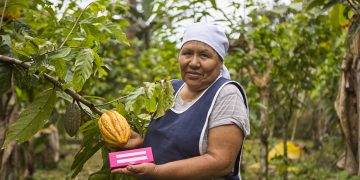








• Smallholder farmers do the most work, but earn the least money on the value chain.
• The UNDP’s Other Bar makes payments along the chocolate value chain transparent.
• Purchases can be reinvested into tree plantations.
How many of you like the taste of fine dark chocolate? Yes, I know. The answer is quite obvious. (Who does not love chocolate?) But how many of you know the farmers behind your chocolate?
This asymmetry of information between the first mile (producers) and last mile (consumers) leads us to a shocking reality:
• According to the Food and Agricultural Organization (FAO), an estimated 500 million small farmers – men and women – produce most of the developing world’s food. Yet their families suffer from even more hunger, have higher rates of poverty and enjoy less access to basic social services than poor people in urban areas.
• Despite being the ones who spend the most hours per day working, producers earn the least profit of all players in the value chain.
• New generations of producers do not see a decent living option in agriculture.
In the words of Francisco Numan Tene, a cocoa producer from Zamora-Chinchipe province in Ecuador who has been engaged in agriculture for more than 40 years: “Agriculture is a way to bequeath poverty to our children.”
It is time to completely turn this concept around. There is an alternative way to do business. An era of radical transparency based on technology has come, and it’s here to stay.
Imagine that, through your purchase, you could generate real and direct impact in the lives of producers and communities. As a consumer, you could know everything about the product you have in your hands. All the information from the value chain: starting from the payment to the farmer, all the way through the freight forwarder fee to export the chocolate. Complete, transparent and verifiable information is one click away.
This sounds good on paper. The question is: how do we apply this concept to reality?

The Other Bar
Image: UNDP
The United Nations Development Program UNDP in Ecuador, in coordination with the Federation of Small Organic Agricultural Exporters of the Southern Ecuadorian Amazon (APEOSAE) and the Dutch FairChain Foundation, developed an experiment called The Other Bar – TOB. TOB is an Ecuadorian chocolate bar that offers consumers three features:
Quality, TOB is a bar made with the best fine aroma cocoa from the Ecuadorian Amazon. Only 5% of world cocoa production is considered part of the fine aroma category. It is characterized by its flavor with floral and fruit notes. This cocoa is grown in a ‘chakra’ agroforestry system, and it is highly appreciated by the top chocolatiers in the world.
Traceability, through a unique QR code printed on the packaging of each chocolate, customers are directed to a website where they have access to all information from bean to bar. They have the option of knowing: who produced the cocoa for that bar; the place where it was obtained; the certifications that cocoa possesses; whether or not it is organic, among other data.

Ana María Villegas, producer of fine aroma cocoa in the Ecuadorian Amazon.
Image: UNDP
You can also know how much the producer was paid for his/her cocoa, through the backup invoices. In this case, the project paid twice the market price of cocoa to the producers, improving their participation in the value chain. All this information is stored in a system backed by blockchain technology, which gives transparency and guarantees that the information will not be modified.
The association that participated in this process is APEOSAE – located in Zamora Chinchipe, it brings together nine organizations with more than 170 individual cocoa, coffee and banana producers.
Halting deforestation is essential to avoiding the worst effects of global climate change.
The destruction of forests creates almost as much greenhouse gas emissions as global road travel, and yet it continues at an alarming rate.
In 2012, we brought together more than 150 partners working in Latin America, West Africa, Central Africa and South-East Asia – to establish the Tropical Forest Alliance 2020: a global public-private partnership to facilitate investment in systemic change.
The Alliance, made up of businesses, governments, civil society, indigenous people, communities and international organizations, helps producers, traders and buyers of commodities often blamed for causing deforestation to achieve deforestation-free supply chains.
The Commodities and Forests Agenda 2020, summarizes the areas in which the most urgent action is needed to eliminate deforestation from global agricultural supply chains.
The Tropical Forest Alliance 2020 is gaining ground on tackling deforestation linked to the production of four commodities: palm oil, beef, soy, and pulp and paper.
Get in touch to join our mission to halt to deforestation.
TOB gives consumers the opportunity to invest directly in the communities through tokens (virtual currency) backed by blockchain, which are embedded in QR codes in the packaging of each bar. These tokens have a value of 25 US cents. The consumer has the option to invest these tokens in two options:
1) Buying a new TOB chocolate
2) Impact goals in the communities
In this case, the impact goal is the planting of cocoa trees on the farms of the producers, which allows them to improve their productivity, thus avoiding expansion into Amazonian forests. With a total of four tokens, you can plant a tree.
This new business model proposed by UNDP Ecuador is based on these four pillars:

Four principles for fairer trade
Image: UNDP Ecuador
This experiment aims to level the playing field for the weakest players in the value chain: the producers. Through the direct participation of consumers leveraging technology, we aim to improve the quality of life of producers and their communities, and bring radical transparency to the chocolate industry.
License and Republishing
World Economic Forum articles may be republished in accordance with our Terms of Use.










