






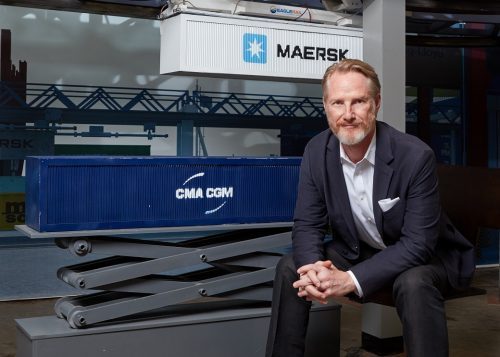

An exclusive interview with Mike Wychocki, Chairman and CEO of EagleRail Container Logistics
Growth trajectory in the decades to come is what decides or sets the
ball rolling for the development of any industry. Looking at the growth
predictions of the container shipping industry, one can comfortably place it
among the most robust in the coming years.
Several studies confirm that container growth (number of containers
being shipped every year) continues to grow between 2 and 6 per cent. The
average annual container growth, for next 10-20 years is estimated to be around
4 per cent.
Mike Wychocki, Chairman and CEO of EagleRail says: “In most countries of the world,
container growth is expected to double. In the case of India, in next 20 years,
it will grow by 200 percent. So, the amount of growth in container handling is
enormous.”
Sharing the growth expectation, Mike backs it up with a logical
explanation. He states, “The middle class is growing and therefore, the
consumer base for finished goods as well as the raw materials is sure to rise.
And, many new categories of products have joined the league of items to be
shipped via containers. Liquids, bulk and even cars are now being shipped in
40-feet containers”.
With annual container growth forecast at 4%, the real challenge for the
shipping industry will be to increase container throughput speed in order to
handle the volume growth. As Mike puts it: “It is not about how many containers
are being shipped, it is about how fast are they being processed in-and-out of
the sea ports that will become paramount.”
To turn this growth story into real-time future for container folks,
port management and utilisation — both port and intermodal operations have to
be optimised. Talking on this aspect, Mike shares that most of the ports around
the world are not at advantageous physical locations and cannot relocate. An additional
difficulty is the rapid urbanization near the ports, so the city around it
which makes it impossible for the ports to expand.
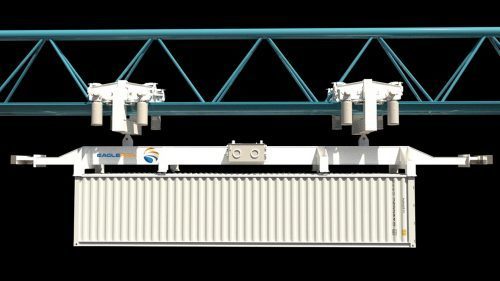
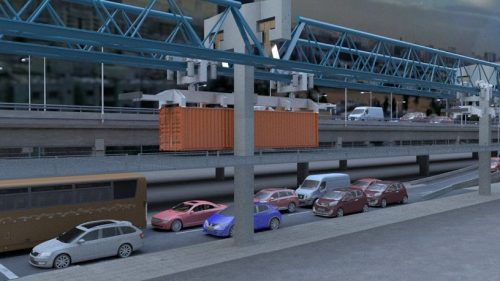
“Therefore, the challenge is — how do you help the port grow two-times in 20 years, if the foot-print of the property cannot get any larger? The answer is you can either turn the inventory faster or builder higher vertical stacks inside the port. There are these new steel high-cube racks that can hold up to 10 containers on top of one-another, but that does not improve in-and-out throughput. Regarding the faster inventory processing, this is where the EagleRail overhead transport network comes into play. It eliminates the majority of shuttling trucks — and the diesel pollution, long waiting hours, congestion at the ports and delivers digital data tracking to your fingertips,” added Mike.
EagleRail
The concept all started seven years back in São Paulo, Brazil when J.
Michael Meissner, the founder of EagleRail, during a presentation for overhead
passenger systems, was asked a question. A gentlemen asked if the monorail
could be adapted to carry a shipping container. He answered — “Why not?” It was
the seedling to the idea of the overhead suspended container transport system.
It was then a concept, but two years later, after Mr. Wychocki took over
the reins of the company, EagleRail has come a long way as the concept has
turned into a reality.
“We are doing pilot studies in several countries and are negotiating
with a location in China; one in South Africa; two sites in Brazil and two in
the US. We have also received requests from five other countries and are trying
to prioritise and decide on taking up the study,” shared Mike.
Advantages with EagleRail
Faster Throughput & 24/7 Automated
Operations
The EagleRail Operating System (EROS) delivers system-wide intelligence
for smart container scheduling, routing and load-balancing algorithms.
No Need for Ground Space
Shuttling containers overhead compliments existing ground operations
without the need for additional real estate enabling faster ship turns and
container evacuation for better ROI on terminal capacity.
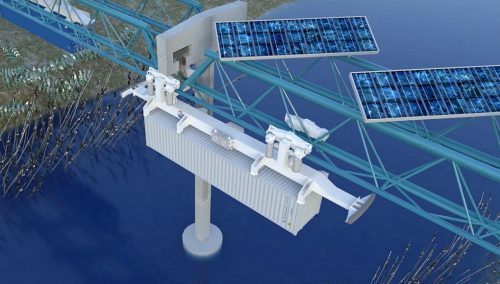
Clean Energy: EagleRail is looking at renewable resources
for any additional energy production such as waste-to-power conversion systems.
Additionally, the top rail can be fitted with solar panels to provide up to 25%
of the system’s power needs.
Cleaner Ports: The ‘easy overhead transport network’
eliminates diesel truck pollution, long waiting hours and congestion at the
ports, thus supporting emission standard maintenance.
Data Capture: Eagle-i, our proprietary routing and scheduling software ensures containers are shuttled with maximum efficiency, tracked using IoT technology, delivering data connectivity with TOS platforms and intermodal software.
ONGOING PROJECTS
EagleRail shares interesting studies going on
in India & Bangladesh.
In Gujarat (India), Eagle Rail is beginning work with the Gujarat
Maritime Board (GMB) who is primarily interested in moving coal or particulates
with their overhead system. Here, the good news is that there already exists
20-feet-long coal containers, with corner casting holes. This makes it easy
with the implementation part as just like the crane, the EagleRail system can
lift it and transport it. The benefit is that it is a cleaner transport system.
Smoother, low friction and stable transfer solves the problem of coal dust and
polluted air.
In addition, it is definitely more autonomous than the trucks. Studies
are underway on how to automate the process. “Right now, we are looking at
2 to 3 different locations and one would be finalised to run a pilot,” said
Mike.
The company is also looking at the other Indian ports like the Ports in
Navi Mumbai, Vizag and Kolkata. Among the emerging markets, India is the best
as it is going to have the highest growth numbers in the future. “The
government of India, under Narendra Modi, is investing a lot in infrastructure
development. A great deal of money is being dedicated to freight corridors and
rail networks. Here, EagleRail is the perfect connection point for India to go
from port economy to rail economy. We feel very good about India and the level
of support,” shared Mike.
Bangladesh
An agreement was signed with Bangladesh for a feasibility study. In this
regard, an MoU was signed with the Chittagong Port Authority. The MoU signing
ceremony was attended by the Secretary Shipping of Bangladesh, US Ambassador to
Bangladesh and US commercial officer to Bangladesh, in Dhaka.
Sharing details, Mike had said: “We have formed a consortium with two partners. First is BUET or Bangladesh University of Engineering and Technology and the second being the PwC, South Asia. They are helping us conduct a study out of Kolkata, Delhi and Gurugram and we are halfway through it. The study is looking very positive and is both for a short system which connects ‘to nearby overflow yards’ and the second one which will be connecting large ocean terminals called Bay terminals for deep-water ships; we are looking at a 6-km-long connection point”.
People from Chicago are on ground, living in Dhaka and Chittagong area,
and are doing the ground work. Delivery of the study is expected by March 1,
2020, post which decisions on how to move forward, how to get funded and what
could be the respective roles, will be taken.
Our studies focus both on technology and economics. We see specifically
see how it will interface with their particular topography. Questions like
where are the pickup points, the drop-off points, where do we have to cross the
roads, where do we have to bury the power-lines, and so on. So, the technology
part is specific to how it implies or fits into their structure and
geographical locations, he added.
The economic part is how many containers will be on the system, traveling
what distance, from what point to what point and what would be the fees for
EagleRail’s 10 – 20 year, long-term lease.
In addition to these, the Company is also doing a small study on the
amount of pollution and Carbon Dioxide emission reduction by replacing diesel
trucks with electric rails. Social impact assessment is also being taken up
where job creation, job replacement and levels of these jobs and remunerations
are being studies, in context of the role in the economic growth in the
Chittagong area.
The entire study is on how to have a better and efficient system through
automation. As EagleRail is a service provider offering Shuttling-as-a-Service
(‘SaaS’) and not an equipment seller, each installation, around the world will
have local SPV (Special Purpose Vehicle) partners. “We are hoping to create a
PPP or Public-Private-Partnership where everyone gets their rightful share of
the operating net profits,” added Mike.
Sea News Feature, January 30










