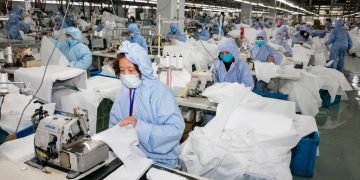







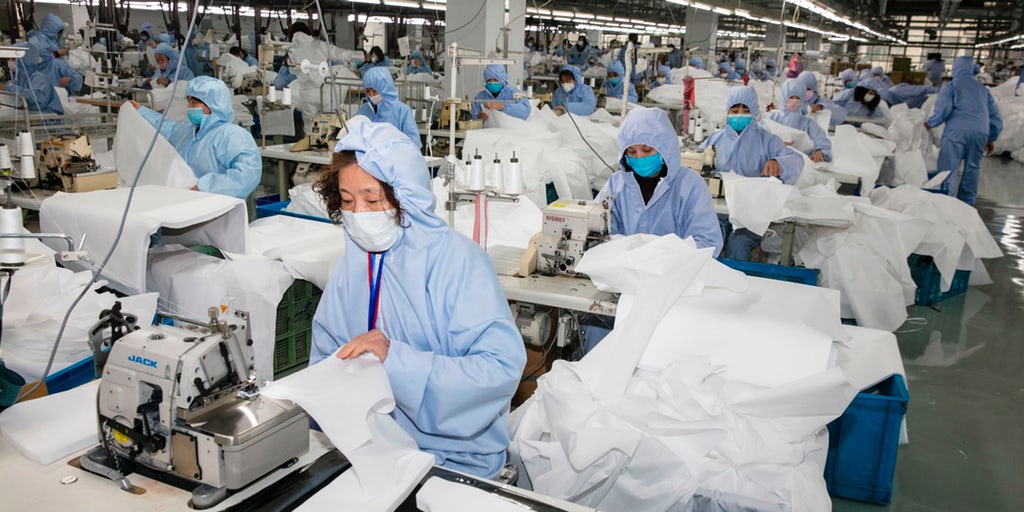
NEW YORK, United States — When China’s government lifted a two-week mandatory holiday earlier this month, Lafayette 148’s factory in Shantou was one of countless businesses to rumble back to life.
But more than a week later, the facility, which makes upscale womenswear, has yet to return to full capacity as some workers are still travelling back to the city from their Lunar New Year holiday, which was extended because of the coronavirus outbreak. Even now, workers wear masks and get their temperatures taken every day, according to Chief Executive Deirdre Quinn. The upscale womenswear label expects its spring collection to hit stores about two weeks late, she said.
“We’re dealing with a little bit of a later delivery, but we’re fortunate because a lot of companies haven’t finished making spring,” Quinn said.
China has reported 73,000 confirmed cases of coronavirus, and nearly 2,000 deaths from the outbreak, which started in the city of Wuhan but has spread throughout the country and 25 other countries, according to the World Health Organisation. At least 150 million people are banned from travelling within China, and Chinese citizens face a growing number of restrictions on their movement abroad.
The outbreak’s economic impact is just beginning to be felt, with labels from Ralph Lauren to Burberry predicting a steep drop in sales. International brands and retailers have been less vocal about the prospect for a months-long disruption to the manufacturing side of the impact in the country that produces more than 30 percent of the world’s clothes, according to the World Trade Organisation.
Lafayette 148’s difficulty ramping up production is not unique; brands and their suppliers must factor the safety and health of their workers into their plans. Even when factories are operating, getting goods out of China is proving to be another hurdle, as container ships and air freight lines are operating at reduced capacity. Some retailers warn they could run out of stock, though predicting when, and which items, is difficult.
“At this point, a lot of companies are in the assessment stage, continuously working with their vendors overseas and also their transportation providers to figure out how long factories are staying closed,” said Jonathan Gold, vice president for supply chain and customs policy at the National Retail Federation, a US trade group.
There are steps retailers can take to keep their supply chains moving while the coronavirus runs its course. Below, BoF provides an action plan.
Ensure a daily dispatch from manufacturers and 3PL providers
The first step toward coming up with a contingency plan is to know what’s happening on the ground. Though most infections are in the Hubei province in central China, which remains on lockdown, cities across the country are implementing quarantine measures of their own. Absentee rates vary widely from workplace to workplace.
Brands, therefore, need to be in close contact with their suppliers. Knowing about production delays well in advance buys time to arrange faster shipment, minimising delivery delays to wholesale partners and customers.
“The worst-case scenario is when you have a black hole in communication and people are making decisions out of fear,” said Brian Bourke, vice president of marketing at Seko, a logistics company that works with retailers worldwide. “If you’re not getting daily updates, you need to really demand it.”
Know your freight options
Naked Cashmere, a direct-to-consumer knitwear brand, mainly relies on a Chinese factory in Hangzhou to produce its sweaters. Hangzhou has documented dozens of confirmed coronavirus cases, though it’s far from the outbreak’s epicentre in Wuhan. The brand’s spring inventory is already en route to US warehouses, but fall production could be affected if work doesn’t return to normal in March and April.
The company is already preparing for that possibility, said Bruce Gifford, chief executive of Naked’s parent, 360 Sweater.
“It’s too early to tell if there are possible supply chain interruptions but we’re adding a little bit of extra production time,” he said.
If there is a delay, Gifford said, the plan is to ship more goods by air. Currently, 360 Sweater ships 60 percent of its freight across the Pacific on ships, a journey that takes about a month, and 40 percent by air, which takes two days.
Booking far in advance is advisable. Air service out of China is heavily limited by quarantine measures and travel restrictions. United Parcel Service has reduced flights to China, while commercial airlines, which carry freight along with passengers, have also cut back. Some air routes have seen rates soar up to 300 percent, Bourke said, and backlogs could quickly form as factories ramp up production.
“The first thing companies need to do is talk to transit companies, ask them what options they have,” Bourke said. “There’s not going to be enough ships and vessels in rotation yet, even when the freight is ready, so they need to understand when things will be ready so they can prebook.”
Expedited ocean shipping is another option, with some routes cutting the trip from Shanghai to Los Angeles to just 12 days. Shipments can also be routed to other ports in Asia or the Middle East and then sent by air the rest of the way.
Amp up customer service and be transparent
It’s crucial that customers and retail partners know when to expect delays. In a crisis, it’s much better to reach out to shoppers before the complaints come pouring in.
“You have to be super transparent and super specific about your recovery progress,” said Bourke. “Doing so can alleviate fears and questions that people may have.”
Instead of being reactive, companies can notify customers about the problems they’re facing and offer compensation if needed, such as a refund or a discount on future purchases.
If possible, shift production to other factories
After the US threatened to impose tariffs on Chinese-made clothing and accessories last year, many retailers stepped up efforts to explore manufacturing options outside of China, including Bangladesh and Vietnam.
The coronavirus is likely to accelerate those plans.
“Larger retailers might have more flexibility to move than smaller retailers, but depending on what kind of product they’re making, it might be time to look for alternate sourcing,” said Gold.
Lafayette 148 made the decision to stay put in China when the tariffs were first announced, but is now weighing the possibility of expanding its manufacturing.
“Down the road, we are looking to potentially diversify some of our manufacturing just for safety’s sake,” Quinn said.
Imports to the US from Vietnam and Cambodia, for instance, have seen an 11 percent increase in the last year, according to the US Commerce Department. To find new suppliers, brands can look for leads at networking events and trade shows, as well as reach out to peers for ideas. They could also consider local manufacturing, which is likely pricier but allows for more flexible lead times and agile inventory management decisions.
Forecast sales and adjust manufacturing plans accordingly
Retailers that rely on Chinese consumers are especially at risk. Lost sales from the coronavirus, compounded by the Hong Kong protests, means international brands stand to lose a substantial portion of revenue this year. To mitigate further losses, these companies must adjust their inventory accordingly to avoid excess products at the end of the season.
Lafayette 148, for instance, relies on China for 9 percent of sales and counts nine stores in the country. Two are open currently, though neither is posting any sales. As a result, the brand has halted production for any inventory that was planned to sell in China. Kering is also halting its operations in China, postponing new store openings and ad campaigns.
Ultimately, there’s little retailers can do other than monitor the situation and react accordingly. For Gifford at Naked Cashmere, it’s a matter of hoping for the best but preparing for the worst.
“The bigger risk isn’t supply chain, the bigger risk is to the overall world economy,” he said. “We could see overall demand in this sector go down, or we could see the coronavirus trigger the recession.”
Lafayette’s Quinn has one suggestion, and that is to take it easy:
“My advice is to just hang in there,” she said. “Remember that we’re talking about clothes, not people. And people are still dying every day from the virus.”
Related Articles:
Everything Fashion Brands Need to Know About the Coronavirus
The Real Cost of the Coronavirus
How to Handle a Customer Service Crisis
Trump’s Tariffs Have Arrived. Here’s How to Avoid Losing Your Shirt










