







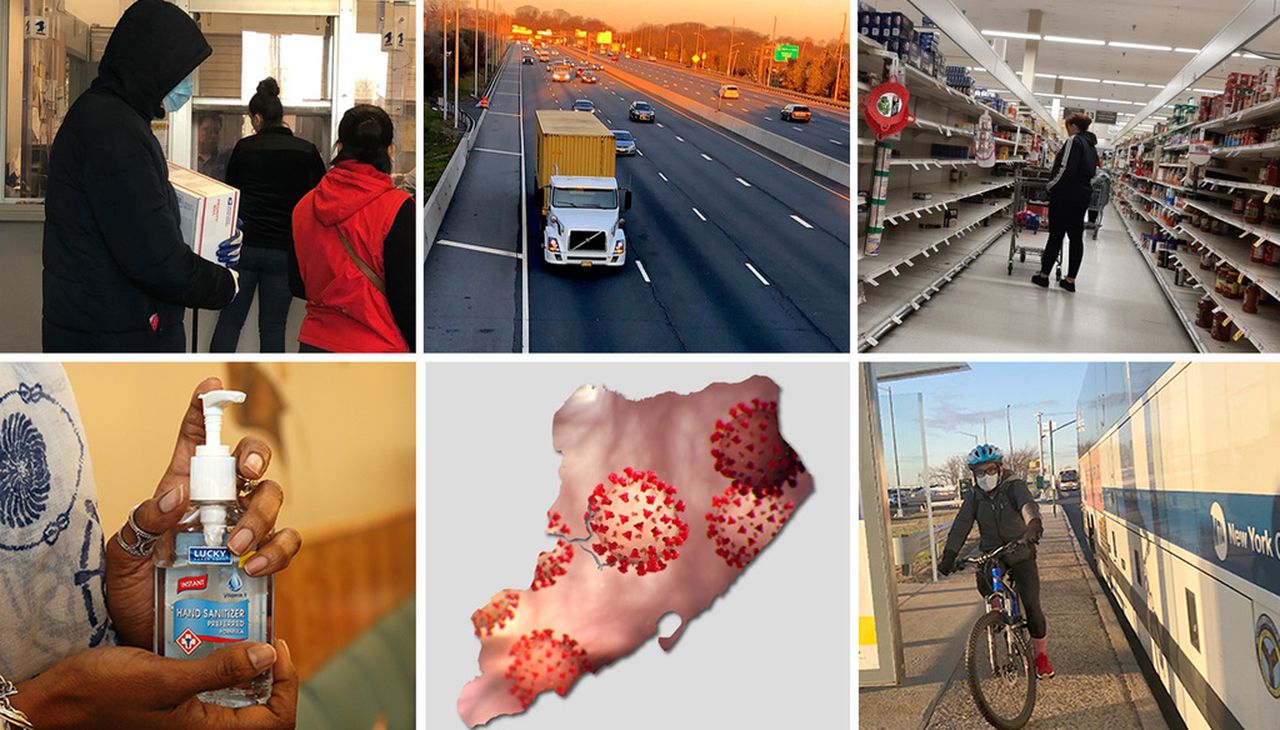
Below is critical information for Staten Islanders, organized into ten key areas. This information will be updated regularly during the coronavirus outbreak. Visit our data page for a visual analysis of confirmed COVID-19 cases on Staten Island and in New York state.
- Confirmed cases: 375 (as of Saturday, March 21)
- Hospitalized cases: 54 (as of Saturday, March 21)
- Deaths: 4 (as of Saturday, March 21)
Get full analysis of current Staten Island data.
As of 8 p.m. on Sunday, the NYPD will be enforcing these rules for individual New Yorkers:
- Only workers providing essential services can be outside their homes in groups and they must use social distancing
- Non-essential gatherings of individuals of any size for any reason (e.g. parties, celebrations or other social events) are canceled or postponed at this time
- Individuals can leave their homes, but they must be six feet from others at all times
- Outdoor recreational activities must be non-contact and people should avoid any activities where they come into contact with other people
- Public transportation must be used only when absolutely necessary. Distancing rules must be applied on public transportation as well
- Those who feel sick should leave their homes only to receive medical care and only after they have assessed their medical status with a tele-health visit
- Young people must practice social distancing and avoid contact with vulnerable populations
- Businesses that are considered essential and are allowed to remain open must implement social distancing rules
There is a different set of rules for vulnerable populations, defined as those over 70, with compromised immune systems or with existing illness. For this group:
- Remain indoors
- Limit outdoor activity to solitary exercise
- Pre-screen all visitors and aides by taking temperature
- Wear a mask when in company of others
- Do not visit households with multiple people
- Everyone in presence of vulnerable people should wear a mask
- Stay six feet from other people
- Do not take public transportation unless absolutely necessary
As of Saturday, March 21 at 8 p.m. all barbershops, hair salons, tattoo or piercing salons, nail salons, hair removal services and related personal care services were closed. Gyms, theaters, retail shopping malls, amusement parks and bowling alleys were already closed until further notice.
As of Sunday at 8 p.m., all other non-essential businesses will close.
New Yorkers are allowed to visit essential businesses, though social distancing should still be implemented. Essential workers are the only individuals who can congregate in groups, although, again, social distancing is required.
Essential businesses include:
- Health care operations – Research and laboratory services, hospitals, walk-in health care facilities, veterinary and animal health services, elder care, medical distribution, home health care workers/aides, doctors and dentists, nursing homes or residential facilities, and medical and equipment providers.
- Infrastructure – Utilities, including power generation, fuel supply and transmission; public water and wastewater, telecommunications and data centers, airports and airlines, and transportation infrastructure, such as bus, rail and for-hire vehicles.
- Construction – skilled trades such as electricians, plumbers; other related construction firms and professionals for essential infrastructure or for emergency repair and safety purposes
- Manufacturing – Food processing, chemicals, medical equipment, pharmaceuticals, safety and sanitary products, telecommunications, microelectronics, agriculture and paper products.
- Retail – Grocery, including food and beverage stores; pharmacies, convenience stores, farmer’s markets, gas stations, restaurants and bars for takeout and delivery, and hardware and building material.
- Services – Trash and recycle collection, tech support, mail and shipping, laundromats and dry cleaning, building and cleaning maintenance, child care, auto repair, warehouse and distribution fulfillment, funeral homes, crematoriums and cemeteries, and animal shelters.
- Financial – Banks, insurance, payroll and accounting.
- Providers of basic necessities to economically disadvantaged populations – homeless shelters and congregate care facilities, food banks, human services providers.
As of 8 p.m. on Sunday, all non-essential businesses will close, but essential stores will remain open. These include: grocery stores, food and beverage stores, pharmacies, convenience stores, farmer’s markets, gas stations, restaurants and bars for takeout and delivery, and hardware and building material stores. Banks and laundromats are also allowed to stay open.
Do call ahead to check on the hours and to confirm a particular business is open.
- Bank hour reductions and branch closings on Staten Island
- Adjusted hours for Staten Island grocery stores
Restaurants continue to remain open for takeout and delivery only, however some restaurants have been forced to close temporarily. Call ahead to confirm that a restaurant is open.
- List of open Staten Island restaurants, as of Saturday
- List of temporarily closed restaurants, as of Friday
New Yorkers are asked to use public transportation only when absolutely necessary.
As of midnight on Sunday, ferry service will be reduced, on the following schedule:
- Only three boats will operate in the morning and evening rush hours on weekdays. Previously, four boats operated during these hours.
- From 7:00 to 9:00 a.m., the ferry will operate every 20 minutes. The ferry previously operated every 15 minutes.
- From 9:00 a.m. to 4:30 p.m., the ferry will continue to operate every 30 minutes.
- From 4:30 to 8:00 p.m., the ferry will operate every 20 minutes. The ferry previously operated every 15 minutes.
- From 8:00 p.m. to every 12:00 a.m., the ferry will continue to operate every 30 minutes.
- From 12:00 to 5:00 a.m. on weekdays, and from 12:00 to 7:00 a.m. on weekends, the ferry will operate every hour. The ferry previously operated every 30 minutes.
The MTA has announced new rules for bus riders: disabled riders will continue to board local buses as usual, but all other riders will back-board. Express bus riders will continue to board as usual, but the first three rows will be left empty to provide appropriate distancing for bus operators.
Back-boarding riders will not pay the bus fare.
Online learning for public school students begins Monday. Schools Chancellor Richard Carranza has asked parents to sign up for the NYC Schools account, which will be critically important as the DOE pushes information out and resources for remote learning needs.
You can go to www.myschools.nyc for more information.
- Tips for parents transitioning their kids to online learning.
- There will be four Staten Island sites for daytime care of the children of first responders.
- On Friday, the city shared new information about meals for New York City students: “Starting Monday, March 23, three meals a day will be served to all New York City students at 439 hub sites citywide…Door Dash will be delivering meals to students whose medical needs are so significant that they should not be leaving the home even to get meals. Food delivery will also be made available to children who reside in City shelters. Families search “Free Meals” on schools.nyc.gov or call 311 to find a site near them. Starting Monday, families can also text FOOD or COMIDA to 877-877 to find a meal near them. A complete list of meal hubs is available here.”
- Information here for parents who need to apply for technology to support their child’s learning.
- Parents of children with special needs will develop individual plans with school officials.
Houses of worship are not ordered closed as part of Gov. Cuomo’s P.A.U.S.E. order, however, it is strongly recommended no congregate services be held and social distance maintained.
Some houses of worship may continue to be open daily for private prayer; worshippers should check for hours and closures.
The Archdiocese of New York has cancelled public mass for Holy Week and Easter.
As of Saturday, ALL visits to both Richmond University Medical Center and Staten Island University Hospital remain suspended.
As of Friday, March 13, only medically necessary visits are allowed at nursing homes.
The state has asked nursing homes to set up skyping and other online communication capacity so families can tele-visit their loved ones.
The state additionally requires health screenings for all nursing home workers each day when they enter a facility and require them to wear surgical masks to guard against any potential asymptomatic spread.
According to the World Health Organization, common signs of infection include respiratory symptoms, fever, cough, shortness of breath and breathing difficulties. In more severe cases, infection can cause pneumonia, severe acute respiratory syndrome, kidney failure, and even death.
Testing guidelines issued Friday, March 20, directed healthcare facilities to immediately stop testing non-hospitalized patients for the virus unless test results impact “the clinical management of the patient,” which the city says gives medical facilities some discretion if they feel a test is vitally important.
City Hall also said the Department of Health would start advising providers and hospitals to stop testing asymptomatic people including healthcare workers and first responders.
If you have symptoms and feel you may qualify for coronavirus testing, you may call the New York State Department of Health at 888-364-3065 for screening and a possible appointment at Staten Island’s drive-through testing center.
The site, located at 777 Seaview Ave., is open from 7 a.m. to 7 p.m. seven days a week. De Blasio has said drive-through sites will be reserved for serious cases only and are not for everyone.
The hotline has also seen long wait times; to avoid waiting, the state recommends patients first call their primary care physician, who may also be able to match them with testing, if appropriate.