






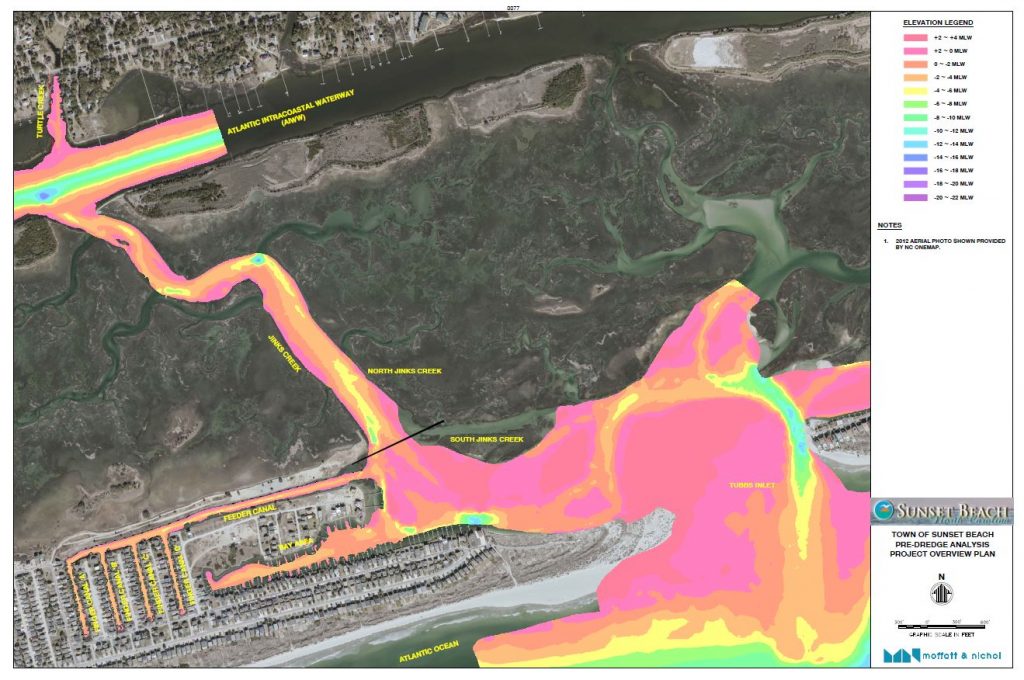

This map of Sunset Beach shows a pre-dredge analysis of the dredging project. Image: Moffat and Nichol
The Coastal Resources Commission has given Sunset Beach its approval to dredge about 18 acres, including south Jinks Creek, to a depth deeper than the connecting waters along its eastern border.
But the commission’s vote Wednesday during its meeting in Beaufort to approve the Brunswick County town’s variance request, which followed the October 2019 Division of Coastal Management approval of the permit with conditions, came despite some members’ objections.
Sunset Beach had submitted its Coastal Area Management Act, or CAMA, major permit application in April 2019, requesting authorization to dredge in the interior waters of Tubbs Inlet. The north and south sections of Jinks Creek connect Tubbs Inlet to the Atlantic Intracoastal Waterway and provide navigable access for canals, a bay area and the feeder channel. The proposed maintenance dredging is to help improve navigational access.
Division staff agreed last week that the town met all the criteria for a variance, but a letter dated Jan. 30 from the Army Corps of Engineers seeking more information on the project, such as the proposed placement of the dredge spoils, spurred questions from some on the commission.
Commission member Robin Smith said that it appeared that the Corps’ letter raised issues beyond simply the spoils disposal issue. Some of the questions relate directly to the impacts of the dredging itself.
“So, given the fact that the Corps has raised some issues, and seems to be clearly saying that they have, so far, found the responses not to be adequate,” Smith said. “I would tend to think we would be better served to wait for the fuller responses to those questions, which I think partly will go, in the end, toward the issue of whether granting the variance would be consistent with the spirit, purpose and intent of the rules.”
Despite the CRC’s approval, the town will have to wait for the Corps’ authorization before beginning the project.
According to the draft biological assessment for the project, there has been significant shoaling in south Jinks Creek from tidal flows entering Tubbs Inlet, and bay area and feeder channel system developed for recreational boating access have been infilled from adjacent upland runoff and erosion, along with wind and wave action.
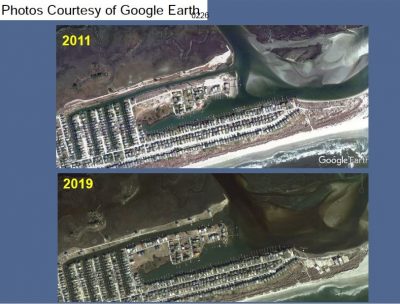
Aerial photos show Sunset Beach in 2011 and 2019. Illustration: DCM
Initial approval conditioned
The town’s application initially included additional dredging in north Jinks Creek, but resource agencies expressed concerns about the effects in north Jinks Creek, which is a designated Primary Nursery Area with “significant shellfish resources.” Given the concerns and the commission’s rules restricting new dredging in PNAs, the proposed dredging of north Jinks Creek was removed from the application, according to the division.
The town also proposed dredging the four easternmost canals, called A, B, C and D, to 6 feet below mean low water and dredging the feeder channel, the bay area and south Jinks Creek to 5 feet below mean low water. The depth in north Jinks Creek between the feeder channel and the Intracoastal Waterway is about 2 feet below mean low water.
Tara MacPherson, a field representative with the division, recommended in June 2019 denying or conditioning the proposed dredging depths, which were inconsistent with a rule that prohibits any canal or boat basin from being excavated deeper than connecting waters, according to state records.
To comply with the rule, the division issued a CAMA major permit in October 2019 authorizing the project with the condition that the maximum dredging depth be 2 feet below mean low water. Town officials did not appeal the CAMA major permit but in December filed a request for the variance to the rule.
DEQ Assistant General Counsel Christine Goebel told the commission Wednesday that the town proposed in its variance request dredging about 10,650 feet of south Jinks Creek, the bay area and the feeder channel, to a maximum depth of 6 feet below mean low water. The finger canals would be dredged to 5 feet below mean low water. The town characterized its request as allowing an extra foot of allowance for each, Goebel explained.
“And so, in viewing this variance, it’s really just the difference between 2 feet and 6 feet, as far as dredge depths,” said Goebel.
The allowance was necessary, according to Robert Neal of Moffatt & Nichol Inc., the town’s consultant on the project, because an excavator is to perform the work from a barge in the waterway. If the contractor is restricted to dredge no more than 2 feet, there was no guarantee that at low tide the water would be navigable immediately after the project.
“We cannot guarantee below minus 1 mean low water, so at low tide you have 1 foot of depth,” he said. “Most outboard motors are going to drag at least 18 inches, our design vessel for this was 2 feet.”
Grady Richardson, Sunset Beach’s town attorney, told the commission that the requested depth would be consistent with areas of north Jinks Creek. He noted that the Division of Marine Fisheries had no issue with the proposed dredging depth, and it will not harm fisheries or habitat.
“We will also point out that the dredging we’re seeking is consistent with dredging depths throughout coastal North Carolina,” Richardson added. “And also, the frequency of the maintenance for dredging at minus 2 verses what we’re seeking will be less. We do agree with staff that will create less of an impact on the environment.”
Beach site not eroding
According to the division, the project is expected to yield about 40,500 cubic yards of beach-compatible sand from south Jinks Creek and 48,600 cubic yards of noncompatible material from the remaining areas. The compatible spoils will be placed on an 8.5-acre area of the oceanfront beach between Fifth and 12th streets on Sunset Beach, and noncompatible material is to be placed in an upland landfill facility.
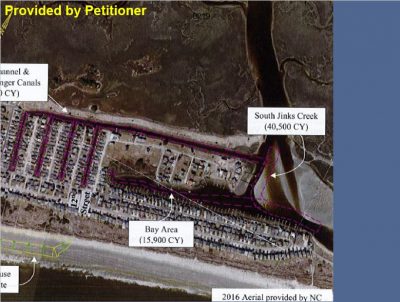
This illustration shows the amount of dredge material expected to be removed. Image: Sunset Beach, DCM PowerPoint
Although the town proposes to place the dredged material on 1,600 feet of oceanfront, the Corps noted that the placement site is not eroding or in need of additional sand.
Neal responded Wednesday during the meeting that the purpose of the beach fill is related to a state law that requires beach-compatible material to be placed on the downdraft beaches, which in this case would be Sunset Beach or Ocean Isle Beach.
“So we are required by rule to essentially keep that material in the system,” Neal said, adding that it’s standard process for dredge material to be placed along the beach. He said that the town approached Ocean Isle Beach, which has eroding shoreline, to place the material there but officials there said the benefit was not worth the cost.
Commission Chair Renee Cahoon noted that the Corps asked an “awful lot of questions” in its Jan. 30 letter, including about the environmental effects of the beach fill.
The Corps said in its letter to Sunset Beach than it had received input from the U.S. Fish and Wildlife Service, National Marine Fisheries Service, the Environmental Protection Agency, North Carolina Division of Coastal Management, North Carolina Wildlife Resource Commission, North Carolina State Historic Preservation Office and the North Carolina Coastal Federation, in addition to public comments, all of which were provided to Neal.
According to the Jan. 30 letter, Neal “provided a summary response document” on Dec. 16, 2019, that “attempted to address the over 200 comments received.”
The six-page letter from the Corps goes on to ask for more information and data on responses Neal provided.
“The need for placement of dredged material on the beach front has not been adequately demonstrated in your application, nor has it been satisfactorily described in the responses to comments,” according to the letter. “The avoidance and minimization descriptions provided in the application were insufficient for this office to determine that the proposed impacts from dredging and subsequent placement of the dredged material are unavoidable and have been minimized, or that compensatory mitigation would not be required at the proposed disposal area(s).”
The Corps also demanded more information on the purpose and need for the dredging depths, the proposed placement on the oceanfront and measures that would be taken to avoid environmental damage.
“I bring this to your attention to allow you the opportunity to modify your project plan to reflect an alternative that would have less impact on the aquatic resources documented at the site or to add to our record whatever additional information you feel is relevant to our review process,” Tyler Crumbley, the Corps’ Regulatory Division deputy chief, wrote in the letter. “Further evaluation of your application will be held in abeyance for 30 days pending receipt of your response. If no response is received within this time frame, we will close our record and a final decision will be made. You should be aware that based on the information we possess at this time it is unlikely a favorable decision would be made on your proposal.”
Cahoon proposed continuing the variance until the commission’s April meeting to give the town time to respond to the Corps’ demands, but Goebel responded that division staff were satisfied with the town’s compliance.
“In this case it’s the town’s place to respond to the Corps and not really DCM,” Goebel said, adding that the division staff was comfortable that it has also addressed and considered the issues.
Breaking down the vote
Although commissioners granted the variance request, the votes were not unanimous.
When voting on a variance, commissioners consider the following four criteria:
- Will unnecessary hardships result from strict application of the rules, standards, or orders? If so, petitioner must identify the unnecessary hardships.
- Do the hardships result from actions taken by the petitioner?
- Do the hardships result from conditions that are peculiar to the property, such as the location, size, or topography of the property?
- Is the requested variance consistent with the spirit, purpose and intent of the rules, standards or orders; will it secure public safety and welfare; and will it preserve substantial justice?
Commissioners Smith and Craig Bromby voted “no” on all four criteria. Cahoon voted “no” on criteria 2 and 4; Phil Norris voted “no” on criteria 2; and Lauren Salter voted “no” on criteria 4. Commissioners voting in favor of all four included Trace Cooper, Bob Emory, Doug Medlin, Neal Andrew, Larry Baldwin and Robert High. Commissioners Alexander Tunnell and Angie Wills were absent.
Opponents of the project questioned the commission’s decision.
“I thought it was interesting that one commissioner wanted to know why the town proceeded with the variance before the (Corps) made their decision. This is a question I asked the Council last week but got no response,” Richard Hilderman, a Sunset Beach property owner, founding member of the Brunswick Environmental Action Team, or BEAT, and retired biochemist, wrote in an email.
Like This Story?
It costs about $500 to produce this and all other stories on CRO. You can help pay some of the cost by sponsoring a day on CRO for as little as $100 or by donating any amount you’re comfortable with. All sponsorships and donations are tax-deductible.










