







The 600-foot-long car-carrying cargo ship that capsized in a Georgia sound between two resort islands will be sawed into pieces — big pieces.
Meanwhile, no detailed safety reviews have been made so far about how to manage those ships, even though a similar capsize could happen at Charleston or any other port worldwide.
Any regulatory changes would be up to the U.S. Coast Guard after the September incident investigation is competed.
The Golden Ray cargo ship capsized late at night on Sept. 8 in a matter of seconds. The harbor pilot at its helm, Charleston native Jonathan “J.T.” Tennant, has been praised for his actions avoiding an oncoming ship and helping rescue the Golden Ray.
The mammoth craft still lies on its side where it went over in St. Simons Sound between the St. Simons and Jekyll island resorts.
The incident is under investigation by the Coast Guard and the National Transportation Safety Board, a process that will take months to complete. The removal is scheduled to start within the next two weeks.
Stability problems have caused earlier capsizes on the car-carrying ships. Ballast water must counterweight (low) the cargo weight (high). The water has to be dumped and refilled each time a ship reaches a new port, and a crew member is assigned to track that weight, as well as the weight of cargo loaded, re-figuring the balance as the ship goes.
Unlike smaller vessels, a pilot can’t really judge whether the craft is top-heavy. The piloting experience has been described as like steering a shoebox.
Neither the State Ports Authority or the Charleston Branch Pilots Association has made any safety changes in the aftermath of the capsize.
“Vessels capsizing in a port is an extremely rare event and not really amenable to contingency planning,” said Jim Newsome, president and CEO of the State Ports Authority.
“The regulations provide that proper stability assessment and management fall with the vessel owner,” said John Cameron, the pilot’s association director, who helped at the Brunswick, Ga., port during the incident.

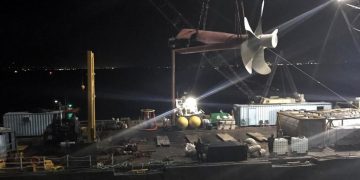
Removal works is about to start on the hull sections of the car-carrying cargo ship Golden Ray capsized in the sound between St. Simons and Jekyll islands. St. Simons Sound Incident Response Unified Command/Provided
The Coast Guard could call for more oversight of the counter-weighting procedure, but “there is an ongoing investigation,” said spokesman Petty Officer 2nd Class Ryan Dickinson. “It’s too early to tell if there will be new policies set in place by the Coast Guard, and there will be a public hearing anticipated in late spring.”
The inter-agency St. Simons Sound Incident Response Unified Command plans to shear the 20,000 ton Golden Ray into eight sections using a diamond-crusted cutting chain deployed from a heavy lifting device shaped like the framework of a huge barn. Each of the eight pieces will weigh more than 2,000 tons — nearly the weight of a Giant Sequoia tree.
The pieces will be moved by barge to be recycled. The residents of the resort islands on either bank of the channel have been warned to expect a lot of noise during daylight hours.
A floating boom and underwater netting will be placed around the ship to skim surface pollution and catch debris, such as the cargo cars floating away.
“Despite the fact that we’re doing everything we can to minimize the impact on the environment, we are aware there are contaminants on that boat, petroleum products, hydraulic fluids,” said spokesman Nate Littlejohn of the Coast Guard.
No final cost has been tabulated, and there’s no firm completion date. But the command knows how soon it wants this massive job done.
“A hurricane coming through and smacking into the wreck could be catastrophic for the environment. We’re try to get it done before hurricane season,” Littlejohn said.
Hyundai Glovis, a South Korean company that owns the Golden Ray, is paying for the work, Littlejohn said.
Reach Bo Petersen at @bopete on Twitter or 843-937-5744.










