






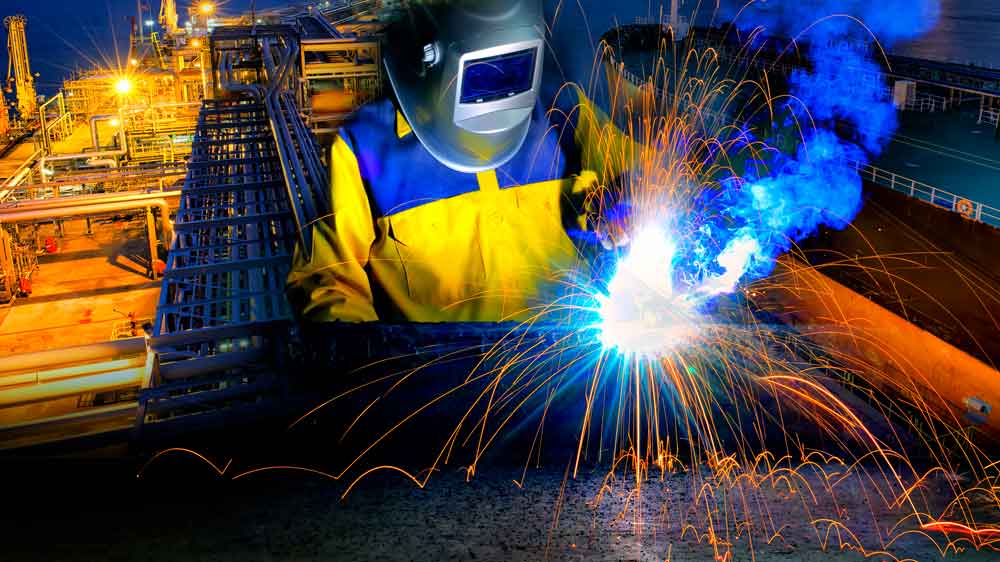
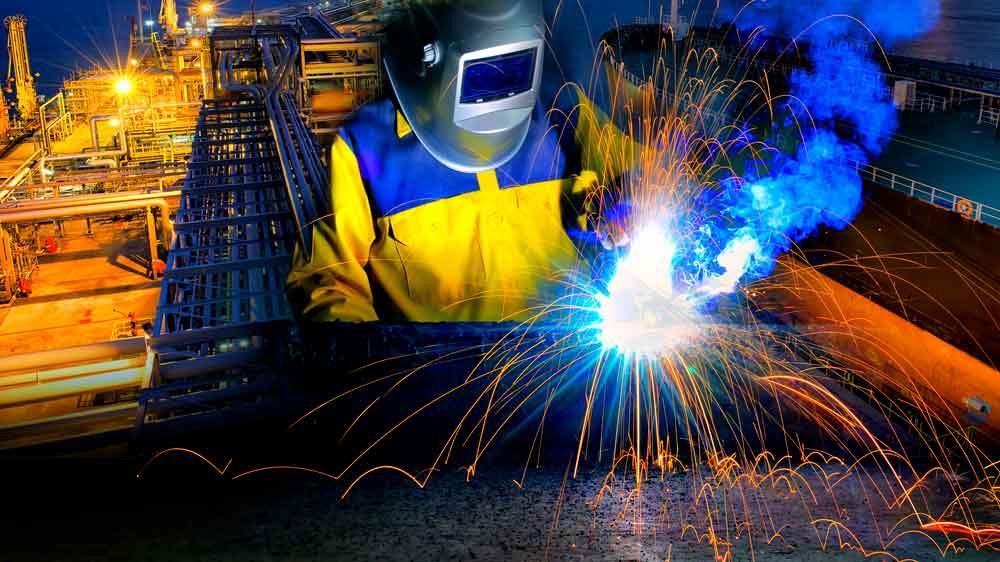
A virtuous cycle of welding talent development, solid project management, and a quality culture could mitigate the effects of the skilled labor shortage in metal fabrication and other manufacturing sectors. Getty Images
Everyone knows about the welder shortage. It’s become a given for anyone in manufacturing and construction. Amid all these challenges, Mike Lang sees opportunity.
Lang is a senior fellow and global director of corporate welding services at Fluor’s construction and fabrication division. For several years he’s traveled to various industry events, including last year’s FABTECH in Chicago, to talk about what he calls the “welding economy”—that is, the true costs behind welding and what a company can do to mitigate those overall costs, particularly for project-based welding in the industrial and construction markets.
Why delve into welding economics? As Lang put it, he wants to “bridge the gap” between technical people and financial people. Welding experts and engineers are entrenched in the technology, managers are entrenched in finances, and quite often the two don’t speak the same language. “We wanted to communicate welding in dollars and cents terms.”
The Human Element
A 2017 study from the Westney Consulting Group described how significantly construction costs are increasing while efficiency is doing the opposite. The construction business is spending more and getting less, especially when it comes to fabricated components like piping.
“While the total cost of construction has increased over the years due to many factors,” Lang said, “we have seen a decrease in installed linear footage [of pipe].”
The study analyzed installed linear footage of pipe between 1970 and 1990. During those years roughly 23,000 linear ft. of pipe were installed in the U.S. per week, and all that constituted about 25% of the total installed cost of construction. Fast-forward to 2017, and the industry was installing about 17,000 linear ft. a week—and yet that work represented between 40% and 60% of the total installed cost of construction.
“This basically means that when the Commodore 64 represented the best in computing excellence, the industry was more efficient than we are today in the age of iPads and smartphones,” Lang said. “I think that a big part of this is because the industry … is ignoring the human element.”
Lang referred to the technology—be it tracking software or other management tools—that, yes, can provide incredible value, but shouldn’t replace the human connection. “I recall a gentleman who was a project director. First thing every morning, he put on his hard hat and boots, walked the entire job site, and shook everyone’s hand. That same job, which received a major award from an industry publication, had less than a 4% reject rate over thousands of welds. The project was the perfect example of how to use technology, but not overindulge in it.”
Technology, he said, can’t compensate for lack of execution planning or an undertrained workforce—factors Lang believes are big reasons that the industry spends more and yet welds less than it did a generation ago.
The Cost of Undeveloped Skill
Imagine a welder leaving a job site for the day. He sees a scaffold being rebuilt around a large structure. Didn’t they just tear that down? he asks his supervisor. He discovers that while the welding was done and visually examined, the contractor hadn’t yet arrived to perform the postweld heat treating, and the nondestructive examination (NDE) had to be done as well. People just didn’t coordinate.
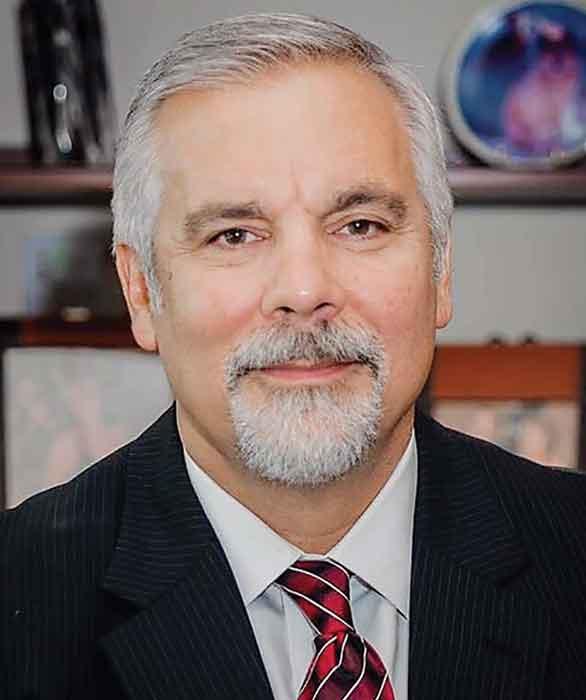
Mike Lang, senior fellow and global director of corporate welding services at Fluor’s construction and fabrication division, presented at FABTECH on the welding economy, communicating the value of talent and good project management in dollars-and-cents terms.
“Even the most basic scaffold can cost up to $10,000 to build,” Lang said.
Lang told this story not only to describe the importance of details and coordination among all the allied processes on a job site, but also to illustrate how such lack of coordination affects welding talent. A welder might leave for 50 cents more an hour, but if he does, it’s probably not about the money.
“Everyone of course has to be competitive with compensation,” Lang said. “But there’s a misconception that talented welders would leave in a heartbeat for just 50 cents more an hour. I think those days are over. When you talk to welders and others in the trades, you can tell that the culture has changed. Sure, people want to make a competitive wage, but they also want to enjoy where they work and the type of work they do.”
Pay matters, but so does the overall work environment, including safety, operational effectiveness, and training.
“Continuous craft training is so important,” Lang said, “and Fluor is committed to growing the industry’s pipeline of skilled craft resources. We have a large multicraft training facility in the Houston area where welders and other critically needed craft workers can upgrade their skills, completely tuition-free. It’s not an entry-level program, but it can take structural welders and make them pipe welders. And there’s no obligation to work for Fluor when training is complete. If Fluor has a job for you when you’re done, that’s of course ideal. If you go to one of our competitors, that’s fine too. We’re primarily focused on investing in the industry’s talent, but hopefully we’ll get you back eventually.”
Lang added that Fluor does it “because we believe it’s the right thing to do in the industry,” but he added that there’s a financial reason too—and it goes back to the cost of undeveloped skill.
Basic testing (not including tests required for nuclear work) might cost $5,000 for a typical welder. As Lang explained, “When you consider that the failure rates in the test booths can be around 50%, the holistic costs of welder testing are significant.
“This needs to be considered in attrition as well,” Lang continued. “Say you have 300 welders on your workforce and 30 leave about every month. This doesn’t mean you’re just testing 30 welders and bringing them on. This means you’re testing about 100 welders to get 30. You’re paying thousands for every person tested, whether they pass or fail. This gets pricey in a hurry.” He added that these are just the hard costs, and they pale in comparison to the costs of low productivity—hence the reason for Fluor’s continued investment in craft training.
A lack of skill among welders has serious costs, but less talked about, Lang said, are the costs behind supervisors and managers with a lack of welding experience. “With the welder skill shortage, the industry must make sure leadership is welding-savvy. Lack of knowledgeable leadership only aggravates what is already a challenging issue.”
So how does one find a good supervisor and manager? “A lot of this just goes back to fundamentals,” Lang said. “Read résumés.”
Managing a welding project requires relevant experience and, most important, knowledge of the processes front-line personnel perform every day. Lang conceded that some operations might hire less-than-qualified supervisors simply because they can’t find anyone with experience. But he countered that this highlights how critical craft training is in maintaining the talent pipeline.
“The cost of bad supervision is very hard to quantify,” Lang said. “It’s more of a commonsense issue.” He added, though, “Seasoned welding professionals know that when welding is not well-managed, a viral negative effect can spread throughout a project.”
Define the Scope, then Add Value
Lang often refers to his personal view about what he calls the 20-40% principle of project management: You need to plan and figure out exactly what you’re doing during the first 20% of the project timeline—the so-called “identification phase.” When you’re 40% through a project, you’ve reached a critical point or possibly a point of no return.
A successful welding project first needs a clearly defined scope. Next, planners need to look for scope-split opportunities, where portions of the scope can be siphoned off to companies that specialize in the required task. A large industrial contract might include furnace fabrication, for instance, so in this case, a large industrial contractor would split the scope and outsource the furnace-building.
This basic part of project management simply defines where the organization excels and where others could help. A clearly defined scope, a solid execution plan, strategic scope-splitting, and comprehensive coordination get the project rolling down a smooth path. Launching a project without a clearly defined scope sends costs spiraling out of control.
The same could be said for projects with contract documents that don’t clearly specify a code of construction. “There are still contracts out there today in the industry that essentially say, ‘I just want you to weld this.’ There’s no code of construction specified,” Lang said. “How can you execute if you do not know what you are executing to?”
Magnitude also plays an important role when defining scope. As Lang explained, “What type of welding are we doing? What’s the material? The thicknesses? What about NDE? It’s going to cost a lot more to X-ray a 3-in.-thick plate than it will a 0.5-in.-thick plate.”
The details really matter, and testing is a prime example. Yes, a project might have NDE that includes visual examination, perhaps some radiography or ultrasonic testing. But what about positive material identification (PMI) tests or hardness tests? As Lang explained, “People might beat their chests and say they’ve done a great job and have no backlog with NDE, and that’s great, but what about these 300 PMIs that aren’t finished? People need to look at NDE more holistically. Something as trivial as a dye-penetrant exam could hold up an entire piping system from getting hydro-tested.”
Of course, defining the scope is just the beginning. “As welding professionals, we can bring more value to the scope,” Lang said. “We could be dull, boring welding people and do everything with TIG and stick, which has been around forever. Or we could try to optimize our processes. We always need to consider the risk, but we need to ask how we can do a better job at welding. It could be a subtle change from SMAW to FCAW, which can pay huge dividends.
“How about alternative inspection methods? Instead of having invasive NDE, have we considered close-proximity radiography or phased-array ultrasonic testing? In these cases, we don’t have to have huge amounts of real estate and displace work crews as much, and we can still get our NDE done.
“Value engineering is about taking a deep dive into your scope and your welding processes, and uncovering ways to optimize them,” Lang continued. “It also plays into how you speak to senior managers. Senior managers aren’t going to be impressed when you talk about a flux-cored weld. It isn’t very inspiring. But if you talk about how FCAW will save them 40%, now you’ve got their attention.”
Other details can get their attention too, even the “seemingly little things,” as Lang called them. Consider gas management. A project manager might take weld shielding gas for granted, assuming he’ll buy the bottles he needs and pay the bill. But there’s so much that goes into shielding gas for welding. “There are ways you can manage gas to make the job site a safer place, by reducing traffic and the number of required bottle changeouts, reduced bottle rents, and more.”
With the scope and its magnitude defined, codes identified, and procedures set, the project then must have qualified welders—and not just those who passed the required tests per the applicable codes, either.
“Too many times in this industry, hiring managers bring people on who’ve passed ASME Section IX or an AWS test, then get them to the field and find they have high reject rates,” Lang said. Sure, the welders were qualified per the codes, but they often didn’t have experience that the specific project required. Passing the code-required test doesn’t always mean a welder can produce welds that pass muster for the job at hand.“We all should be looking to be not just code-compliant, but code-compliant to the scope of the project,” Lang said. “If the project involves welding Schedule 10 stainless steel pipe, it wouldn’t be very smart of us to test on 6-in. Schedule 80 carbon steel.”
Once welders reach the job site, they need appropriate levels of support, both functional and technical. The functional support comes from those who oversee multiple projects and, on a broad level, ensure each is set up for success. Lang and his team of welding experts play this role at Fluor.
The technical support can come from welding specialists or engineers. They can work remotely for simple jobs but then be on-site for complex work. The scope, Lang said, should define the kind of technical support needed from the get-go. And, of course, the better the project planning that occurs before arriving at the job site (or the “premobilization activity”), the better idea planners should have about what kind of technical support the welders need.
Quality Culture
“I’ve crunched the numbers regarding rework for the past 10 years, and I keep coming up with a similar number,” Lang said. “The cost of rework for a weld is typically between 260% and 300% greater than what was initially bid.”
One might talk about rework and say, “That’s why we have quality control,” but as Lang explained, this shows just how misunderstood the quality role really is. After all, you can’t “inspect” quality into an existing weld and magically eliminate the rework.
“Quality often really doesn’t interact directly with construction at the point of execution,” Lang said. “They base everything off lagging indicators, like a reject report. But at that point, the damage is already done. The best way that the industry can ensure quality is to have good technical guidance while executing the project. Quality is incredibly important, but its main purpose is to issue verification. Quality sees the work has been done, it’s been done to code and to spec, and they approve it. But by that point, the heavy lifting has been done on the technical side of it, at the point of execution.”
Put another way, quality happens at the source, but QC personnel act as the insurance. Just as one wouldn’t go through life without any kind of insurance product, a contractor wouldn’t want to pursue any project without quality personnel. But like insurance, quality is by nature reactive and there to handle the exceptions.
All these elements—talent development, detail-oriented project management, and a quality culture—work together as a virtuous cycle. When welders enjoy their work, they climb the ladder, learn more, then spread the word. This fills the talent pipeline from the front line to the executive suite. That talent continues to perfect their project management skills, which in turn feeds a quality culture.
In this environment, a welder wouldn’t see daily firefighting, like scaffolding being rebuilt and money being wasted from a lack of communication and coordination. The virtuous cycle would not only help attract more people to an industry in dire need of skilled workers, but also lower costs and increase productivity. As Lang sees it, it’s a virtuous cycle worth replicating.
This article was based in part on a presentation given at FABTECH, Nov. 11-14, Chicago. The next FABTECH will take place in Las Vegas, Nov. 18-20, 2020.










