








Government purchases are a trillion-dollar opportunity for U.S. businesses
Governments buy a wide variety of goods and services from the private sector, from bridges and road construction to power plants and digital infrastructure to office and hospital supplies. In 2018, global government procurement amounted to $11 trillion or 12 percent of global GDP. The U.S. government procurement market alone was $837 billion in 2010.
While most countries have regulations to ensure government procurement is handled in a fair and transparent manner, procurement processes are susceptible to a high incidence of corruption, particularly in the form of undue influence on the bidding outcomes of public contracts.
Enter global procurement trade disciplines
The first agreement on government procurement – called the “Tokyo Round Code on Government Procurement” – was negotiated in 1979 by a small group of countries who wanted to develop a set of harmonized rules governing public procurement that would set a high standard for transparency and openness. That agreement was subsequently renegotiated as the Agreement on Government Procurement (GPA) in 1994 as part of the creation of the World Trade Organization (WTO), and members agreed to further expand the GPA in 2012. As of May of last year, when Australia became the most recent member to join the GPA, 48 countries were party to the Agreement, with 34 countries having observer status (including 10 of those in active negotiations to join the agreement). The GPA now covers $1.7 trillion in government procurement activities from its member countries.
The GPA includes general disciplines to ensure fair, open and transparent procurement processes for products that exceed a dollar threshold specified by the agreement. Additionally, each country has committed to a “schedule” which specifies which of its entities and purchases are subject to the agreement. Countries typically exclude defense and national security purchases from the agreement as well as set-asides for small, minority-owned and veteran-owned businesses. Disputes under the GPA can be raised through the WTO dispute settlement system.
Some WTO members but not all
The GPA is a so-called “plurilateral” agreement, meaning only a subgroup of WTO member countries are party to it, and therefore the WTO’s most-favored-nation principle does not apply. Rather, the countries that are parties to the agreement grant each other access to their government procurement markets under the terms of the GPA, but that access is not offered to WTO member countries that are not GPA members.
The United States includes similar procurement language from the GPA in its bilateral free trade agreements, like the recently negotiated U.S.-Mexico-Canada Agreement. All told, the United States has procurement agreements with 58 countries, including the GPA countries and countries with which it has separate free trade agreements.
Even for countries that are not GPA members, the rules in the agreement have become the accepted norms for government procurement globally, with most countries aspiring to this level of fairness and transparency, even if they don’t implement the GPA fully.
The relationship between GPA and “Buy American” requirements
Prior to the GPA, Congress enacted a series of domestic content statutes to ensure that public procurement projects funded by U.S. tax dollars benefit U.S. firms and workers. The Buy American Act of 1933 requires federal government procurement of U.S.-origin articles, supplies and material or manufactured products to be produced “substantially all” from domestic inputs. While equipment can have a minimal amount of foreign content to qualify, the allowed amount is extremely low. The act generally also allows a price preference for domestic end products and construction materials.
Buy American requirements may be waived under three circumstances: (1) if a decision is made that it is in the public interest to do so; (2) if the cost of U.S.-made products is unreasonable; or (3) if the products are not available in sufficient quality or quantity from U.S. producers. Since the GPA was negotiated, a fourth circumstance was introduced: Buy American can be waived with respect to procurement bids originating from countries that have provided reciprocal access to their own domestic procurement markets.
A push for expansion?
The Trump administration is reportedly reviewing the benefits of the WTO’s Government Procurement Agreement. As reported to the WTO, the United States offered more procurement opportunities to foreign firms in 2010 (the last year for which data are available) than the next five largest GPA parties combined, which include the European Union’s 27 members, Japan, South Korea, Norway and Canada. The United States may open as much as 80 percent of federal contracts to foreign suppliers, whereas the European Union, Japan and Korea may open somewhere between 13 and 30 percent of central government contracts to foreign suppliers.
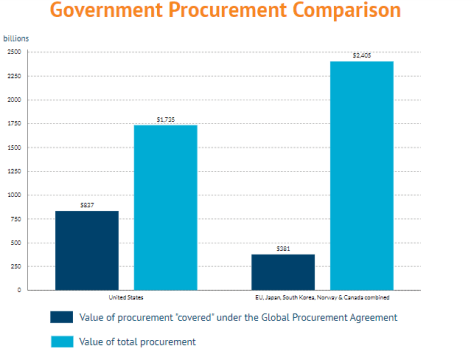

However, a U.S. government review that offered those calculations also points out that lags and inconsistencies in foreign government data reporting, data gaps, and a lack of methodology for reporting on sub-federal procurement, make it difficult to determine GPA benefits with accuracy.
And while foreign suppliers are able to compete for certain U.S. government contracts, the GPA and bilateral free trade agreements enable U.S. companies to compete in the nearly $2 trillion dollar government procurement market in the other signatory countries, an opportunity that would be significantly limited by withdrawal from the GPA. In many cases, such as sales of medical devices and medicines to state-run hospitals, software for government agency use, sales of power equipment, and the construction of hard infrastructure, the GPA offers the primary form of access by U.S. companies to foreign markets.
Worse than losing reciprocity
Ironically, American withdrawal from GPA would also complicate the ability of U.S. companies to sell their products to the U.S. government. Very few U.S. products today are 100 percent American. Supply chains of U.S. companies are increasingly global, meaning that even products manufactured within the United States are likely to have non-U.S. components or materials. Today, U.S. companies selling equipment to the U.S. government containing non-U.S. content from a GPA signatory country are not subject to the Buy American Act. However, if the United States were to withdraw from GPA, Buy American regulations would apply, potentially disqualifying U.S. companies from selling products that contain foreign content to the U.S. government.
Participation in the GPA not only maintains U.S. companies’ ability to compete for foreign contracts, it also gives the U.S. government leverage to negotiate greater market access under better terms by seeking to expand coverage. This may be particularly important as economies grow around the world and begin to spend higher percentages of their budgets on government procurement. Also, the race is on to set technology standards around the world such as 5G. If U.S. companies cannot bid to secure government contracts, they may find themselves on the outside of key growth markets, ceding them to competitors from Europe, Canada, Japan and China.
Another way to improve the WTO
While the global trade rules in the GPA seem like an arcane subject, the agreement has had a profound impact on government procurement practices globally. It opened an enormous government procurement market for the signatory countries – including the United States – and created a set of open and transparent regulations that even non-signatories countries work toward. Working within the agreement to improve and expand coverage would benefit U.S. suppliers not just to compete overseas, but to compete for contracts here at home.
__________________________________________________________________

Orit Frenkel is the Executive Director of the American Leadership Initiative, which is advancing a new smart power paradigm of American global leadership. She is also the President of Frenkel Strategies, a consulting firm specializing in trade and Asia. Previously she spent 26 years as an executive for GE and before that as a trade negotiator at the Office of the U.S. Trade Representative.
This article originally appeared on TradeVistas.org. Republished with permission.










