






Staff photo / Allie Vugrincic
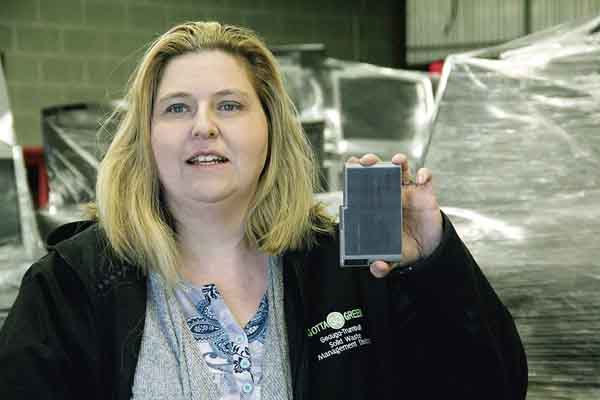
Jennifer Jones, executive director of the Geauga Trumbull Solid Waste Management District, talks about the lithium battery recycling process while holding a lithium-ion battery from a laptop.
WARREN — Right now, it costs money to recycle EV batteries.
Perfecting that process is a matter of national security, said Jeff Spangenberger, director of the ReCell Center, the U.S. Department of Energy’s $15 million lithium-ion battery recycling center at Argonne National Laboratory in Illinois.
The center is focused on perfecting the methods for recycling the components of the batteries so it will be more profitable to run recycling centers in the U.S., he said.
ReCell is “going after the technology that isn’t being researched because it is challenging and there is a lot of risk involved. We are trying to find the tech to make it economically desirable,” Spangenberger said. “ReCell is trying to reduce cost liabilities for recyclers.
“We relied, not so much anymore, on others for oil and now we rely on other countries for batteries or battery materials,” Spangenberger said. “We don’t want that. Recycling allows us to to keep those materials in the U.S. and then make new batteries with the new materials. That is a benefit to national security.”
And when a method is perfected to make money instead of losing money on the recycling of the batteries, then the new batteries will sell for less, lowering the total cost for new EVs, Spangenberger said.
It takes a lot of energy to extract virgin materials to make batteries out of previously unused lithium and cobalt, so perfecting the recycling process will also lower the overall environmental impact of producing the electric vehicle. That’s because the manufacturing of the vehicle is the most carbon expensive part of the vehicle’s life, as long as it is being charged on a grid that doesn’t use coal to generate energy.
CARBON FOOTPRINTS
A 2018 report prepared by the International Council on Clean Transportation, a nonprofit that conducts research for environmental regulators, compared the life cycle emissions of conventional European cars to European electric vehicles.
“Electric vehicle manufacturing requires more energy and produces more emissions than manufacturing a conventional car because of the electric vehicles’ batteries. Lithium-ion battery production requires extracting and refining rare earth metals, and is energy intensive because of the high heat and sterile conditions involved. Most lithium-ion batteries in electric vehicles in Europe in 2016 were produced in Japan and South Korea, where approximately 25 percent to 40 percent of electricity generation is from coal,” the report states.
Manufacturing an electric vehicle accounts for about half of the vehicle’s lifetime emissions and about half of those manufacturing emissions are generated by the battery production. About half of the battery manufacturing emissions are from material production, according to the report.
“Materials production is responsible for approximately half of the greenhouse gas emissions from battery production, and recycled materials typically have a lower carbon footprint than the same materials from virgin sources,” the report states.
So if more of the manufacturing materials are made with recycled materials, the impact on the environment to make electric vehicles would likely decrease.
“Overall, electric vehicles typically have much lower life-cycle greenhouse gas emissions than a typical car in Europe, even when assuming relatively high battery manufacturing emissions. An average electric vehicle in Europe produces 50 percent less life-cycle greenhouse gases,” the report states. The benefit varies from 28 percent to 72 percent, depending on what fuels the energy grid where the vehicle is being charged.
The number could also vary because of what fuels the energy grid where the batteries are produced.
Grids that rely more on renewable energy sources than on carbon-based sources can help keep the vehicle’s carbon footprint down, the report states.
Tesla’s battery factory in Nevada is using 100 percent renewable energy to produce its batteries — most of it produced on site, the report states.
“Grid decarbonization will have a much larger impact on the use phase of electric vehicles, as the carbon intensity of electricity is directly proportional to the emissions per kilometer driven. For this reason, a cleaner grid — both where electric vehicles are produced and charged — will be the largest single driver of electric vehicle life-cycle emissions reduction in the future,” the report states.
WHAT TO DO WITH BATTERIES?
So what does a person do if they find themselves with an EV lithium-ion battery on their hands in the Mahoning Valley?
First, get it out of your hands.
The batteries have a much higher voltage than the car batteries found in an old Chevy.
It takes specialized training to remove, install or otherwise handle the batteries, said Amy Shotts, production manager at Youngstown Auto Wrecking.
“There is a special procedure to remove it,” Shotts said. “You don’t want to touch that in the wrong way. You can get a shock from a regular car battery, but with how high the voltage is for the electric vehicles … you don’t want to be shocked by that.”
The company resells the EV batteries that end up there, usually after an accident that totals the vehicle but leaves behind a battery that is still functional. The ones in bad shape are sold to a vendor that buys up their other junk batteries for recycling, Shotts said.
Jennifer Jones, executive director of the Geauga Trumbull Solid Waste Management District, said the district has never received a lithium-ion car battery, but if someone brought one in, the district would take it.
“Our vendor, Penn Ohio, takes all of our batteries and sorts them and sends them out themselves. We typically get the smaller ones in computers and phones,” Jones said.
Jones said it is important to work out the kinks in the recycling supply chain now.
“Electric vehicles look toward the future. They are a way to avoid gasoline consumption. But the price needs to be reasonable. The cost to replace a battery is too high for most people. But once we can recycle them and make new batteries at a better price, then we will see more people in our area buying them. We need to get ahead of the curve and figure out how to do it now. We need to be proactive about developing the technologies and encouraging the development of facilities,” Jones said.
If someone is interested in opening up a facility in the area, Jones said she may be able to help with grants and other assistance.
CHEMISTRY
The way the metals in lithium ion batteries are recycled now is by melting the battery down, or by placing the batteries in a tank of acid to dissolve the metals and then allow them to precipitate out into their individual components, Spangenberger said.
It reduces down to a pure metal salt such as cobalt sulfate and is infinitely recyclable, unlike other materials like plastic.
But retrieving the metals from a battery’s cathodes means the cathodes have to be remade.
“Fifty percent of the cost to make a cathode comes from the raw materials and the other 50 percent of the cost comes from the process of making it into the battery. If you recycle the material back down to the raw material, you have to put 50 percent of the cost back into it to make a cathode,” Spangenberger said.
So ReCell is working on cathode recycling, ways to regenerate the cathode without having to remove the metals so it can retain its value, Spangenberger said.
ReCell is also looking at efficient ways to remove other recyclable material, studying battery designs to develop ways to make it easier to recycle newer batteries and performing environmental supply chain analysis and modeling to identify ways to further reduce the strain on the environment and resources, he said.










