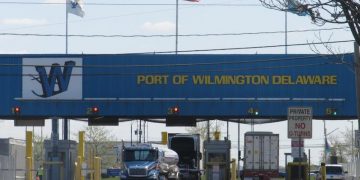








It’s been just over a year since the State of Delaware reached a 50-year lease agreement, turning over operation of the Port of Wilmington to GT USA, the American arm of global port operator Gulftainer.
The deal was expected to bring additional revenue to the state while creating thousands of direct and indirect jobs as Gulftainer invests up to $700 million dollars to upgrade and expand the port.
Contributor Jon Hurdle looks at where port expansion plans are 14 months into the agreement, and the current outlook for the Port’s future.
There’s one stoplight on the quarter-mile road between the Port of Wilmington and I-495, and it represents the only potential traffic holdup between the port and America’s interstate highway system.
No other East Coast port can claim such quick access for trucks carrying containers to U.S. markets, and that, said the Port of Wilmington’s chief executive officer, Eric Casey, leaves it well positioned to grow the volume of goods shipped from around the world as the port begins a $700 million expansion.
Fourteen months after formally taking over operation of the port from the state-run Diamond State Port Corporation, Casey’s employer, GT USA, is pressing ahead with plans to increase efficiency by investing some $100 million in new cranes, tractors, forklifts, warehouses and roads to speed the movement of containers.
Significantly, it is also in the early stages of developing a new port at nearby Edgemoor, a former DuPont site that will have the capacity to process cargo from a new generation of mega-ships starting in 2023.
The two projects together represent a major upgrade for the port, a significant economic development opportunity for Delaware, and a new source of revenue for a state that has lacked the resources to invest as heavily in the port as GT USA, the American unit of Gulftainer. The company is a global port operator that manages about 40 percent of the container terminals in the Middle East, and has businesses in seven countries.
Gov. John Carney, who finalized the concession agreement between the state and GT in September 2018, said the project would “significantly expand” jobs at the port over a decade. The concession allows GT to develop the port as it sees fit over 50 years, and requires it to make royalty payments to the state over the next decade.
GT has so far made quarterly payments totaling $7.1 million to Diamond State Port Corp., which owns the port, based on the amount of cargo that moves through the port, said a spokesman for Secretary of State Jeff Bullock. The company and Diamond State project that royalties could rise to $13 million a year over the next 10 years, a figure that suggests the latest payments are on track to meet expectations.
The new port is expected to grow faster than its East Coast competitors, Casey said, because shipping companies will know that they can get their goods to U.S. customers in the northeast corridor and the Midwest faster than via other ports due to Wilmington’s close proximity to the Atlantic Ocean, the highway system, and the national freight-rail network.
And the lone stoplight on Terminal Avenue shows that cargo-laden trucks leaving the Port of Wilmington are less subject to delays from traffic congestion than at competing ports in other East Coast cities, he said.
“Wilmington and Edgemoor have an advantage over our colleagues on the East Coast because there’s no congestion,” Casey said in an interview at the port. “We’re less than a quarter mile off the interstate. Which means less than a quarter mile from leaving our port gate, you have no traffic lights between here and Canada, Miami and Chicago.”
That means containers on trucks can reach Chicago in 12 hours or 20 hours by rail, Casey said.
By contrast, trucks from competing ports have slower trips through urban areas before hitting the interstate network, and that will reduce their competitiveness when the expanded Port of Wilmington is up and running, he said.
“Shippers can use other East Coast ports but they aren’t going to be as fast to that market as we are,” he said.
Dennis Rochford, president of the Maritime Exchange for the Delaware River and Bay, a trade association that represents ports including Wilmington, declined to say whether the remade Port of Wilmington would out-perform its local competitors, but acknowledged that Wilmington is attractive to shipping companies because it’s closer to the ocean than ports like Philadelphia or Camden, and so can save shippers time and money because they don’t have to sail up the river. (Ed. note – Dennis Rochford is a member of Delaware Public Media’s Board of Directors)
Still, Rochford argued that Wilmington will not be the only Delaware River port to benefit from the Army Corps of Engineers’ recent dredging of the main river channel to 45 feet to accommodate bigger ships from around the world, including via the Panama Canal.
“Deepening the Delaware River channel to 45 feet is a plus for all the ports on the river,” he said. “That will be a catalyst for port investment and port infrastructure” such as new cranes at the Packer Avenue terminal in Philadelphia.
Although Casey aims to build up the volume of trade going through Wilmington, he’s not looking to poach cargo from nearby ports. Rather, he aims to develop Wilmington as a conduit for new imports that currently reach American markets in limited quantities or not at all.
Different kinds of produce from western and southern Africa, for example, would be candidates for the increased volume that Casey wants to see coming through Wilmington. He said he has had visits from delegations from several African countries looking for ways of using the port to develop U.S. markets for their goods.
Casey plans for Wilmington to keep its dominance in shipments of produce, especially bananas, while building volume in “dry goods” such as electronics, clothes and shoes. Meanwhile, the port is building its capacity to handle bulk goods such as crude oil or coal, and large “breakbulk” cargo such as turbines or railcars that are not carried in containers.
The combination will create a multi-use port that will be “somewhat recession resistant”, Casey said. “We’re barely on the floor of where we can get to.”
For now, GT is seeking federal, state and local permits for the Edgemoor port, which is expected to cost some $600 million to develop. The company aims to complete it by 2025, when it would annually process 1.2 million TEUs – twenty-foot shipping containers, the standard unit of container volume – or about three times as much as the current port handles.
When they are both fully developed, the combined capacity of the new Port of Wilmington will be 1.8 million TEUs – imports and exports together — or about 6.4 times the volume handled when GT took over the port in 2018.
But even if it achieves a higher growth rate than its competitors, Wilmington is likely to continue to handle a smaller volume of cargo than some of its East Coast competitors such as New York-New Jersey which handled 7.18 million TEUs in 2018, and the Port of Virginia that expects to handle almost 3 million TEUs in the current fiscal year.
The Edgemoor site will be dredged to 45 feet to accommodate the new generation of mega-ships, and is being designed to simultaneously handle two ships, each carrying 14,500 TEUs, about three times the capacity of those that currently call at Wilmington.
Plans also call for a mile of new railroad to connect the Edgemoor site with existing freight lines, and talks have been taking place with CSX and Norfolk Southern to operate container trains there, Casey said.
Planning for the new port also accounts for sea-level rise, which is expected to swamp coastal infrastructure like ports in coming decades, according to state forecasts. Casey said the new terminal’s berths are being designed to be higher than the minimum to allow for “variability” in sea level.
If the whole port attracts new trade in line with GT’s plans, it will also produce warehouses, trucking companies, railroads, restaurants, and homes, Casey predicted. But he refused to say how many jobs it could create because that will depend on how much new cargo is attracted, and when.
“Are we going to be an economic development engine that’s going to take a significant turn in the next five years? No question,” he said. “But to give you a specific number of jobs? I can’t because it depends on what type of cargoes come and when they come.”
Kurt Foreman, president of the Delaware Prosperity Partnership, a public-private entity that succeeded the Delaware Economic Development Office at the start of the Carney administration, predicted that the expanded Port of Wilmington will attract more trade because it’s closer to the ocean than some nearby ports, and has a strong operator that is investing heavily.
And he predicted that the single stoplight between the port and the interstate supports GT’s argument that Wilmington can get its goods to market faster than other ports. “They like to say that it’s one stoplight from a significant part of the population on the East Coast,” Foreman said.
But even one stoplight is not good enough for Casey, who thinks trucks to and from the port will flow better with a traffic circle instead.
“We literally have one traffic light, and I’m trying to change it to a traffic circle so we have none,” he said.










