





The many industries that make up the world of freight have undergone tremendous change over the past several decades. Each Friday FreightWaves will explore the archives of American Shipper’s nearly 70-year-old collection of shipping and maritime publications to showcase interesting freight stories of long ago.
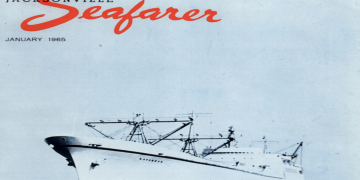
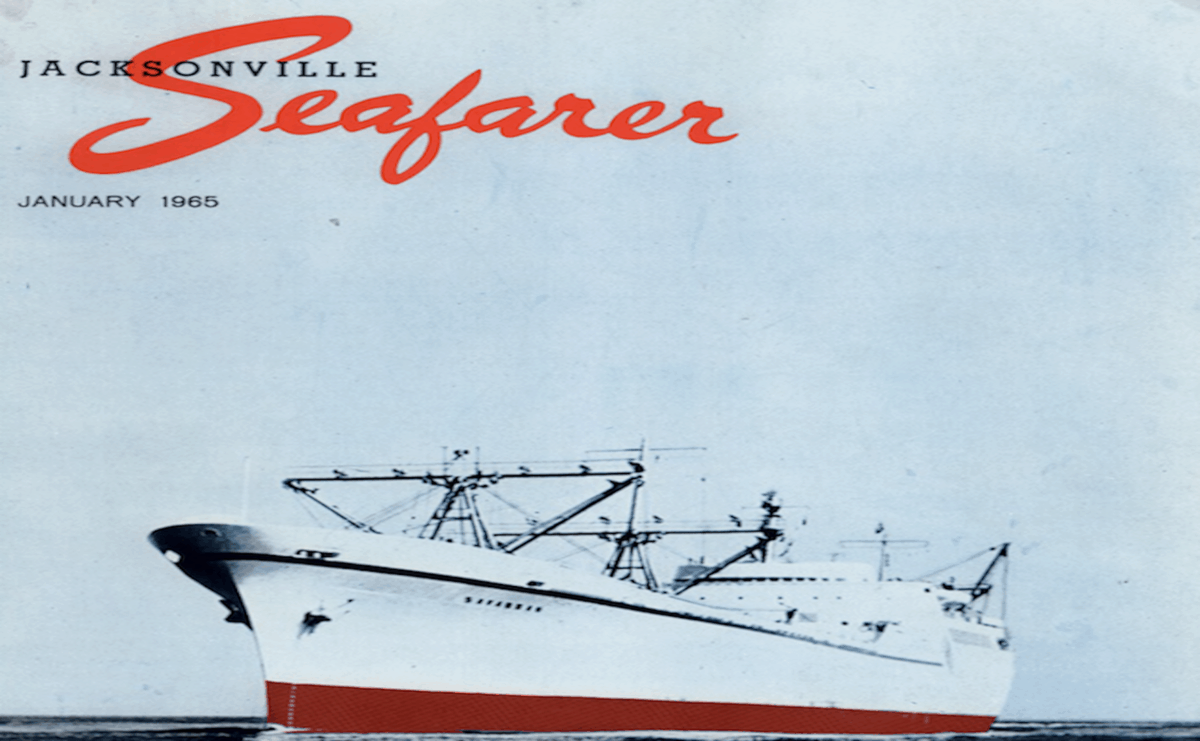
The following are summarized excerpts from the January 1965 edition of the Jacksonville Seafarer magazine. David A. Howard, the founder of Howard Publications Inc., launched the publication in Jacksonville, Florida. Howard later established the statewide maritime and trade publication Florida Journal of Commerce in 1969. He and his son, Hayes H. Howard, went on to expand it nationally in 1974, rebranding it as American Shipper. FreightWaves acquired American Shipper in July 2019.
Click here to view the entire addition of the Jacksonville Seafarer – January 1965.
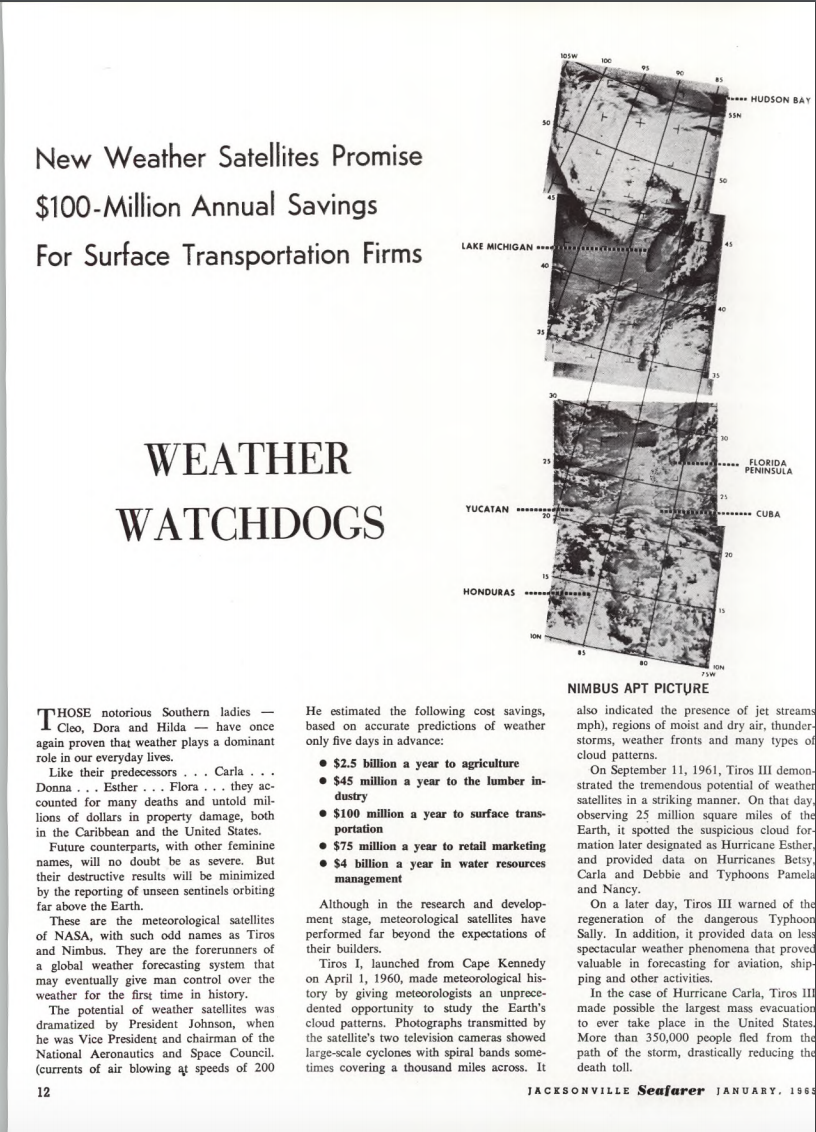
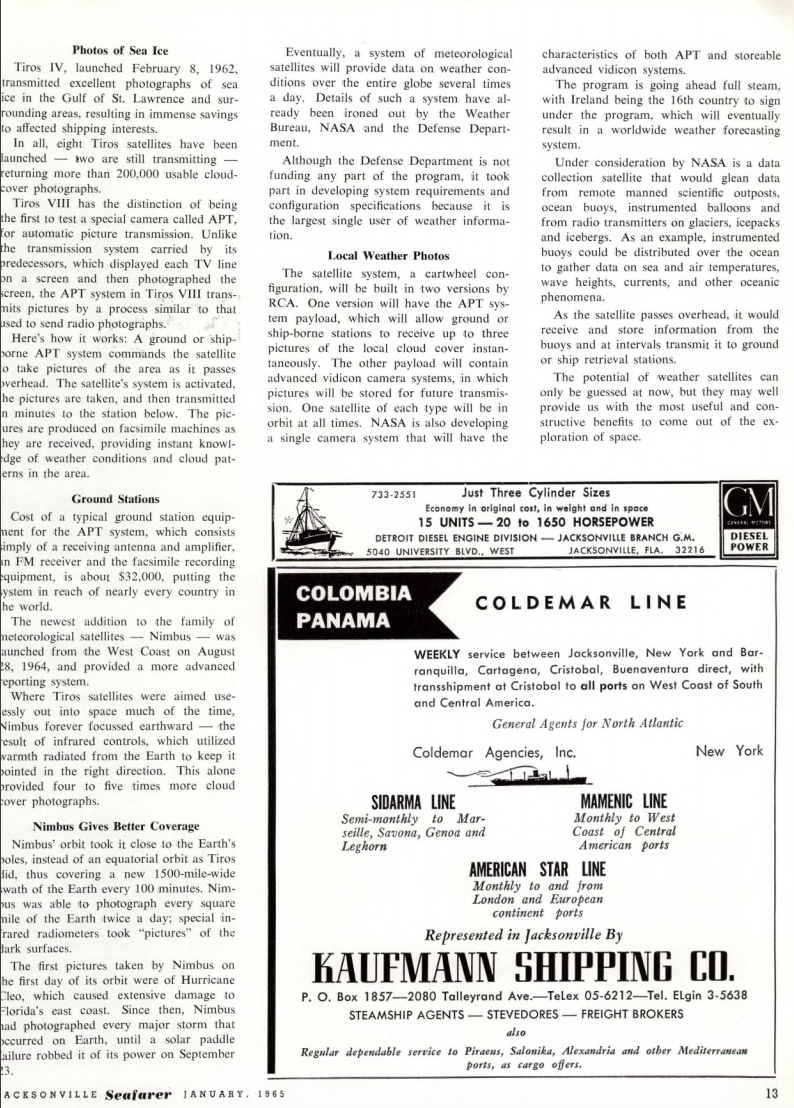
Weather Watchdogs — The launch of meteorological satellites
The catastrophic aftermath hurricanes leave in their wake may soon be minimized as NASA continues to invest in its global weather forecasting system of meteorological satellites. Although in the research and development stage, the satellites have far exceeded expectations.
President Lyndon Johnson was an early advocate for pursuing weather satellites when he was vice president and chairman of the National Aeronautics and Space Council.
Johnson estimated the following cost savings, based on the accuracy of weather predictions five days in advance:
- $2.5 billion a year to agriculture.
- $45 million a year to the lumber industry.
- $100 million a year to surface transportation.
- $75 million a year to retail marketing.
- $4 billion a year in water resources management.
The first of these satellites, Tiros I, launched from Cape Kennedy on April 1, 1960. The launch made scientific history as it provided meteorologists an unprecedented opportunity to study the cloud patterns around the globe. The satellite provided images of large-scale cyclones with spiral bands at some points covering a thousand miles across.
In September 1961, NASA celebrated the launch of Tiros III, which was capable of observing 25 million square miles of the Earth. On its first day in orbit, the satellite spotted a cloud formation later designated as Hurricane Esther. Tiros III also made possible the largest mass evacuation to ever take place in the United States as more than 350,000 people fled the imminent threat of Hurricane Carla, drastically reducing the death toll. It later went on to provide data on many hurricanes and typhoons and has widely improved weather forecasting in aviation and shipping.
Tiros IV launched in February 1962 and immediately provided meteorologists incredible photographs of sea ice in the Gulf of Lawrence and surrounding areas. The satellite’s detection of ice attributed immense savings for shippers navigating the waters.
In all, NASA has launched eight Tiros satellites — two are still transmitting — returning more than 200,000 usable cloud cover photos.
Meteorologists predict a global system of satellites providing weather data several times a day will become an eventual reality. Plans for such a system are already in the works by the Weather Bureau, NASA and the Defense Department.
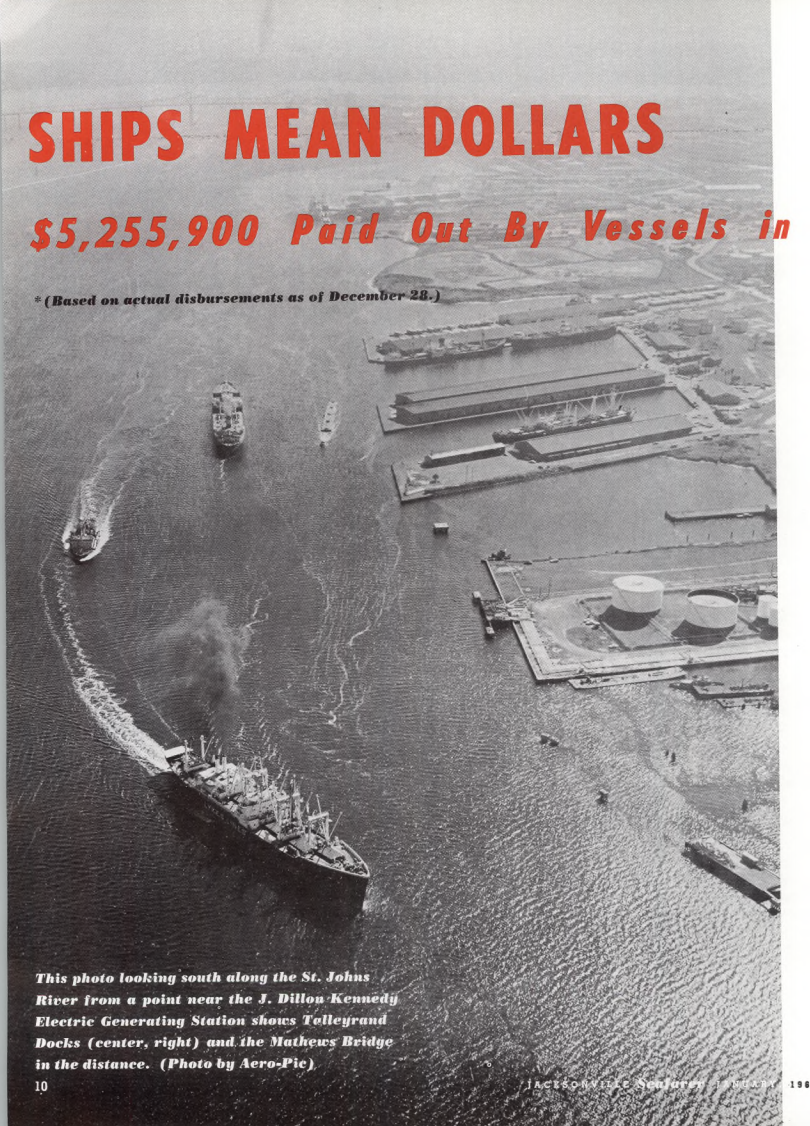
Port of Jacksonville sees growth in facilities and revenue
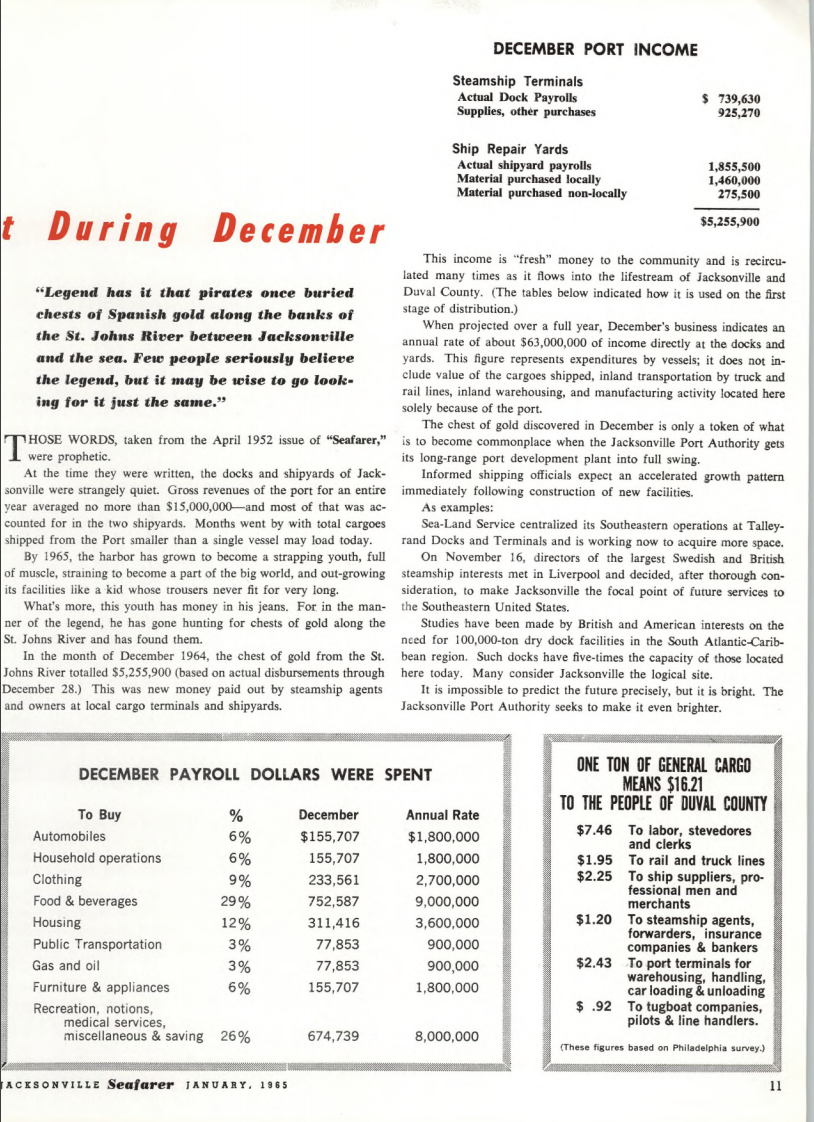
The Port of Jacksonville saw December 1964 revenues totaling $5,255,900 (approximately $43.3 million in 2019). This new money paid out by steamship agents and owners at local cargo terminals and shipyards provides “fresh” money for the city of Jacksonville and the rest of Duval County.
The port has seen tremendous growth over the years considering the fact that in 1952, Jacksonville brought in merely $15,000,000 in annual revenue (approximately $144.7 million in 2019). In that year, for instance, many months went by with total cargoes shipped from the port smaller than a single vessel may load today.
December’s report indicates an annual rate of about $63 million (approximately $519.6 million in 2019) of income directly at the docks and yards. However, this figure only represents expenditures by vessel. Not included is the value of the cargoes shipped, inland transportation by truck and rail lines, inland warehousing and manufacturing activity located here solely because of the port.
December’s high revenue stream is only a token of what will become commonplace. The Jacksonville Port Authority looks to begin work on its long-range port development plan. After completion of the new facilities, informed shipping officials expect to see accelerated growth at the port. Sea-Land Service has centralized its Southeastern operations in Jacksonville and is currently looking to acquire more space. Directors of the largest Swedish and British steamship interests have also decided to make Jacksonville the focal point of future services to the Southeastern United States.
Studies have been made by British and American interests on the need for 100,000-ton dry dock facilities in the South Atlantic-Carribean region. A dock of this size has five times the capacity of those located here today. Many consider Jacksonville the logical site.
World’s largest coal-phosphate barge in service
The Louise Kirkpatrick, the longest dry cargo barge ever built, completed its maiden voyage to Tampa Bay on Nov. 12 alongside the 3,200-horsepower tug Katrine Clewis.
Hauling approximately 17,000 tons of coal, the journey of these shipping vessels marks the start of Tampa Electric’s widely expanded coal-procurement procedures. The company’s improved coal shipping efforts include plans to purchase another barge and tug in early 1965 along with a river towboat. A river-to-ocean-shipping transfer station is also under construction near New Orleans.
Operating regularly between Tampa and New Orleans, the Louise Kirkpatrick looks to deliver economic savings as its closed-circuit operation lowers the cost of coal for Tampa Electric. Hauling phosphate rock on its return trips to New Orleans, the ship also provides lower costs for producers in the mid-continent area.
Florida Power Corporation is building a coal-fired generating plant at Crystal River on the Gulf Coast. Coal from Kentucky will be barged to New Orleans and then shipped across the Gulf to the plant. After discharge at Crystal River, the barge will proceed to Tampa to load phosphate similar to the Tampa Electric Company operation.