






The many industries that make up the world of freight have undergone tremendous change over the past several decades. Each Friday, FreightWaves explores the archives of American Shipper’s nearly 70-year-old collection of shipping and maritime publications to showcase interesting freight stories of long ago.
The following are summarized excerpts from the January 1966 edition of the Florida Journal of Commerce. David A. Howard, the founder of Howard Publications Inc., launched the Florida-based maritime and trade publication in 1959 following the success of the Jacksonville Seafarer Magazine in 1952. He and his son, Hayes H. Howard, went on to expand the Florida Journal of Commerce nationally in 1974, rebranding it as American Shipper. FreightWaves acquired American Shipper in July 2019.
Click here to view the entire edition of the Florida Journal of Commerce — January 1966.
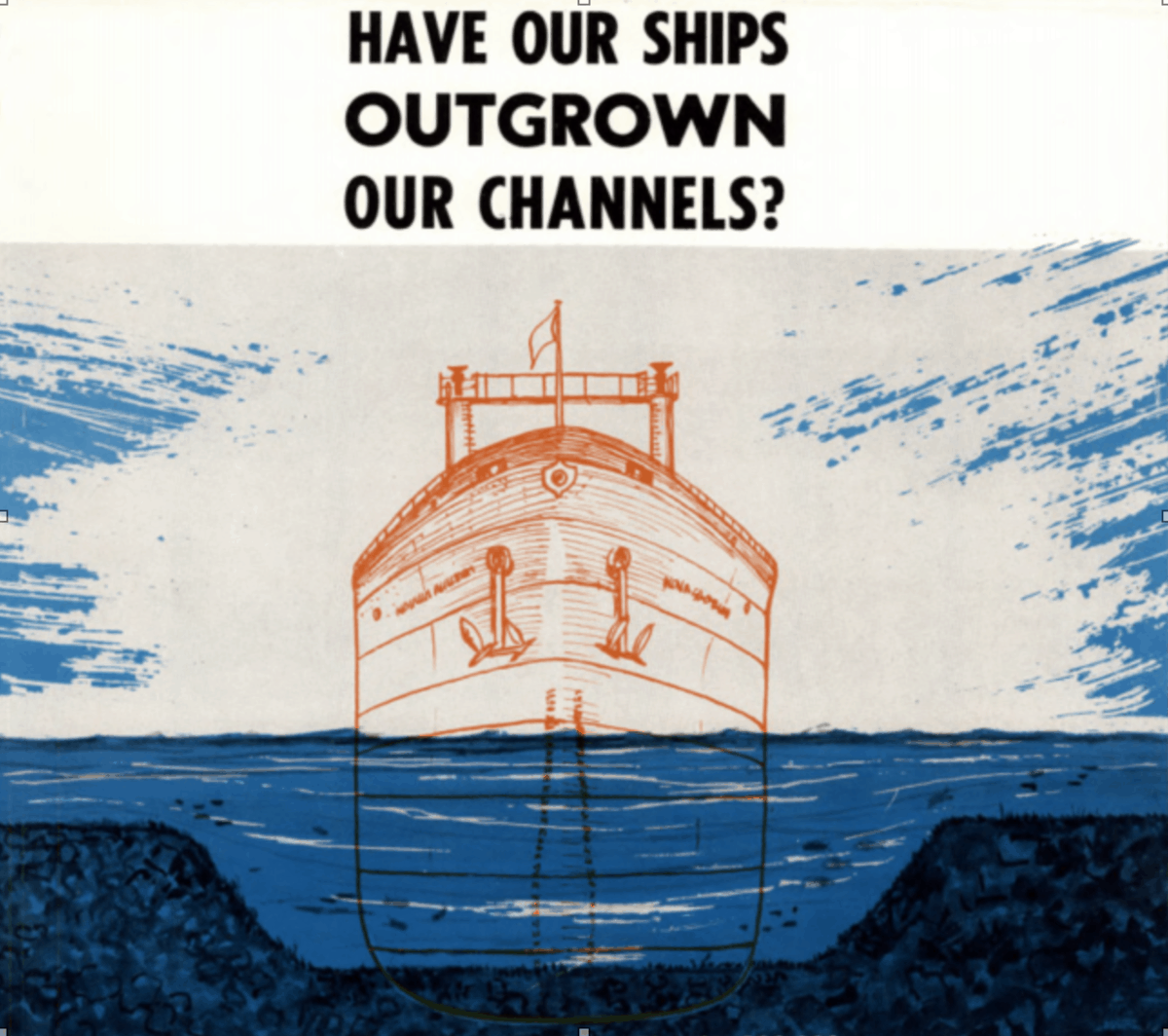
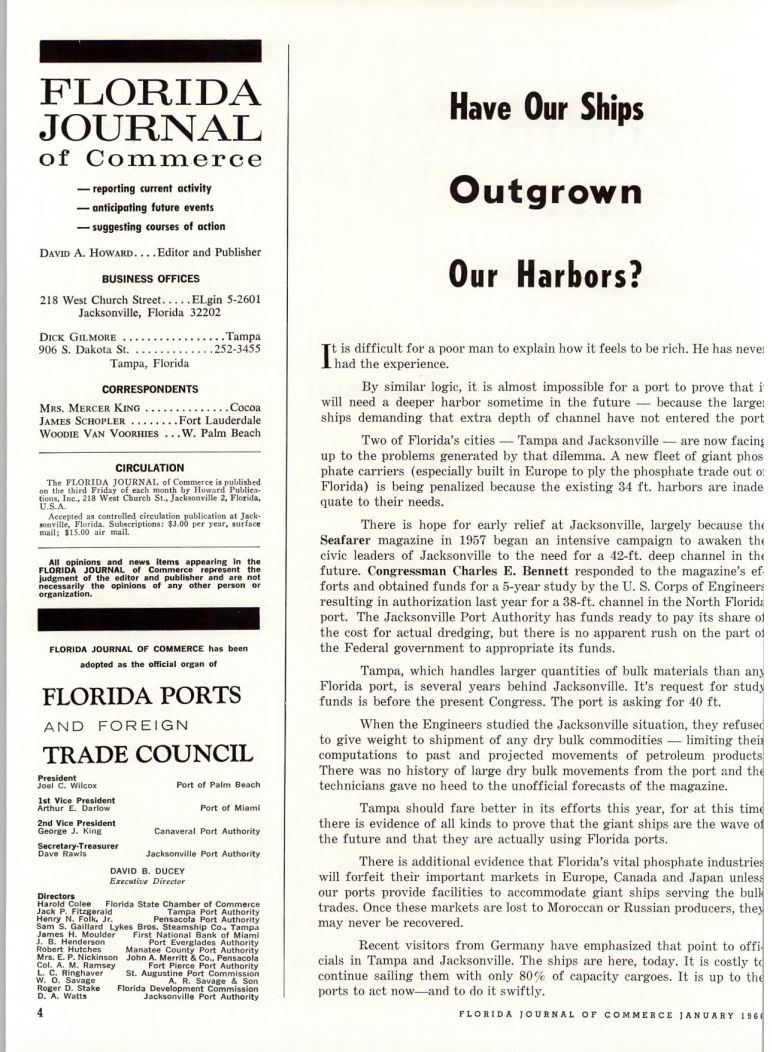
Have Our Ships Outgrown Our Harbors?
It is difficult for a poor man to explain how it feels to be rich. He’s never had the experience. By similar logic, it’s almost impossible for a port to prove that it will need a deeper harbor sometime in the future — because the larger ships demanding that extra depth of channel have not entered the port.
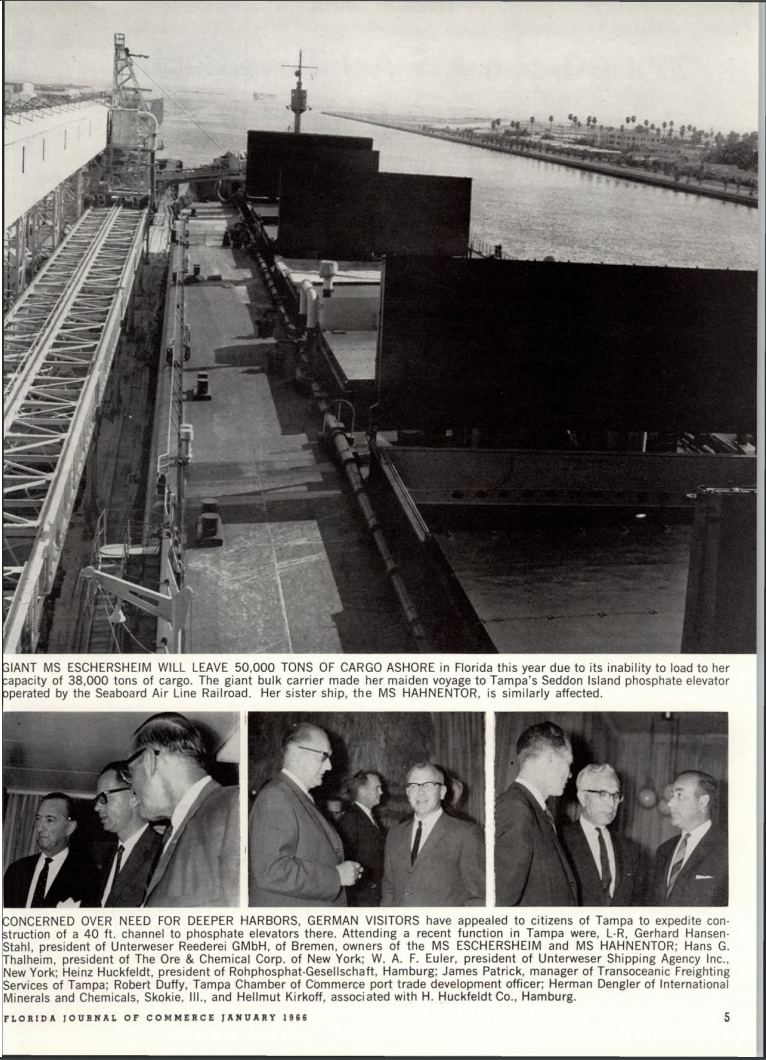
Two of Florida’s cities — Tampa and Jacksonville — are now facing up to the problems generated by that dilemma. A new fleet of giant phosphate carriers (especially built in Europe to ply the phosphate trade out of Florida) is being penalized because the existing 34 ft. harbors are inadequate to their needs.
There is hope for Jacksonville, though. The Seafarer magazine in 1957 began an intensive campaign to awaken civic leaders to the need for a 42-ft. deep channel in the future. Congressman Charles E. Bennett responded to the magazine’s efforts and obtained funds for a 5-year study by the U.S. Corps of Engineers resulting in authorization last year for a 38-ft. channel in the North Florida port. The Jacksonville Port Authority has funds ready to pay its share of the cost for actual dredging, but there is no apparent rush on behalf of the Federal government to appropriate its funds.
Tampa, which handles larger quantities of bulk materials than any Florida port, is several years behind Jacksonville. Its request for study funds is before the present Congress. The port is asking for 40 ft.
When the Engineers studied the Jacksonville situation, they refused to give weight to shipment of any dry bulk commodities — limiting their computations to past and projected movements of petroleum products. There was no history of large dry bulk movements from the port and the technicians gave no heed to the unofficial forecasts of the magazine.
Tampa should fare better in its efforts this year, for at this time there is evidence of all kinds to prove that the giant ships are the wave of the future and that they are actually using Florida ports.
There is additional evidence that Florida’s vital phosphate industries will forfeit their important markets in Europe, Canada and Japan unless our ports provide facilities to accommodate giant ships serving the bulk trades. Once these markets are lost to Moroccan or Russian producers, they may never be recovered.
Recent visitors from Germany have emphasized that point to officials in Tampa and Jacksonville. The ships are already here. It’s costly to continue sailing them with only 80% of capacity cargoes. It’s up to the ports to act now — and to do it swiftly.
Aluminum Sub Dives 1¼ Mile in Bahamas
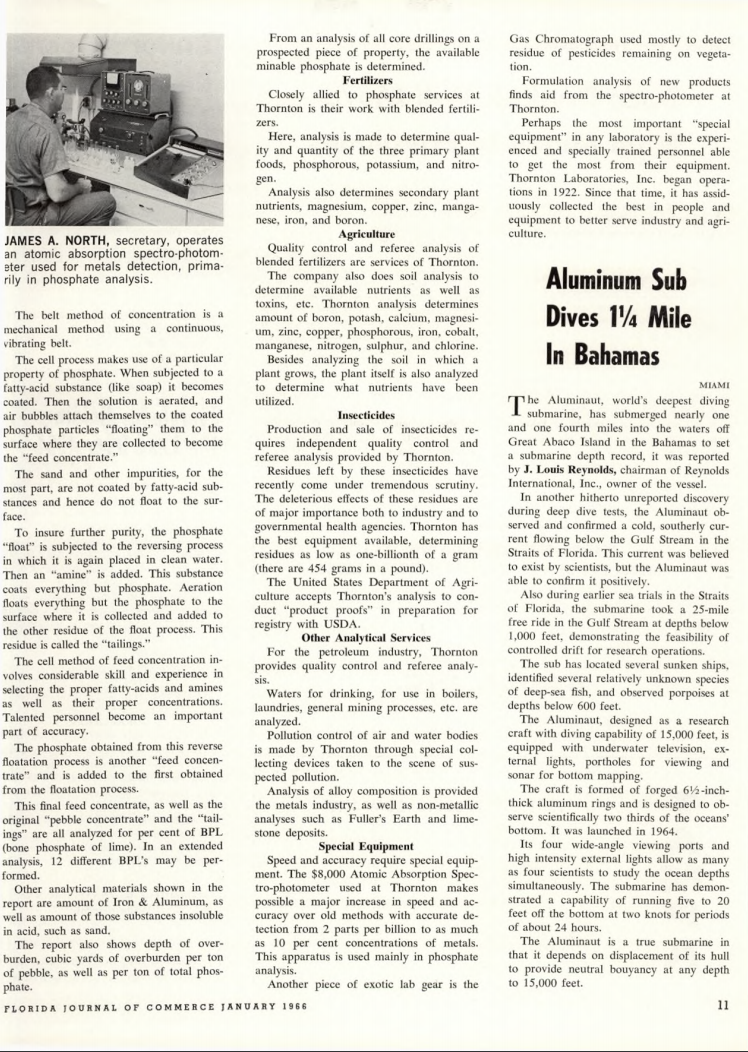
The Aluminaut, the world’s deepest diving submarine, has submerged nearly one and one fourth miles into the waters off Great Abaco Island in the Bahamas to set a submarine depth record, it was reported by J. Louis Reynolds, chairman of Reynolds International, Inc., owner of the vessel.
During the deep dive tests, the Aluminaut observed and confirmed a cold, southerly current flowing below the Gulf Stream in the Straits of Florida. This current was believed to exist by scientists, but the Aluminaut was able to confirm it positively.
Also during earlier sea trials in the Straits of Florida, the submarine took a 25-mile free ride in the Gulf Stream at depths below 1,000 feet, demonstrating the feasibility of controlled drift for research operations. The sub has located several sunken ships, identified several relatively unknown species of deep-sea fish, and observed porpoises at depths below 600 feet.
The Aluminaut, designed as a research craft with diving capability of 15,000 feet, is equipped with underwater television, external lights, portholes for viewing and sonar for bottom mapping.
Launched in 1964, the craft is formed of forged 6½-inch-thick aluminum rings and is designed to observe scientifically two thirds of the oceans’ bottom.
Its four wide-angle viewing ports and high intensity external lights allow as many as four scientists to study the ocean depths simultaneously. The submarine has demonstrated a capability of running five to 20 feet off the bottom at two knots for periods of about 24 hours.
The Alumninaut is a true submarine in that it depends on displacement of its hull to provide neutral buoyancy at any depth to 15,000 feet.
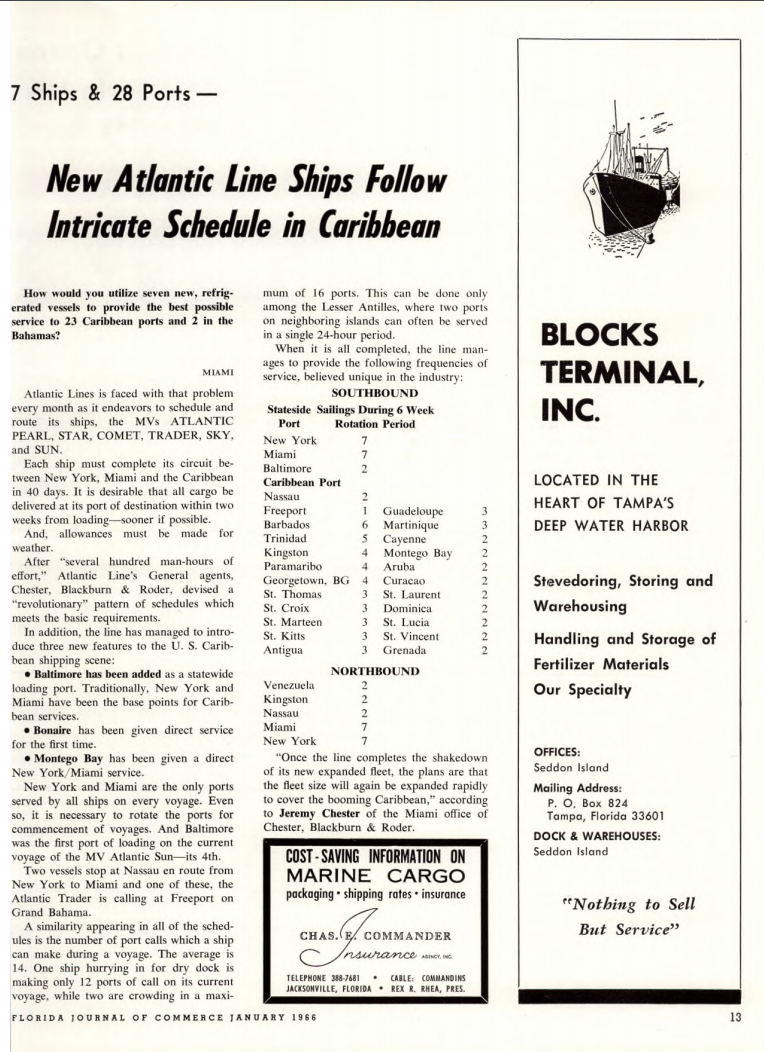
New Atlantic Line Ships Follow Intricate Schedule in Caribbean
How would you utilize seven new, refrigerated vessels to provide the best possible service to 23 Caribbean ports and 2 in the Bahamas? Atlantic Lines is faced with that problem every month as it endeavors to schedule and route its ships, the MV’s Atlantic Pearl, Star, Comet, Trader, Sky and Sun.
Each ship must complete its circuit between New York, Miami and the Caribbean in 40 days. Ideally, all cargo will be delivered at its port of destination within two weeks of loading — sooner if possible. And, allowances must be made for weather.
After “several hundred man-hours of effort,” Atlantic Lines’ General agents, Chester, Blackburn & Roder, devised a “revolutionary” pattern of schedules which meets basic requirements. In addition, the line has managed to introduce three new features to the U.S. Caribbean shipping scene:
- Baltimore has been added as a statewide loading port. Traditionally, New York and Miami have been the base points for Caribbean services.
- Bonaire has been given direct service for the first time.
- Montego Bay has been given a direct New York/Miami service.
New York and Miami are the only ports served by all ships on every voyage. Even so, it’s necessary to rotate the ports for commencement of voyages. And Baltimore was the first port of loading on the current voyage of the MV Atlantic Sun — its 4th. Two vessels stop at Nassau en route from New York and Miami and one of these, the Atlantic Trader, is calling at Freeport on Grand Bahama.
A similarity appearing in all of the schedules is the number of port calls which a ship can make during a voyage. The average is 14. One ship hurrying in for dry dock is making only 12 ports of call on its current voyage, while two are crowding in a maximum of 16 ports. This can only be done among the Lesser Antilles, where two ports on neighboring islands can be served in a single 24-hour period.
“Once the line completes the shakedown of its new expanded fleet, the plans are that the fleet size will again be expanded rapidly to cover the booming Caribbean,” according to Jeremy Chester of the Miami office of Chester, Blackburn & Roder.