






Turkish Cargo Spreading its wings
By Surya Kannoth
With its investments and ever-growing fleet, the global air cargo brand Turkish Cargo has taken concrete steps to achieve its target to become one of the top-five brands in the air cargo industry by 2023, marking the centennial of the foundation of the Republic of Turkey.
At a time when the cumulative contraction of the global air cargo market was at 5 percent, Turkey’s national flag carrier’s air cargo brand, Turkish Cargo, grew significantly with a tonnage increase of 8.8 percent. This was according to September 2019 data released by World Air Cargo Data’s (WACD).
The cargo carrier currently serves 126 countries and keeps raising its success bar by combining its broad range of services and operational capabilities. On the basis of the tonnage sold, the carrier has grown by 11.1 percent in America, 9.7 percent in the Far East Region, 8.7 percent in Europe, 7.9 percent in the Middle East, and 5.3 percent in Africa.
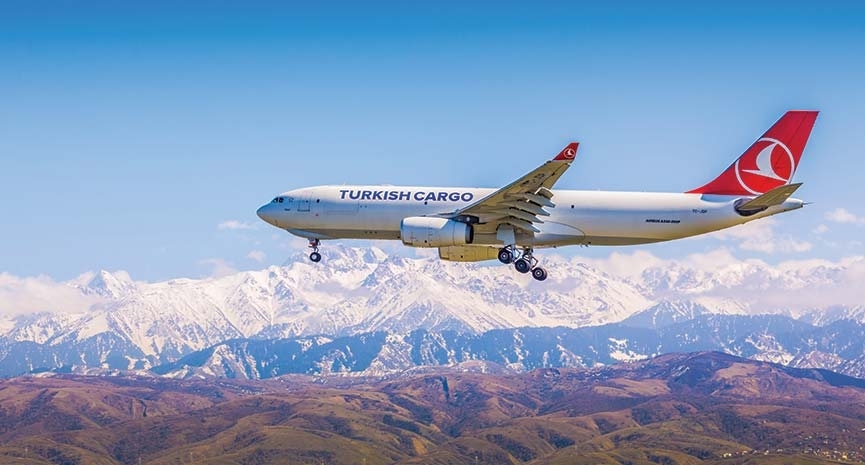
In addition to the flag-carrier Turkish Airlines’ cargo-carrying capacity, Turkish Cargo operates direct cargo flights to 88 destinations with its cargo aircraft fleet. It has achieved sustainable growth through its current infrastructure and newly made investment that has continued to increase its capacity through successful operations in over 300 destinations constituting its current flight network.
In a recent interaction with media, Tuncay Eminoglu, vice president – sales (Asia and Far East), Turkish Airlines laid emphasis on Africa being the priority for airline, as the air carrier expands its horizons to all four corners of the world. Turkey’s flag carrier flies to 56 destinations in Africa, second only to Ethiopian Airlines and first in terms of cargo services, he highlighted. Eminoglu further added that the airline saw 12.8 percent growth in its passenger numbers in 2008-2018, three times the world average.
The cargo arm of Turkish Airlines, Turkish Cargo has been at the forefront of flying pharmaceuticals and the carrier has created a pharma corridor connecting over 400 stations. This involves carrying healthcare cargo to important and certified destinations such as Mumbai, Brussels, Istanbul, Singapore, Dubai, Basel, London, and Amsterdam. Recently, it renewed its The International Air Transport Association (IATA) Center of Excellence for Independent Validators (CEIV) Pharma certificate until 2022. The cargo carrier, which serves in 14 stations that hold the European Union’s (EU) good distribution practice certificate (GDP), also carries out its pharmaceutical transport operations in 40 stations that hold QEP (Qualified Envirotainer Provider) certificate and ensures active temperature control between destinations.
Commenting on the expansion of the pharma corridor, Turhan Özen, chief cargo officer, Turkish Airlines, said in a media release, “As Turkish Cargo, we carry out the pharmaceutical transports from Atatürk and Istanbul Airports that have been certified by the global air cargo authorities and thus hold the IATA CEIV certificate within the cold chain integrity. While maintaining our successful dual hub operations, we carry out the land transports between two airports by using active temperature-controlled vehicles that hold all the necessary international certificates to preserve the cold chain integrity. Together with our flag-carrier master brand Turkish Airlines, we aim to become one of the top three air bridges of the world.”
Recently, it inducted the sixth Boeing 777F, capable of flying at a range of 9,200 kilometres, without any limitation, to its fleet. The Boeing 777F falls under the new-generation freighter category capable of carrying 102 tonnes and equipped with a high level of fuel saving capacity and technical safety. Turkish Cargo will have a total of 8 Boeing 777Fs by 2020. Developing and reinforcing continuously its fleet of 344 aircraft including 24 freighters, Turkish Cargo is rapidly beefing up its products and services.
As for growing its network, Turkish Cargo recently added Kuala Lumpur (KUL), keeping in mind its import and export potential so that it can carry electronic products, medical products, and spare parts to various countries around the world and especially Frankfurt and Amsterdam in Europe and Chicago, Atlanta, and Houston in the United States. The Kuala Lumpur flights will be operated with Boeing 777F cargo aircraft, on the Istanbul (ISL)–KUL– Ho Chi Minh/Vietnam (SGN) route, thus creating a strong import-export line in the region. Another important new connection was with the city of Ahmedabad (AMD), located in western India, in the state of Gujarat, which is connected with Doha (DOH) and Bahrain (BAH) that possess high import potential. One of the fastest growing cities, Ahmedabad is a big market for pharmaceuticals. The flights will be on the DOH–AMD–ISL and BAH–AMD-ISL routes and they will be operated with Airbus 330F aircraft.
In 2019, Turkish Cargo transitioned its operations to the newly constructed Istanbul Airport deemed as one of the largest airports in the world.
In his speech at the opening ceremony of the Association of International Forwarding and Logistics Service Providers (UTIKAD) summit, Ilker Ayci, chairman of the board of directors and the executive committee of Turkish Airlines said that Turkish Cargo was listed most widely-flying air cargo company in the world, operating direct cargo flights to 86 countries with its 24-plane air cargo fleet.
Having increased its rank from 13th to 7th in the global air cargo market, he added that Turkish Airlines would increase its share of 4 percent in the global air cargo market.
“Turkish Airlines attaches great importance to logistics and has placed logistics at the center of its strategic plans in the last few years,” he said. Observing a gradual shift in the logistics sector, he said, “We are moving from a period, in which when countries and companies are competing with each other, to a period in which supply chains compete with each other.”
This feature was originally published in January – February 2020 issue of Logistics Update Africa.










