






By Patrick Burnson, Executive Editor ·
December 16, 2019
While trade tensions between the U.S. and China have eased recently, a recent survey launched by Resilience360 indicates that companies with global manufacturing networks remain concerned.
Among other findings, the results revealed that two-thirds (66%) of the nearly 300 customer respondents have been impacted by the business disruptions and significant operational challenges presented to them by the U.S.-China trade war.
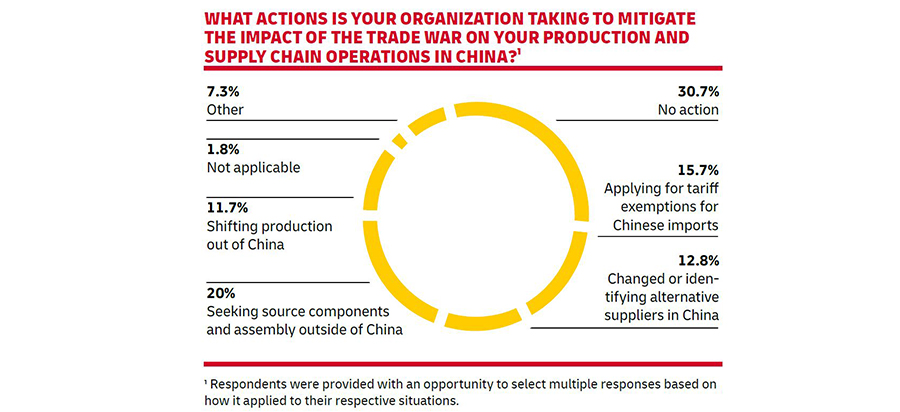
Going even deeper, 25.3 percent of respondents cited that they had not planned any contingency plans to mitigate the risks posed by the trade war. By way of summary, here are the findings:
-
Among other findings, the results revealed that two-thirds (66%) of the nearly 300 customer respondents have been impacted by the business disruptions and significant operational challenges presented to them by the U.S.-China trade war.
- Resilience360 surveyed global customers from disparate industries including life sciences, technology, automotive, mobility, engineering, manufacturing, consumer, retail, energy, chemicals, aerospace, and transportation.
Key findings from the study show that:
-
Lack of contingency planning to mitigate risks: 25.3 percent of respondents cited that they had not planned any contingency plans to mitigate the risks posed by the trade war. In particular, 47.6 percent of respondents from the engineering & manufacturing and 40 percent of automotive and mobility sectors declared that they had no contingency plans at all despite being industries heavily targeted in the trade war.
-
More than two-thirds of the total respondents are impacted by the trade war:
Two-thirds of respondents (66%) indicated that they were either highly affected or somewhat affected by the challenges created by the U.S.-China trade war. -
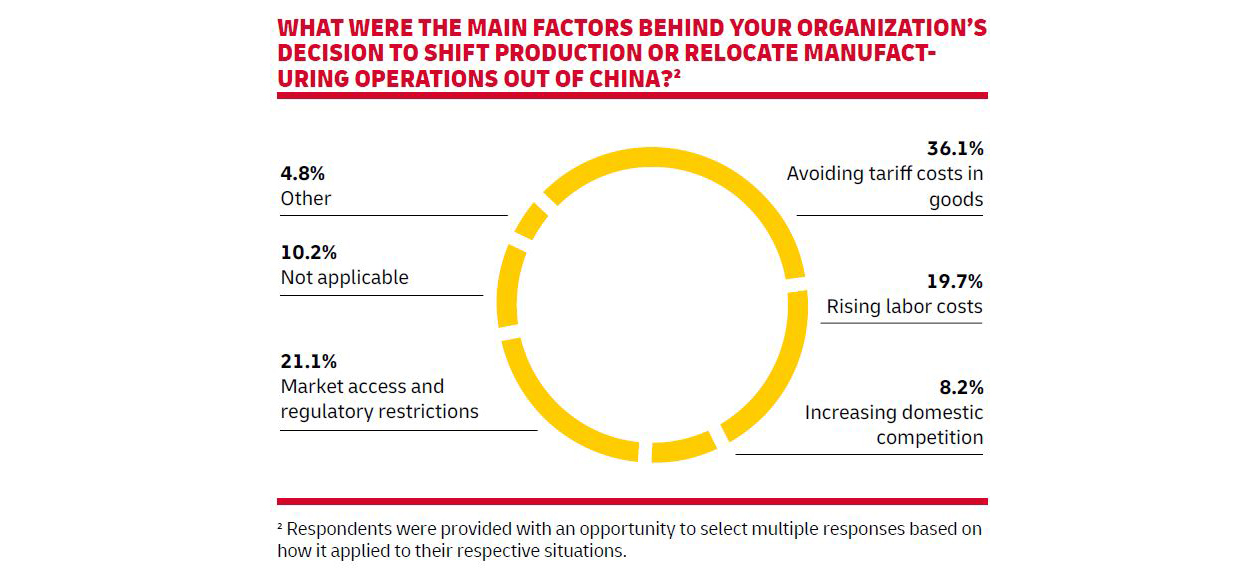
Tariff costs are the reason for relocating from China: The primary reason why organizations are considering either shifting production or relocating manufacturing activities out of China is the need to avoid tariff costs (57 percent), which is followed by market access and regulatory restrictions (33 percent), rising labor costs (31 percent), and increasing domestic competition from Chinese firms (13 percent).
-
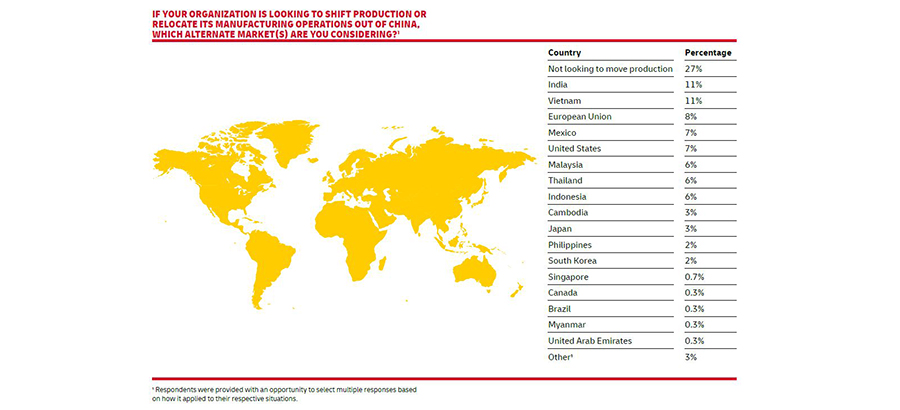
India and Vietnam are the preferred destinations for rerouting production/manufacturing: India (11 percent) and Vietnam (11 percent) are the preferred options for respondents when looking to shift production or move manufacturing operations outside of China due to the trade war. Other major areas that identified include the European Union (7.7 percent), Mexico (6.7 percent), U.S. (6.5 percent), Malaysia (6.1 percent), Thailand (5.8 percent), Indonesia (5.5 percent), Cambodia (3.2 percent) and Japan (2.5 percent).
- Regulatory restrictions/uncertainty are also a factor: For multinational companies with supply chain operations in China, more than half of the respondents view regulatory uncertainty and restrictions as being the largest non-tariff barrier (53 percent); followed by customs clearance delays (36 percent); increased inspections such as environmental, product review, or security audits (28 percent); and business licensing and administrative barriers (17 percent).
Tobias Larsson, Chief Executive Officer, Resilience360:
“The survey confirms what many have suspected—the volatility of the U.S.-China trade war has brought about considerable uncertainty for companies with global manufacturing networks. Successive tariff escalations, regulatory burdens, and other non-tariff barriers have raised serious questions about how companies can adapt their supply chains to prepare for commercial risks amid escalating trade tensions.”
“This research provides our customers the ability to benchmark their own risk planning efforts with industry peers, assess current contingency plans, adapt supply chain networks where needed and ultimately—protect the bottom line as global trade tensions continue to persist,” he continued.
The U.S.-China trade war is a high-profile example of the type of supply chain disruption that Resilience360 helps companies monitor, mitigate and make contingency plans against. The supply chain risk management company predicts, monitors, and mitigates disruptions both man-made and natural, including hurricanes, cyberattacks, labor strikes, protests and a rapidly changing regulatory environment.
Although mainstream business journals have been reporting that India may become less attractive to U.S. supply chain mangers if its regulatory rules become more complex, Larsson told SCMR in an interview that the nation remains an attractive alternative:
“Based on our survey report findings on the U.S.-China trade war, we found that a sizeable portion of our respondents (11 percent) identified India as a possible destination if they were to relocate or shift production out of China. This could be reflective of not only ongoing developments but also greater efforts that various countries – including India – are making to bolster manufacturing and better position themselves within Asian and global supply chains.”

December 17, 2019
About the Author

Patrick Burnson, Executive Editor
Patrick Burnson is executive editor for Logistics Management and Supply Chain Management Review magazines and web sites. Patrick is a widely-published writer and editor who has spent most of his career covering international trade, global logistics, and supply chain management. He lives and works in San Francisco, providing readers with a Pacific Rim perspective on industry trends and forecasts. You can reach him directly at [email protected]

Subscribe to Supply Chain Management Review Magazine!
Subscribe today. Don’t Miss Out!
Get in-depth coverage from industry experts with proven techniques for cutting supply chain costs and case studies in supply chain best practices.
Start Your Subscription Today!










