






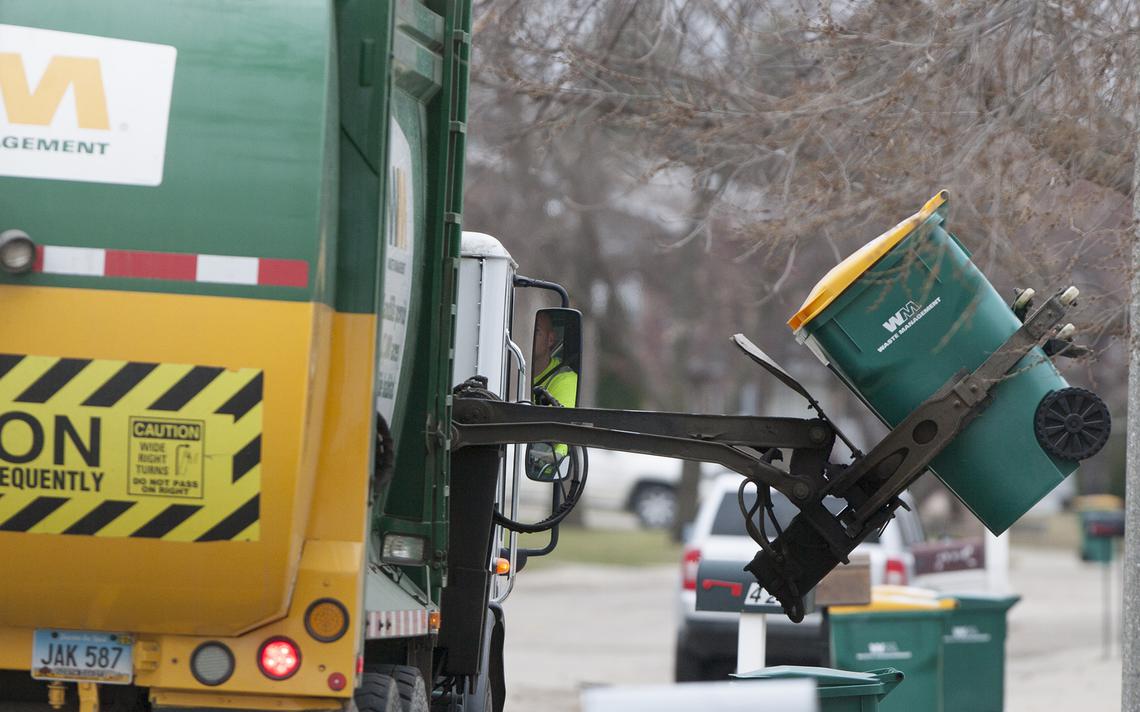
The city recycling collected from 2016 to 2019 rests at a whopping 8,765 tons, or nearly as much as 50 blue whales. But in the past few years, that number has varied wildly, something that Leah Rae Amundson, the city’s public works chief, said is at least in part driven by lighter shipping materials, city growth and more activity at the local recycling drop sites.
It’s a look at the surprisingly complex economics of how residents’ recycling gets to the curb — and where it goes after pickup.
“It’s kind of an interesting dynamic, seeing shifts in materials …” Amundson said. “As (companies) change to lighter materials, the challenge is to find end-use for that. What we’re seeing with some of the companies on a global scale is, they’re looking to develop some of that full-circle, closing that loop and really figuring out how to recycle those materials.”
The city’s residential recycling pick-up program is the oldest in North Dakota, and dates to 1990. Nowadays, it’s contracted with Waste Management for $58,000 a month — with about 13,000 residences that are eligible to use it, plus three drop sites around the city and availability to about a third of local apartment-dwellers. The recycling program is a vital part of how the city strives to achieve a state benchmark: 40% of waste recycled or “diverted,” from a landfill, as in the case of composting. Right now, the city is at 36% “in the past few years,” Amundson said.


But besides help with waste diversion, Grand Forks residents working hard to recycle also can keep in mind the quality of what they’re setting at the curb, as a means of keeping the business of recycling itself sustainable.
Julie Ketchum, a spokesperson for Waste Management, said the market for recycled goods has been shifting in recent years, notably as China — a significant consumer of recyclables — has scaled back its consumption. As a result, Ketchum said, recyclables were suddenly that much more plentiful in the U.S., flooding the market. Suddenly, it’s much more important for recycling to be high-quality, usable material.
“Just generally, throughout the U.S., recycling service providers are working to reduce the amount of contamination that is showing up in the recycling stream,” Ketchum said. “They want clean material, and it means we have to get clear messages out to the general public about what is recyclable and what is not.”
In other words, Grand Forks residents who really care about effective recycling have to take care to make sure what they leave at the curb — or drop off at sites — is actually ready to be recycled.
Waste Management’s website offers a quick overview, noting that, generally, “Clean bottles, cans, paper and cardboard” are OK for recycling, but that foods and liquids aren’t. If material is bagged, then it’s harder to sort effectively; “loose plastic bags” themselves are a definite no.
“In Grand Forks, we have been tagging some carts when they have high levels of contamination. And with tagging, that’s a signal to the recycler that they need to look at how they’re recycling,” Ketchum said. “It makes the business and the recycling program economically sustainable.”
And, soon, the city could partner with Grand Forks Air Force Base on both recycling and garbage service, part of a waste management system that city leaders hope will be helpful to base officials and isn’t expected to come at cost to the city. The move, City Administrator Todd Feland has said, would help accommodate the Air Force in the community at a time when the U.S. government is constantly scouting for efficiencies in its military, sometimes at the cost of installations themselves.
“What can we do to extend city services and provide win-wins?” Feland said last month. “The win for us is that we’re still getting paid for the services that we’re providing.”










