



• Latest
  • Trending
  • All
Here’s Why GE Still Isn’t Worth the Risk for Most Investors

Here’s Why GE Still Isn’t Worth the Risk for Most Investors

February 16, 2020
Last Mile Delivery Market Worth Observing Growth | UPS, FedEx, SF Express

Last Mile Delivery Market Worth Observing Growth | UPS, FedEx, SF Express

April 23, 2024
Top 5 Spend Analysis Software ranked in 2024

Top 5 Spend Analysis Software ranked in 2024

March 1, 2024
How Tesla And BMW Are Leading A Supply Chain Renaissance With Blockchain

How Tesla And BMW Are Leading A Supply Chain Renaissance With Blockchain

January 19, 2024
LATAM Cargo strengthens European cargo links

LATAM Cargo strengthens European cargo links

April 14, 2020
Ford making reusable hospital gowns from airbag materials as efforts against coronavirus expand

Ford making reusable hospital gowns from airbag materials as efforts against coronavirus expand

April 14, 2020
Don’t Sweat NBC’s Decision to Cut Back on Television Ad Inventory

Don’t Sweat NBC’s Decision to Cut Back on Television Ad Inventory

April 14, 2020
Software firms sharpen focus on AI, big data as IT spending drops

Software firms sharpen focus on AI, big data as IT spending drops

April 14, 2020
Navigating turbulent times in your supply chain (TL:DR version)

Navigating turbulent times in your supply chain (TL:DR version)

April 14, 2020
Last Mile Delivery by Drones Market is Booming Worldwide

Last Mile Delivery by Drones Market is Booming Worldwide

April 14, 2020
AIR CARGO MARKET SIZE, SHARE, DEMAND, TREND, LATEST INNOVATIONS & APPLICATION ANALYSIS AND INDUSTRY GROWTH FORECAST 2027 – Science In Me

AIR CARGO MARKET SIZE, SHARE, DEMAND, TREND, LATEST INNOVATIONS & APPLICATION ANALYSIS AND INDUSTRY GROWTH FORECAST 2027 – Science In Me

April 14, 2020
Wheat procurement in Patiala: 6,500 coupons issued to farmers – cities

Wheat procurement in Patiala: 6,500 coupons issued to farmers – cities

April 14, 2020
Pandemic, Plastics And The Continuing Quest For Sustainability

Pandemic, Plastics And The Continuing Quest For Sustainability

April 14, 2020
  • Supply Chain
  • Logistics
  • Warehousing
  • Procurement
  • Shipping
  • More
    • Strategic Sourcing
    • Spend Analysis
    • Inventory
    • Contact Us
No Result
View All Result
United States International Supply Chain Commission
Home Procurement

Here’s Why GE Still Isn’t Worth the Risk for Most Investors

by usiscc
February 16, 2020
in Procurement
0
Here’s Why GE Still Isn’t Worth the Risk for Most Investors
491
SHARES
1.4k
VIEWS
Share on FacebookShare on Twitter

General Electric‘s (NYSE:GE) shares are up 40% over the past six months, with a 15% gain since the start of 2020. Backing up that price gain was a better-than-expected fourth-quarter earnings showing. Before you get sucked into the recovery story, though, step back and take a closer look at the bigger picture. Here are a few reasons most investors should remain on the sidelines at GE.

1. Debt is lower, but still a problem

One of the big underpinnings of GE’s stock advance was the company’s decision to sell a portion of its healthcare division. That move freed up around $20 billion of cash for debt reduction. Some industry watchers believe that this move, combined with other asset sales and cash-raising efforts, has basically solved the industrial company’s debt problems. This is wishful thinking.

A person pointing to a graph on a computer screen

Image source: Getty Images.

Even after reducing the company’s fourth-quarter debt load by $20 billion, debt still makes up roughly 70% of the company’s capital structure. That’s a significant number when you consider that peers like Emerson Electric and Honeywell are sitting at roughly 33% and 45% on this metric. This isn’t an apples-to-apples comparison because neither Emerson nor Honeywell have a financial arm like GE (more on this below), which is where more than 75% of GE’s debt lies. However, you can’t simply dismiss the leverage issue because GE’s industrial businesses and its finance arm all fall under the same corporate umbrella.     

General Electric’s debt situation is much improved, but it still hasn’t fixed its balance sheet problems. And this doesn’t even take into consideration the company’s roughly $40 billion in insurance liabilities and annuity benefits (one of the bigger liabilities on the company’s balance sheet), which leads into concern No. 2.   

2. The black box

One of the ongoing problems at General Electric is the company’s finance arm. This division was, basically, the one that brought the industrial giant down to earth during the deep 2007 to 2009 recession. GE started building its finance division under Jack Welch, and it expanded to the point that it had vastly outgrown its core purpose of helping customers buy the company’s products. There was no quick fix, but management did start to trim the division.   

More than a decade after the recession ended, GE still hasn’t been able to extract itself from some of the troublesome finance-related businesses it got into. And worse, there’s no way for investors to really know what’s going on with the business. GE, meanwhile, has come out several times over the past decade and said that things were worse than expected in the finance division. This isn’t something that should inspire confidence.   
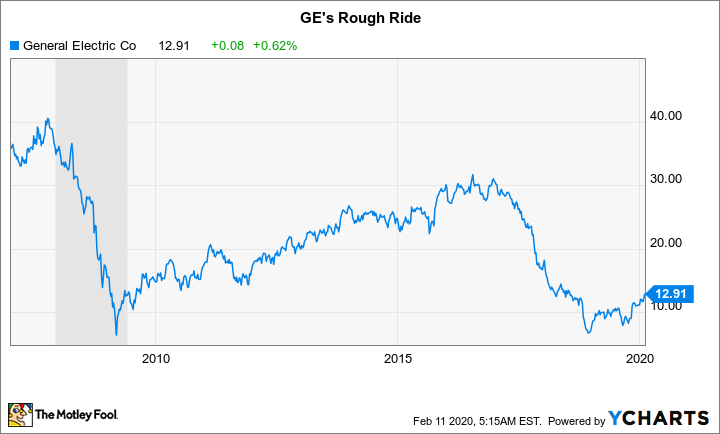
GE Chart

GE data by YCharts.

To be fair, GE has made great strides in reducing the size of its finance business. However, at this point, what is left is likely a mixture of the core business (helping finance customer purchases) and the stuff GE couldn’t offload to others. That latter category is most likely the home of some really ugly things, noting that the “insurance liabilities and annuity benefits” liability on its balance sheet increased by nearly 12% in 2019.

That line item relates to insurance policies (such as long-term care insurance) that the company sold and is now allowing to run off. It must put money aside to pay for these liabilities, which is cash it can’t use for other purposes (see below for why that’s so important). These are very long-lived insurance policies, so this issue isn’t going away anytime soon.  

The size of the finance issue is a big unknown for investors, and sometimes it seems that even GE doesn’t quite understand how big it is. The 12% increase in the “insurance liabilities and annuity benefits” line item was a tidy $4.2 billion. But that’s just chump change, noting that GE took an $11 billion charge in early 2018 with roughly 70% related to its insurance operations. It followed that up with an early 2019 announcement that it would need to take another $14 billion or so in charges over a roughly seven-year span to shore up its finance unit, again largely related to the insurance business. This is a complicated mess that will linger for years and that most investors would be better off avoiding.   

3. Forward, at half speed

The next issue to keep in mind is that, even after GE solves the debt issue and fully mends its finance arm, it still has to run its main businesses. It’s doing a great job of that in its healthcare and aviation arms, where segment margins are robust, hitting 21.9% and 23%, respectively, in the fourth quarter. Healthcare threw off $2.5 billion in free cash flow in 2019, with aviation generating an even larger $4.4 billion.    

General Electric’s problem is that its other two divisions, power and renewable energy, are struggling. Power’s segment margin was just 5.6% in the fourth quarter, with renewable energy posting a negative 4.1% segment margin. Through 2019, these two businesses produced negative cash flow of roughly $2.5 billion. GE is facing industrywide headwinds, so the troubles aren’t completely self-inflicted, but it still needs to fix these divisions if it wants to get back on the growth track. All in, they account for 40% of the company’s top line, so this is not a small problem.   

A special situation

After a huge price decline, General Electric probably has material turnaround potential. But the turnaround, while making progress, still comes with notable risks. Most investors, particularly those with a conservative bent, should probably continue to avoid this industrial icon. Yes, GE was once considered a blue-chip stock, but it no longer deserves that moniker. And it’s likely to be a long time before it earns it again. 

Share196Tweet123
usiscc

usiscc

  • Trending
  • Comments
  • Latest
Escape From Tarkov – How to Rotate Items

Escape From Tarkov – How to Rotate Items

February 5, 2020
Supply chain examination: Planning for vulnerabilities you can’t control

Supply chain examination: Planning for vulnerabilities you can’t control

December 7, 2019
Procurement Project Manager job with Camden London Borough Council

Procurement Project Manager job with Camden London Borough Council

February 17, 2020
Art Battle Wichita Falls III at The Warehouse, 1401 Lamar.

Art Battle Wichita Falls III at The Warehouse, 1401 Lamar.

0
Global Industry Analysis, Size, Share, Growth, Trends, and Forecasts 2016–2024 – ZMR News Reports

Global Industry Analysis, Size, Share, Growth, Trends, and Forecasts 2016–2024 – ZMR News Reports

0
PHOTOS: Ottawa firefighters respond to warehouse fire

PHOTOS: Ottawa firefighters respond to warehouse fire

0
Last Mile Delivery Market Worth Observing Growth | UPS, FedEx, SF Express

Last Mile Delivery Market Worth Observing Growth | UPS, FedEx, SF Express

April 23, 2024
Top 5 Spend Analysis Software ranked in 2024

Top 5 Spend Analysis Software ranked in 2024

March 1, 2024
How Tesla And BMW Are Leading A Supply Chain Renaissance With Blockchain

How Tesla And BMW Are Leading A Supply Chain Renaissance With Blockchain

January 19, 2024
  • Privacy Policy
  • Terms of Use
  • Disclaimer
  • DMCA
  • Contact Us

Copyright © 2024 United States International Supply Chain Commission (usiscc.org)

This website uses cookies to improve your experience. We'll assume you're ok with this, but you can opt-out if you wish. Cookie settingsACCEPT
Privacy & Cookies Policy

Privacy Overview

This website uses cookies to improve your experience while you navigate through the website. Out of these cookies, the cookies that are categorized as necessary are stored on your browser as they are essential for the working of basic functionalities of the website. We also use third-party cookies that help us analyze and understand how you use this website. These cookies will be stored in your browser only with your consent. You also have the option to opt-out of these cookies. But opting out of some of these cookies may have an effect on your browsing experience.
Necessary
Always Enabled

Necessary cookies are absolutely essential for the website to function properly. This category only includes cookies that ensures basic functionalities and security features of the website. These cookies do not store any personal information.

Non-necessary

Any cookies that may not be particularly necessary for the website to function and is used specifically to collect user personal data via analytics, ads, other embedded contents are termed as non-necessary cookies. It is mandatory to procure user consent prior to running these cookies on your website.

SAVE & ACCEPT
No Result
View All Result
  • Supply Chain
  • Logistics
  • Warehousing
  • Procurement
  • Shipping
  • More
    • Strategic Sourcing
    • Spend Analysis
    • Inventory
    • Contact Us

Copyright © 2024 United States International Supply Chain Commission (usiscc.org)







