






The coronavirus outbreak that originated in Wuhan, China, is causing businesses, health officials and patients to worry about potential shortages of prescription drugs.
That’s because the vast majority of active ingredients in medicines dispensed in the U.S. are made in factories overseas, many in China.
NPR has exclusive reporting on how disruptions in China are affecting some drugmakers’ ability to make key ingredients. On March 3, we emailed facilities registered with the U.S. Food and Drug Administration to ask what products they manufacture, how the outbreak was affecting their work and how they were coping.
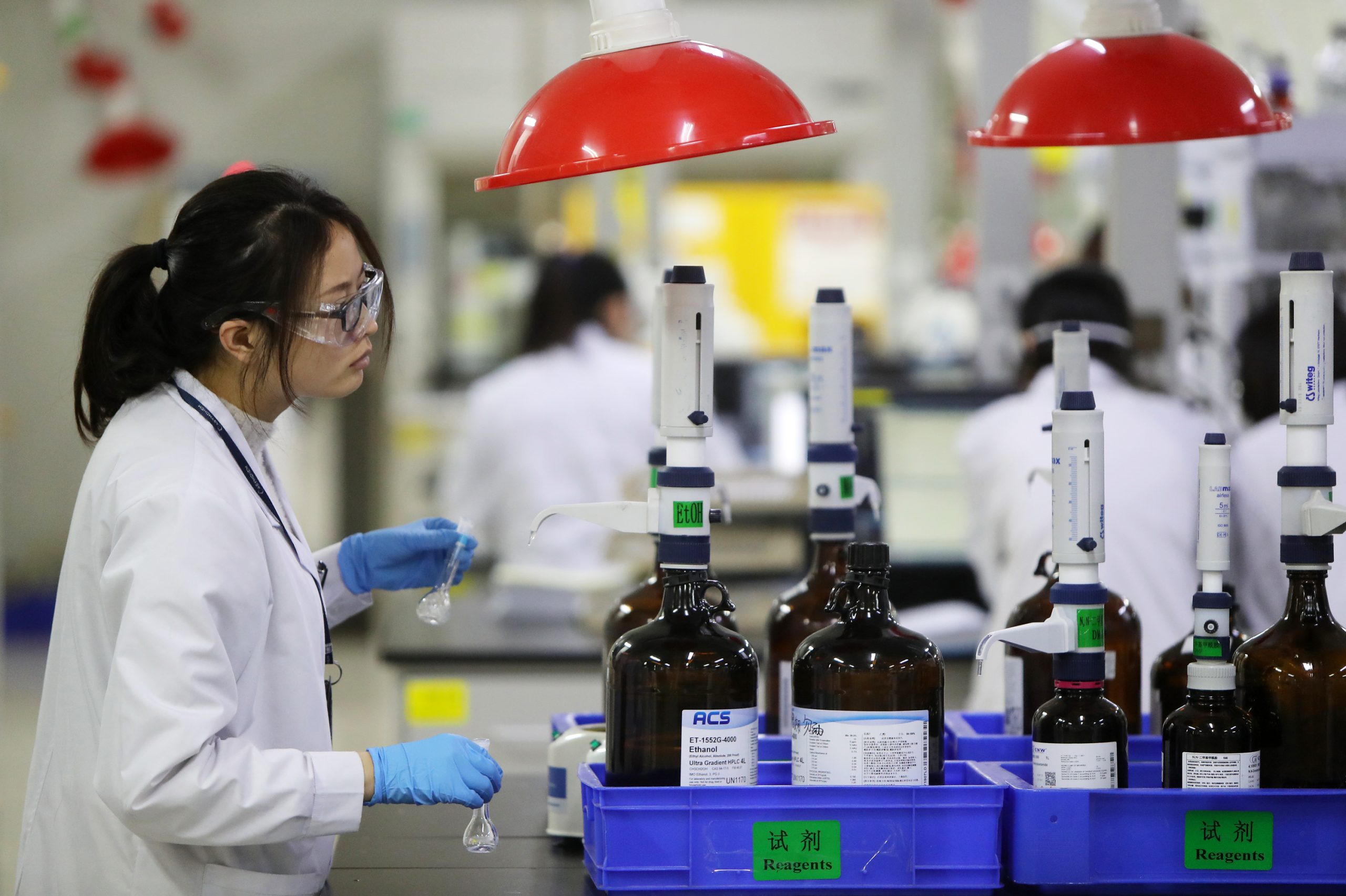
Since then, nine companies with operations in China spoke directly to NPR. The facilities make a wide range of pharmaceuticals and some also make other health-related products, including nasal strips and agricultural insecticides.
So far, the serious supply disruptions many have feared haven’t come to pass. Many facilities are back online after production interruptions related to the coronavirus response. Others say they were far enough from the epicenter of the outbreak in Wuhan to continue working immediately after the extended Chinese New Year break.
Still, even facilities that are almost back to normal are anticipating a second wave of setbacks.
“A lot of our suppliers still are not answering phones because they can’t get to work or their site isn’t open,” says Elut Hsu, president of Morrisville, N.C.-based Asymchem, Inc., which has eight facilities in northeast China that manufacture drugs and drug ingredients. Asymchem is a contract manufacturer whose ingredients go into antibiotics, oncology drugs and antivirals sold by other companies.
Asymchem had replenished ingredients and supplies ahead of the new year holiday.
“We always stock up enough for at least a month,” she says. “So we’re OK for now. But the secondary wave of supply issues could be coming.”
Some projects had no interruptions, and others were delayed about four weeks, she says. That kind of delay usually isn’t enough to prompt a shortage.
Hsu says the extent of the outbreak became apparent to her colleagues in China as they were preparing to travel home for Chinese New Year at the end of January. Many employees are from other parts of the country. Some cut their holidays short to return to work on time, but others needed to remain in quarantine.
Although the Asymchem facilities in China were able to reopen on Feb. 10, the southernmost facility — nearest to Wuhan — was working with a smaller staff. It’s taken weeks to return to their normal workforce.
Many manufacturers are taking extra precautions to avoid the virus. Some people tell NPR they’re required to eat meals alone, wear masks to work, and have their temperatures checked once a day or more. They also avoid gatherings like meetings.
Gary Ye, of Tianyu Pharmaceuticals, says his facility couldn’t start back up until the last week in February because there were more than 100 coronavirus cases in his city, Taizhou, on Feb. 10. Although he says no one who works at Tianyu Pharmaceuticals has been diagnosed with the illness, they returned to work with extra requirements to keep the virus from spreading. His facility makes drug substances bound for the United States, including losartan for hypertension and montelukast for allergies and asthma.
“It had some impact to our business, we had to explain to clients we could not meet some deadlines in some cases,” he wrote in an email. “For drug substance manufacturing, it’s quite difficult to speed up, the only thing we can do is to make the most of our production capacity.”
He says his facility also experienced difficulties related to travel restrictions between provinces and cities. Although medical and living supplies were allowed through borders, manufacturing material was not. Those restrictions have since been lifted.
“It’s very costly for all kinds of measures China are taking, but obviously quite effective and successful,” he added.
Spread of coronavirus in China has slowed dramatically and businesses have begun to resume work..
“At this stage, most of the companies seem to be largely in operation,” says Benjamin England, a consultant and attorney with several dozen clients who import products to the U.S. Many manufacture drugs in China. “We’re not at least hearing of there being continued delay or restrictions with respect to production. And that’s true on the medical device side, too.”
Sheng Ding, dean of pharmacy at Tsinghua University in Beijing, says most drug manufacturing in China operates outside of Wuhan and is therefore returning to normal. “Things (e.g., getting back to work in full speed) are changing pretty quickly, especially in the last week as the outbreak situation is under control,” he wrote in an email.
Several U.S. drugmakers, including Pfizer and Mylan, have told their investors that the virus could harm their ability to manufacture products or get supplies to do so.
The Food and Drug Administration says it is in contact with more than 180 drug manufacturing facilities, and as of Feb. 26 it had identified 20 products or ingredients that are exclusively manufactured in China and could go into shortage.
The agency said on Feb. 27 that only one shortage has officially been attributed to the outbreak so far because manufacturers can’t get the active pharmaceutical ingredient they need to make it.
The agency didn’t name the drug and said there are alternatives for patients.
A 2012 law requires companies to tell the FDA if they are having manufacturing problems six months in advance of a possible shortage — or as soon as they know. Then, the FDA can jump in to help prevent a shortage.
But the law has its weaknesses, says Erin Fox, senior director of drug information and support services at the University of Utah Health Hospitals, who tracks national drug shortages. “If the company chooses not to report, nothing bad happens to them,” she says. “They don’t get fined.”
What’s more, companies aren’t legally required to tell the FDA why their drug is in shortage. And they can’t force a company to make a drug if it doesn’t want to anymore.
The agency gets “a lot of blame when drugs are short, but they don’t really have much control at all,” Fox says.
Still, any drug shortages caused by coronavirus manufacturing disruptions probably won’t appear immediately or all at once, Fox says.
“If [manufacturers] bought six months worth of raw material before Chinese New Year and they’re maybe not ready to make a batch until right now, they may not run out of that raw material until later this fall,” Fox says. “And then by then, maybe things will be OK.”
Rachna Shah, a professor in the supply chain and operations department at Carlson School of Management at the University of Minnesota says she, too, is reassured by the knowledge that drug manufacturers hold months of inventory.
“There’s more fear than there needs to be,” she says.
9(MDAxODM0MDY4MDEyMTY4NDA3MzI3YjkzMw004).gif)