








- The digital media revolution has been transformative – but it has a dark side.
- As millions more come online, these negative aspects will become magnified.
- All stakeholders must collaborate to build a supply chain that is good for both customers and business.
Twenty-five years ago the first digital banner ad was launched, and a media revolution was born. Since then, data and digital technology have disrupted every aspect of the advertising, media and marketing ecosystem, transforming how we inform, entertain and engage people.
There have been many positive benefits. Creativity has expanded. Nearly any information can be found instantly. Shopping has never been easier. People connect in novel ways never thought possible. And the next decade will bring more change. We can see a world without ads as we know them today: where mass personalization is the norm; where immersive technologies transform media experiences; and where advertising serves as a positive force for society.
But there is a dark side to this revolution. Lack of transparency has led to massive media waste, and issues of brand and human safety. As digital media became dominant, we faced the inconvenient truth that we were operating in a murky and sometimes even fraudulent media supply chain. And while progress has been made to clean it up, it’s not enough. Digital media continues to grow – and with it, a dark side persists. Waste and fraud continue. Privacy breaches and consumer data misuse keeps occurring. Unacceptable content continues to be seen and viewed alongside brands. Bad actors siphon funds from advertisers and find ways to create scams, divisiveness and social unrest.
These are significant problems. As the next half of the world’s population comes online, the problems could grow exponentially unless all stakeholders come together and act. We are in the early stages of artificial intelligence and virtual, augmented and mixed reality – so imagine what broad application of those technologies could bring if left unchecked. While the clean-up efforts must continue, it’s time to use our collective intellectual firepower to chart the course for a different future.
With almost 3.8 billion people now online globally, the digital world offers significant benefits, but also poses the risks of harmful content.
The Global Alliance for Responsible Media (GARM), created by the World Federation of Advertisers, is scaling its impact by partnering with the World Economic Forum’s platform for Media, Entertainment and Culture to improve the safety of digital environments, addressing harmful and misleading media while protecting consumers and brands.
GARM focuses on ensuring viewer safety for consumers, reducing risks for advertisers, developing credibility for digital platforms and, more broadly, ensuring a sustainable online ecosystem.
The Alliance is working with the Forum’s network of industry, academic, civil society and public-sector partners to amplify its work on digital safety and to ensure that consumers and their data are protected online within a healthier media ecosystem.
Businesses can join the Forum’s Platform for Shaping the Future of Media, Entertainment and Culture and apply to partner with the Alliance and similar initiatives. Read more in our Impact Story or contact us to find out more.
Brand new
It’s time to create a responsible media supply chain that is built for the year 2030. Imagine a media supply chain that operates in a way that is safe, efficient, transparent, accountable, and properly moderated for everyone involved, especially for the consumers we serve. Imagine a responsible media supply chain that builds in the following attributes:
Content quality. Every media provider would have complete control over content quality on their platform. Common standards would be followed so certain types of content would not exist and would certainly not be monetized through advertising. Advertising would never be next to content where opioids are being offered; where illegal drugs are promoted; where abhorrent behavior is present; or where violence is seen.
Civility. Freedom of speech is a right, but civility is a responsibility. That means every media provider would handle editorial comments in a way that promotes freedom of expression, but in a way that creates a balanced and constructive discourse. Technology would enable broad and productive conversations, but technology would not make it easy to hijack conversations and disproportionately amplify negativity, divisiveness, or hate.
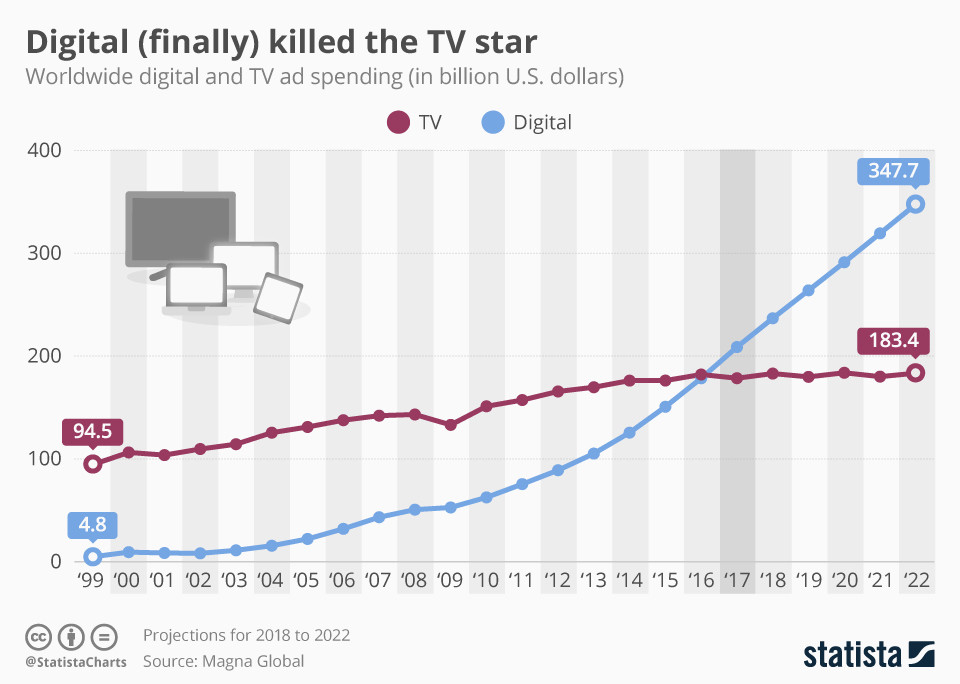
Digital ad spending now far outstrips TV in the US
Image: Statista
Transparency. That means all media providers would enable full measurement visibility on ad viewability and audience reach, both within their platforms and across all platforms. This would create a better experience for consumers who would not be forced to see the same ad over and over again – on the same program, on the same platform, or across multiple platforms. Transparency would help avoid annoying consumers with too many ads and avoid wasting money.
Data responsibility. That means all stakeholders would follow common privacy standards and practices that start and end with serving the best interests of consumers. Choices would be simple, consistently worded, and completely understandable, so each person knows exactly what permission they’re granting and what control they have over their data. Consumers would trust that all media providers and advertisers are responsibly handling their data.
It’s time for all stakeholders to come together and create a responsible media supply chain that builds in content quality, civility, transparency, and data responsibility from the very start – a supply chain that is good for consumers and good for business. We’re on the edge of the next great revolution of technology. With all the great minds in our industry, we can and should avoid the pitfalls of the past and chart the course for a responsible future.
License and Republishing
World Economic Forum articles may be republished in accordance with our Terms of Use.










