

• Latest
  • Trending
  • All
Just How Can You Lose Something The Size Of A Cargo Ship?

Just How Can You Lose Something The Size Of A Cargo Ship?

February 26, 2020
Last Mile Delivery Market Worth Observing Growth | UPS, FedEx, SF Express

Last Mile Delivery Market Worth Observing Growth | UPS, FedEx, SF Express

April 23, 2024
Top 5 Spend Analysis Software ranked in 2024

Top 5 Spend Analysis Software ranked in 2024

March 1, 2024
How Tesla And BMW Are Leading A Supply Chain Renaissance With Blockchain

How Tesla And BMW Are Leading A Supply Chain Renaissance With Blockchain

January 19, 2024
LATAM Cargo strengthens European cargo links

LATAM Cargo strengthens European cargo links

April 14, 2020
Ford making reusable hospital gowns from airbag materials as efforts against coronavirus expand

Ford making reusable hospital gowns from airbag materials as efforts against coronavirus expand

April 14, 2020
Don’t Sweat NBC’s Decision to Cut Back on Television Ad Inventory

Don’t Sweat NBC’s Decision to Cut Back on Television Ad Inventory

April 14, 2020
Software firms sharpen focus on AI, big data as IT spending drops

Software firms sharpen focus on AI, big data as IT spending drops

April 14, 2020
Navigating turbulent times in your supply chain (TL:DR version)

Navigating turbulent times in your supply chain (TL:DR version)

April 14, 2020
Last Mile Delivery by Drones Market is Booming Worldwide

Last Mile Delivery by Drones Market is Booming Worldwide

April 14, 2020
AIR CARGO MARKET SIZE, SHARE, DEMAND, TREND, LATEST INNOVATIONS & APPLICATION ANALYSIS AND INDUSTRY GROWTH FORECAST 2027 – Science In Me

AIR CARGO MARKET SIZE, SHARE, DEMAND, TREND, LATEST INNOVATIONS & APPLICATION ANALYSIS AND INDUSTRY GROWTH FORECAST 2027 – Science In Me

April 14, 2020
Wheat procurement in Patiala: 6,500 coupons issued to farmers – cities

Wheat procurement in Patiala: 6,500 coupons issued to farmers – cities

April 14, 2020
Pandemic, Plastics And The Continuing Quest For Sustainability

Pandemic, Plastics And The Continuing Quest For Sustainability

April 14, 2020
  • Supply Chain
  • Logistics
  • Warehousing
  • Procurement
  • Shipping
  • More
    • Strategic Sourcing
    • Spend Analysis
    • Inventory
    • Contact Us
No Result
View All Result
United States International Supply Chain Commission
Home Shipping

Just How Can You Lose Something The Size Of A Cargo Ship?

by usiscc
February 26, 2020
in Shipping
0
Just How Can You Lose Something The Size Of A Cargo Ship?
491
SHARES
1.4k
VIEWS
Share on FacebookShare on Twitter

I’m writing from a cozy farmhouse just outside of Oxford, UK where we are slowly emerging from a particularly intense Atlantic storm. Some areas have widespread flooding, while fallen tree branches and damaged roofs are countrywide. Our neighbours in the Irish Republic are first in the path of these storms, and receive an especially strong pasting.

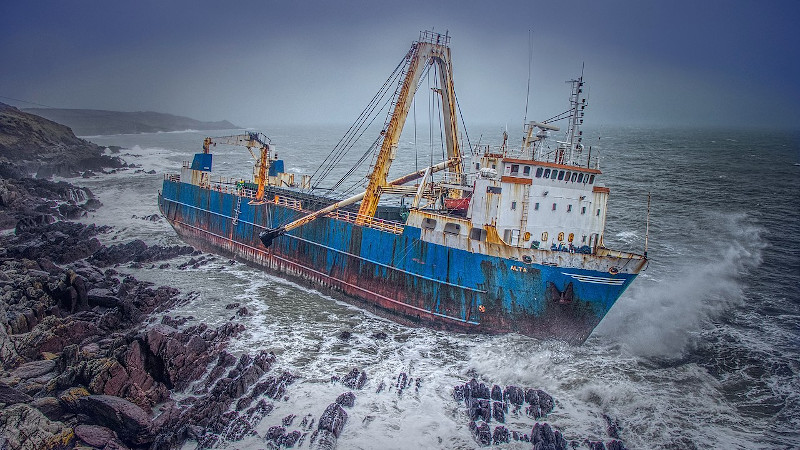
In the news following the storm is a merchant ship that was washed up by this storm on the coast of Country Cork. The MV AltaĀ  is a nearly 2300t and 77m (just over 253 ft) freighter that had been abandoned in 2018 south of Bermuda after a mechanical failure had rendered it incapable of navigation. Its crew had been rescued by the US Coast Guard, and since then — apart from a brief sighting in mid-Atlantic by a Royal Navy polar research vessel — it had passed unseen as a drifting ghost ship before appearing on the Irish coast.

In a very literal sense it had dropped off the radar, but the question for us is how? With the huge array of technological advances in both navigation aids and global sensing available at the end of the 21st century’s second decade, should that even be possible? It’s worth taking a while as land-lubbers to look at how ships are tracked, to try to make sense of the seeming invisibility of something that is after all pretty large and difficult to hide.

One Of These Maps Is Not Like The Other

Some of these distances are not like the others: the familiar Mercator world map projection.
Some of these distances are not like the others: the familiar Mercator world map projection. [Public domain]

Perhaps in understanding this it’s best to start by looking at the scale of the distances involved. We are used to viewing the world in terms of the map on the wall in your primary school. Known as the Mercator projection, a spherical globe has been distorted into a cylinder which can then be unwrapped as a rectangular piece of paper. On this side of the Atlantic they have Europe and Africa roughly in the centre, with the International Date Line skirting New Zealand on their right, and the Pacific ocean and Alaska on their left. Doing this makes it easy for us to create a mental picture of where places are in the world, but creates a significant distortion in our perception of distance.

Greenland for example is many times smaller than its depiction in a Mercator projection, and the distance across the far north Atlantic from Greenland to Norway appears as the same as that from for example New York to Morocco. In reality the former is in the region of 1000 miles while the latter is over 3500 miles. As a comparison the road distance between New York and San Francisco is about 2900 miles.

The Atlantic, It’s Bigger Than You Imagine

The North Atlantic ocean viewed on a spherical globe projection.
The North Atlantic ocean viewed on a spherical globe projection. [Public domain]

Viewing the Atlantic on a spherical projection then shows the true size of the ocean, as the American mid-west is on one horizon and the Middle East on the other, with the sea occupying most of the visible surface. If by some engineering magic there were a road bridge across it I would take about a week to drive the distance in my little hatchback, but in fact aside from a few islands such as Bermuda or the Azores there is nothing. A look at any of the online ship tracking sites that map reports from AIS transponders appears to show it as crowded with shipping, but even then that is an illusion created by the size of the icons on a web page. In fact on those maps each ship is a fraction of a pixel in size on the in-browser map, their optical horizon in the region of 5km is the same, as is their roughly 20 nautical mile X-band radar view.

In that light It’s easy to believe that the captain of a ship such as the Alta could plot a course that would keep it away from other craft and effectively disappear from view in a space that vast. It’s not impossible that without a captain and with its AIS transponder out of action it could also drift unseen through the same space.

You Won’t Find It Unless You Go Looking For It

One of the US Navy's venerable Lockheed P-3 maritime patrol aircraft. US Navy [Public domain]
One of the US Navy’s venerable Lockheed P-3 maritime patrol aircraft. US Navy [Public domain]

So aside from that passing visual encounter with the Royal Naval vessel it achieved the feat of crossing the Atlantic unseen. But surely we live in the 21st century, don’t our governments ceaselessly monitor the waves for would-be enemies? The answer to that is, we hope, yes, but even then it’s fair to say that seeking out drifting Panamanian-flagged merchant ships is unlikely to be a priority.

They may have radar-equipped maritime patrol aircraft in the sky, undersea hydrophones, and satellite monitoring overhead, but all of those things require naval intelligence to direct them towards a vessel of interest. If intelligence indicates a potentially hostile ship has left port, then a formidable array of machinery and technology will shadow its every move. But the Alta, floating rudderless with no one aboard, hardly fits the bill as a threat to global security. Indeed it could have evaded some of those systems anyway, as without the engine or wake of a ship under power to detect, they simply wouldn’t have found it.

We hope the Alta will not cause a headache to the Irish authorities and that perhaps a few extra tourists come and spend their Euros in the area when they come to see it, but if its fate tells us anything it is this: We sometimes like to believe that we are the masters of our world, when in fact over so much of its surface we are still as at the whim of nature as our ancestors were centuries ago when they crossed oceans in tiny wooden craft.

MV Alta header image: Colm Ryan / CC BY-SA 4.0

Share196Tweet123
usiscc

usiscc

  • Trending
  • Comments
  • Latest
Escape From Tarkov – How to Rotate Items

Escape From Tarkov – How to Rotate Items

February 5, 2020
Supply chain examination: Planning for vulnerabilities you can’t control

Supply chain examination: Planning for vulnerabilities you can’t control

December 7, 2019
Procurement Project Manager job with Camden London Borough Council

Procurement Project Manager job with Camden London Borough Council

February 17, 2020
Art Battle Wichita Falls III at The Warehouse, 1401 Lamar.

Art Battle Wichita Falls III at The Warehouse, 1401 Lamar.

0
Global Industry Analysis, Size, Share, Growth, Trends, and Forecasts 2016–2024 – ZMR News Reports

Global Industry Analysis, Size, Share, Growth, Trends, and Forecasts 2016–2024 – ZMR News Reports

0
PHOTOS: Ottawa firefighters respond to warehouse fire

PHOTOS: Ottawa firefighters respond to warehouse fire

0
Last Mile Delivery Market Worth Observing Growth | UPS, FedEx, SF Express

Last Mile Delivery Market Worth Observing Growth | UPS, FedEx, SF Express

April 23, 2024
Top 5 Spend Analysis Software ranked in 2024

Top 5 Spend Analysis Software ranked in 2024

March 1, 2024
How Tesla And BMW Are Leading A Supply Chain Renaissance With Blockchain

How Tesla And BMW Are Leading A Supply Chain Renaissance With Blockchain

January 19, 2024
  • Privacy Policy
  • Terms of Use
  • Disclaimer
  • DMCA
  • Contact Us

Copyright Ā© 2024 United States International Supply Chain Commission (usiscc.org)

This website uses cookies to improve your experience. We'll assume you're ok with this, but you can opt-out if you wish. Cookie settingsACCEPT
Privacy & Cookies Policy

Privacy Overview

This website uses cookies to improve your experience while you navigate through the website. Out of these cookies, the cookies that are categorized as necessary are stored on your browser as they are essential for the working of basic functionalities of the website. We also use third-party cookies that help us analyze and understand how you use this website. These cookies will be stored in your browser only with your consent. You also have the option to opt-out of these cookies. But opting out of some of these cookies may have an effect on your browsing experience.
Necessary
Always Enabled

Necessary cookies are absolutely essential for the website to function properly. This category only includes cookies that ensures basic functionalities and security features of the website. These cookies do not store any personal information.

Non-necessary

Any cookies that may not be particularly necessary for the website to function and is used specifically to collect user personal data via analytics, ads, other embedded contents are termed as non-necessary cookies. It is mandatory to procure user consent prior to running these cookies on your website.

SAVE & ACCEPT
No Result
View All Result
  • Supply Chain
  • Logistics
  • Warehousing
  • Procurement
  • Shipping
  • More
    • Strategic Sourcing
    • Spend Analysis
    • Inventory
    • Contact Us

Copyright Ā© 2024 United States International Supply Chain Commission (usiscc.org)







