







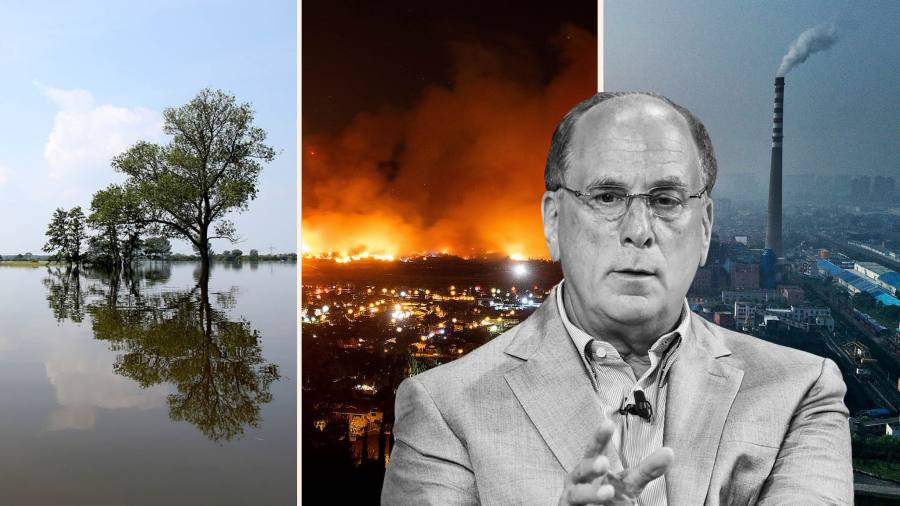
BlackRock chief Larry Fink has warned that the world’s largest asset manager will take a “harsh view” of companies that fail to provide hard data on the risks they face from climate change.
As part of his annual missive to chief executives last week, Mr Fink said the $7tn asset manager had spent “several years” talking to companies about their preparations to report on the risks and opportunities they faced from global warming. Now the time had come, he said, for companies to disclose those details.
In the letter, Mr Fink said that by the end of the year he wanted all companies to “disclose in line with industry-specific” guidelines set out by the SASB — the Sustainability Accounting Standards Board, a non-profit organisation that sets voluntary financial reporting standards.
He also called for businesses to report under the TCFD, or the Task Force on Climate-related Disclosures, a voluntary framework that was spearheaded by Mark Carney, the outgoing governor of the Bank of England.
“We want better transparency and better understanding,” Mr Fink told the Financial Times. “What we are seeking is better information [from companies on ESG] to have better judgment.”
Mr Fink’s endorsements of SASB and the TCFD have the potential to have far bigger ramifications immediately than the asset manager’s headline grabbing plans to divest from companies that generate 25 per cent of revenues from thermal coal or its plans to increase the number of exchange traded funds that invest sustainably.
Many public companies will now come under pressure from one of their biggest shareholders to disclose in line with those standards. At the same time, rival asset managers are likely to follow in BlackRock’s footsteps and adopt the two frameworks as part of their own investment process.
Huw van Steenis, chair of the sustainable finance committee at UBS and a former senior adviser to Mr Carney, says: “2020 may be the year when climate-risk analysis of portfolios moves out of a niche into the mainstream. Investors and boards have begun to realise that it can be more costly to ignore these issues than to try to grapple with them.
“Better metrics — harnessing TCFD and SASB as the gold standards — will be critical to mobilising capital and helping investors make better informed decisions.”
Tim Buckley, director of energy financial studies at the Institute for Energy Economics and Financial Analysis, says there is a growing need for companies to report in a coherent manner. “If you don’t have consistent disclosure in each sector, companies choose and self disclose the measures they track and that they think are important,” he says.
BlackRock’s elevation of SASB and the TCFD, however, comes at a time when the investment industry is grappling with an “alphabet soup” of different standards. Numerous international organisations have been created to support better reporting on ESG issues in recent years, causing Robert Eccles, a visiting professor of management practice at Saïd Business School and SASB’s first chairman, to claim last year that investors were overwhelmed by the “alphabet soup” of arbiters in the ESG industry.
Established in late 2015, the TCFD is a relatively recent initiative but it is influential thanks to its backing by the Financial Stability Board, a body that makes recommendations to the G20 group of nations. Last summer, the TCFD said it had the backing of almost 800 organisations.
The TCFD applies to financial companies primarily, while San Francisco-based SASB, which traces its roots to 2011, can be applied to all companies, meaning that the two can be blended.
Businesses such as General Motors, Nike and Kellogg’s have signed up to report in line with the accounting standards, which BlackRock has been involved with for several years including as part of its investor advisory group. In 2018 SASB unveiled guidelines for how companies should report financially material ESG concerns in 77 industries, from clothing to telecommunications.
Elsewhere, the Amsterdam-based Global Reporting Initiative is another prominent ESG reporting framework. A survey from law firm Shearman & Sterling last year found that the GRI, which started in 1997, was the leading reporting framework embraced by companies ahead of SASB or TCFD.
But GRI has a reputation for being tougher, calling on companies to report more information than SASB, which only requires businesses to detail material ESG risks they might confront but have not traditionally talked about.
Janine Guillot, chief executive of SASB, says the standard setters are not in competition. “SASB is uniquely designed for investors,” she says. “On top of that the world needs a broader set of standards on how companies affect the world, and that’s where the GRI comes in.”
Mr Fink told the FT that BlackRock had endorsed the TCFD and SASB because of the “flexibility” of the standards.
“If there is a better standard tomorrow we will use it,” he said. “We made a judgment call at this moment that the best standard at the moment, which has the greatest flexibility, is SASB.”
For companies that fail to adhere to the asset manager’s request, Mr Fink has a warning. “BlackRock will be increasingly disposed to vote against management and board directors when companies are not making sufficient progress on sustainability-related disclosures and […] plans underlying them.”
Mr Buckley says the TCFD is becoming the de facto standard for climate-related risks, while SASB can take on this role for wider ESG reporting.
The world’s largest asset manager, as well as the world’s largest pension fund — Japan’s $1.5tn Government Pension Investment Fund — and the world’s largest sovereign wealth fund, Norway’s oil fund,
all say they would use the TCFD in their investment portfolios.
“It is no longer voluntary,” Mr Buckley says. “The TCFDs are becoming almost a prerequisite for companies and the investors who invest in them.”
Axel Pierron, managing director of Opimas, a financial services consultancy, says that frameworks such as SASB, GRI and the TCFD all focus on the notion of materiality in ESG analysis.
“It is not surprising that BlackRock is integrating these approaches to ensure that climate change risk is well identified and integrated into its investment strategy,” he says.
But he questions whether SASB or the TCFD will become the global sustainability frameworks for companies and investors, pointing out that new EU regulations could potentially create default standards in the asset management industry in Europe.
“While these two standards will certainly benefit from BlackRock support to gain even greater adoption, one should not conclude that BlackRock’s adoption of the two standards will mean a de facto dominance of these approaches, given the current level of debate among scientists around climate change scenarios,” he adds.
A senior executive at a large European asset manager, however, says he believes the TCFD will become the global framework for reporting climate risk. But he issues a note of caution about SASB, saying: “I have high hopes for it. But it is very American right now. There are not too many European companies or investors backing it.”
Natasha Landell-Mills, head of stewardship at Sarasin & Partners, adds that having consistency in reporting is a good thing.
But she argues: “What BlackRock — indeed all investors — should demand first and foremost, though, is that companies ensure material climate risks are incorporated into their core financial statements. There is no need for a whole new set of accounts for this.”










