






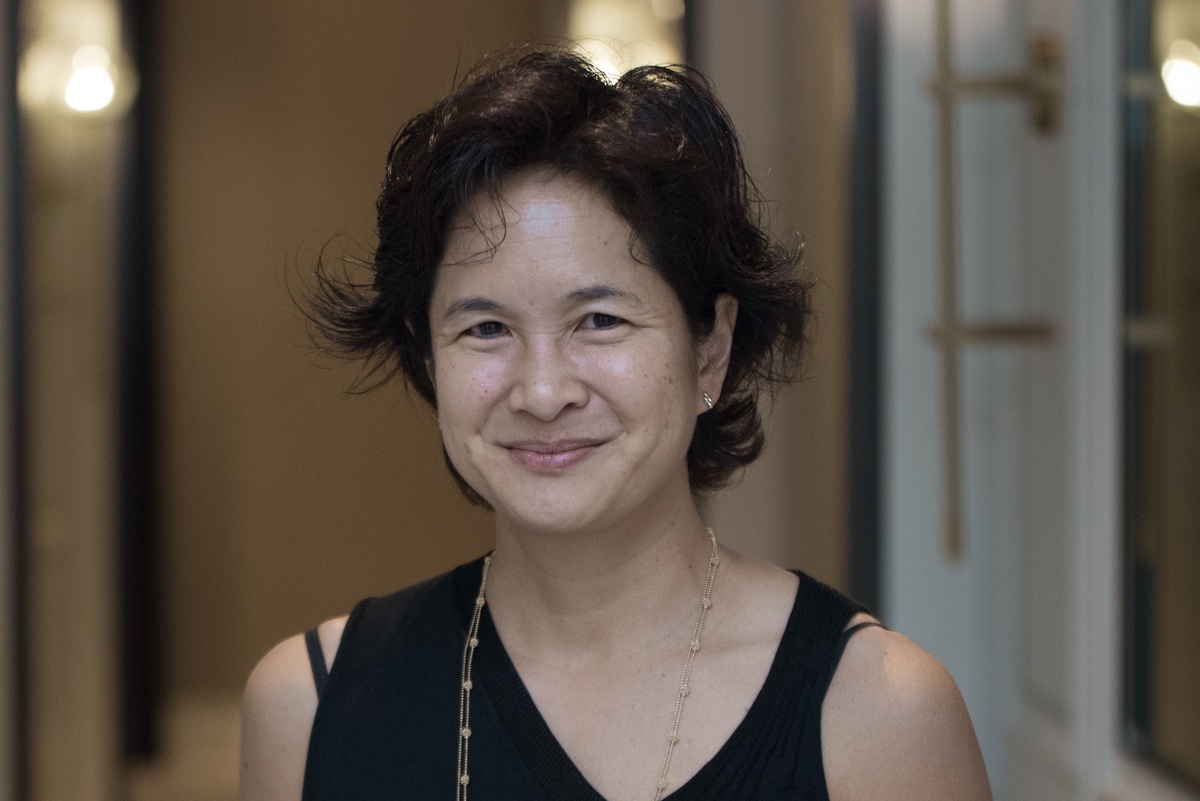
Pamela Mar’s dream is to see a garment worker in a factory rising to become a clothing designer through online education.
Mar, the executive vice-president of supply chain futures at Fung Academy and director of sustainability at Fung Group, is a believer in the potential of technology and innovation to drive sustainability.
“Eventually, mobile is going to be the way everyone learns in the future. It already is for many people, but especially in countries with weaker educational systems,” said Mar, whose employer is a Hong Kong-based supply chain and logistics conglomerate.
The rollout of the WorkerApp—a joint initiative by the Fung Academy (Fung Group’s learning arm) and Li & Fung (a member of the Fung Group)—is the most important task she has accomplished in the past year, she said.
The free app improves the human resource practices of factories, and allows workers to be educated on topics like health and finance, such as how to avoid being ensnared by moneylenders, she said.
Mar is one of nine individuals who made Eco-Business’ inaugural A-List, a who’s who of Asia Pacific’s most influential corporate sustainability executives, who have done the most to make business less harmful for people and planet over the last 12 months.
Before joining Fung Group, she held roles in Chinese electronics manufacturer TCL Multimedia Technology Holdings and the World Economic Forum, among other organisations.
“
The only thing that humans can do better, right now, than machines, is spot the next opportunity.
The New York native tells Eco-Business how growing up in cities made her treasure nature.
What sparked your interest in sustainability?
I’ve always had an interest in social development, which is part of sustainability because it’s all about how we help developing countries get out of poverty, and how we support their citizens to get empowered and improve their quality of life, to be able to achieve any ambition.
And the environmental side is about treasuring nature. I grew up in cities and I know how to appreciate nature, because I didn’t have it when I was growing up! I was born in New York and my family moved every four or five years, so I moved from New York to Tokyo, to Washington DC, to Hong Kong.
I’ve moved around a lot, but I’ve always lived in cities. So I really see how society doesn’t always treasure nature as it should.
What is the hardest thing about your job?
The hardest thing about my job is convincing people that a sustainable future is as good as what we have today, and possibly even better. People have habits, and they like to do the same things over and over again, because that’s their comfort zone. So it’s getting people to step out of their comfort zone and dispense with their mental models about how they view business, and say, “Okay, how do we actually improve the way the world works using sustainability as a lens?”.
We’ve always used a financial lens (how do we make more money?) and a speed lens (how do we do things faster?), and sustainability is a new lens for people and they’re not quite familiar with it.
We need to educate everyone and really show them, using case studies and projects and pilots and business models, that a sustainable future is actually better than the present.
What is the most important thing that you’ve done in the past year?
We’re rolling out a free mobile app for workers. The WorkerApp basically enables factories that the Fung Group works with to educate and engage workers. It improves the human resource practices of factories, while allowing the workers to get educated on a range of topics from health and financial, to sustainability.
Eventually, mobile is going to be the way everyone learns in the future. It already is for many people, but especially in countries with weaker educational systems. We want to put more and more onto this mobile platform and offer it to factory workers.
My dream is that a factory worker who starts as just a sewing line worker can actually educate herself to become a clothing designer through online education.
We’re rolling that out and we’ve made a lot of big strides in Vietnam, Indonesia and India, with over 40 factories using the app, benefitting thousands of workers. I’m really happy about that this past year.
What is the biggest question that CSOs should be asking themselves this year?
Are you moving fast enough to push out new business models which will drive a sustainable future?
We always need to say, “Okay, we’re doing all the required things, such as audits, compliance, disclosure, dealing with investors and so on. But what next?” We have to actually innovate the field of sustainability. Because every time there’s new technology, that enables us to do even more. So we need to always push ourselves to seek that greener path, that new business model.
What is the most effective way to get your CEO to take sustainability seriously?
I think many company heads already get it. They know that sustainability is important to the company’s future competitiveness.
The question is, how do we get there? We basically need to show them that we can be sustainable, because there are consumers out there who would buy sustainable goods, and there are governments which are only going to let us operate if we are sustainable. There are investors who will invest in us because we are sustainable. It’s all about giving them the business case.
The moral case is clear. It’s just a question of, what are the trade-offs that you’re willing to make? And so we need to show them that those trade-offs are quite small.
If you could start your sustainability role all over again, what would you do differently?
I think I would collaborate more within the industry. Because collaboration helps us all achieve more, faster. The problems that we’re solving, especially ones inside the supply chain—such as modern slavery, wages, and education—are too big for any company to solve alone.
And the thing is, it really doesn’t matter whether a worker is in one of our factories or one of our competitors’ factories; that worker moves around.
So we need to share what we know, share everything about what has worked and what hasn’t, so that more people can get on board.
It used to be that sustainability was a tool to make a company’s reputation better. But when one company does a bad thing, it reflects on all of us. So, my interest is actually in making the whole industry better.
What is your unsustainable guilty pleasure?
Travel.
Why will you never replaced by a robot?
I might be, because sustainability is all about using information that you have to make a better decision. And sometimes there may be too many data points for the human mind to grapple with more effectively than a computer; that’s where we shouldn’t be afraid to allow computers to do the filtering for us.
The only thing that humans can do better, right now, than machines, is spot the next opportunity. Because that is about values, about society, and how fast change is happening, and I don’t think computers can really predict that yet.
Then there’s the need for accountability. Because if the computer makes a mistake, you need someone to be where the buck stops.
What buzzwords in sustainability could you do without?
“Shared value”, because I think any business that is actually governed properly is already thinking in terms of shared value.
I think “triple bottom line” and “CSR” (corporate social responsibility) imply that the normal course of business doesn’t include social relevance, which of course it should.
The Intergovernmental Panel on Climate Change’s 10-year climate deadline to reduce emissions to avoid the worst consequences of climate change. Will we make it, or are we doomed?
It’s not looking good. But I think humans have a way of coping with the natural environment and I think we will find a way to cope.
The challenge will be to make sure that those who are able to cope, are not just the rich. So, the role of government needs to be a lot better at distributing in society, to share the losses and the gains more equally, because I think a lot of dislocation is going to happen.
But are we going to end up underwater? It’s difficult to say.
Pamela Mar was one of nine sustainability executives selected for the EB A-List in 2019. Read our other interviews with the A-Listers here.
Eco-Business will be calling for nominations for the 2020 A-List in September. Do you know a corporate sustainability leader who is really moved the needle for their business and industry? Bear them in mind for our next call for nominations.
Thanks for reading to the end of this story!
We would be grateful if you would consider joining as a member of The EB Circle. This helps to keep our stories and resources free for all, and it also supports independent journalism dedicated to sustainable development. For a small donation of S$60 a year, your help would make such a big difference.










