


• Latest
  • Trending
  • All
Metric of the Month: Trends in Structuring Supply Chain Analytics

Metric of the Month: Trends in Structuring Supply Chain Analytics

February 1, 2020
Last Mile Delivery Market Worth Observing Growth | UPS, FedEx, SF Express

Last Mile Delivery Market Worth Observing Growth | UPS, FedEx, SF Express

April 23, 2024
Top 5 Spend Analysis Software ranked in 2024

Top 5 Spend Analysis Software ranked in 2024

March 1, 2024
How Tesla And BMW Are Leading A Supply Chain Renaissance With Blockchain

How Tesla And BMW Are Leading A Supply Chain Renaissance With Blockchain

January 19, 2024
LATAM Cargo strengthens European cargo links

LATAM Cargo strengthens European cargo links

April 14, 2020
Ford making reusable hospital gowns from airbag materials as efforts against coronavirus expand

Ford making reusable hospital gowns from airbag materials as efforts against coronavirus expand

April 14, 2020
Don’t Sweat NBC’s Decision to Cut Back on Television Ad Inventory

Don’t Sweat NBC’s Decision to Cut Back on Television Ad Inventory

April 14, 2020
Software firms sharpen focus on AI, big data as IT spending drops

Software firms sharpen focus on AI, big data as IT spending drops

April 14, 2020
Navigating turbulent times in your supply chain (TL:DR version)

Navigating turbulent times in your supply chain (TL:DR version)

April 14, 2020
Last Mile Delivery by Drones Market is Booming Worldwide

Last Mile Delivery by Drones Market is Booming Worldwide

April 14, 2020
AIR CARGO MARKET SIZE, SHARE, DEMAND, TREND, LATEST INNOVATIONS & APPLICATION ANALYSIS AND INDUSTRY GROWTH FORECAST 2027 – Science In Me

AIR CARGO MARKET SIZE, SHARE, DEMAND, TREND, LATEST INNOVATIONS & APPLICATION ANALYSIS AND INDUSTRY GROWTH FORECAST 2027 – Science In Me

April 14, 2020
Wheat procurement in Patiala: 6,500 coupons issued to farmers – cities

Wheat procurement in Patiala: 6,500 coupons issued to farmers – cities

April 14, 2020
Pandemic, Plastics And The Continuing Quest For Sustainability

Pandemic, Plastics And The Continuing Quest For Sustainability

April 14, 2020
  • Supply Chain
  • Logistics
  • Warehousing
  • Procurement
  • Shipping
  • More
    • Strategic Sourcing
    • Spend Analysis
    • Inventory
    • Contact Us
No Result
View All Result
United States International Supply Chain Commission
Home Supply Chain

Metric of the Month: Trends in Structuring Supply Chain Analytics

by usiscc
February 1, 2020
in Supply Chain
0
Metric of the Month: Trends in Structuring Supply Chain Analytics
492
SHARES
1.4k
VIEWS
Share on FacebookShare on Twitter

In 2019, APQC conducted research on the implementation of analytics in supply chain and compared results to those gathered in 2016. A lot has changed for the better in three years: APQC found that many organizations have made great strides in their supply chain analytics efforts. For example, 78% of respondents to APQC’s 2019 survey agree or strongly agree that analytics is ingrained in how their organizations conduct business and manage performance—an increase from just under 60% in 2016. Faced with vast and ever-growing amounts of data, the number of supply chain leaders that actively turn to analytics for decision making support is growing.

Analytics structures

The research in both 2016 and 2019 examined how organizations structure their analytics programs at the supply chain level. Additionally, APQC conducted a similar investigation into analytics at the enterprise level (i.e., across the entire organization or corporation). In its research, APQC defined analytics program structures as follows:

  • Centralized: managed through a central corporate department or center of excellence
  • Decentralized: analytics staff or programs are located within business units
  • Hybrid: combines a centralized oversight structure with staff embedded in the businesses

Broadly speaking, the structure of an analytics program can reflect an organization’s analytics needs as well as the maturity of its analytics efforts. For example, organizations with specific analytics needs (such as understanding customer demand) will generally opt for function-specific analytics teams and a decentralized governance structure. Organizations with enterprise-wide data initiatives, top-down mandates from executive management, or a desire to leverage pre-existing analytics capabilities generally choose a hybrid model, which leverages a centralized governance team with decentralized implementation teams in each business unit or location.

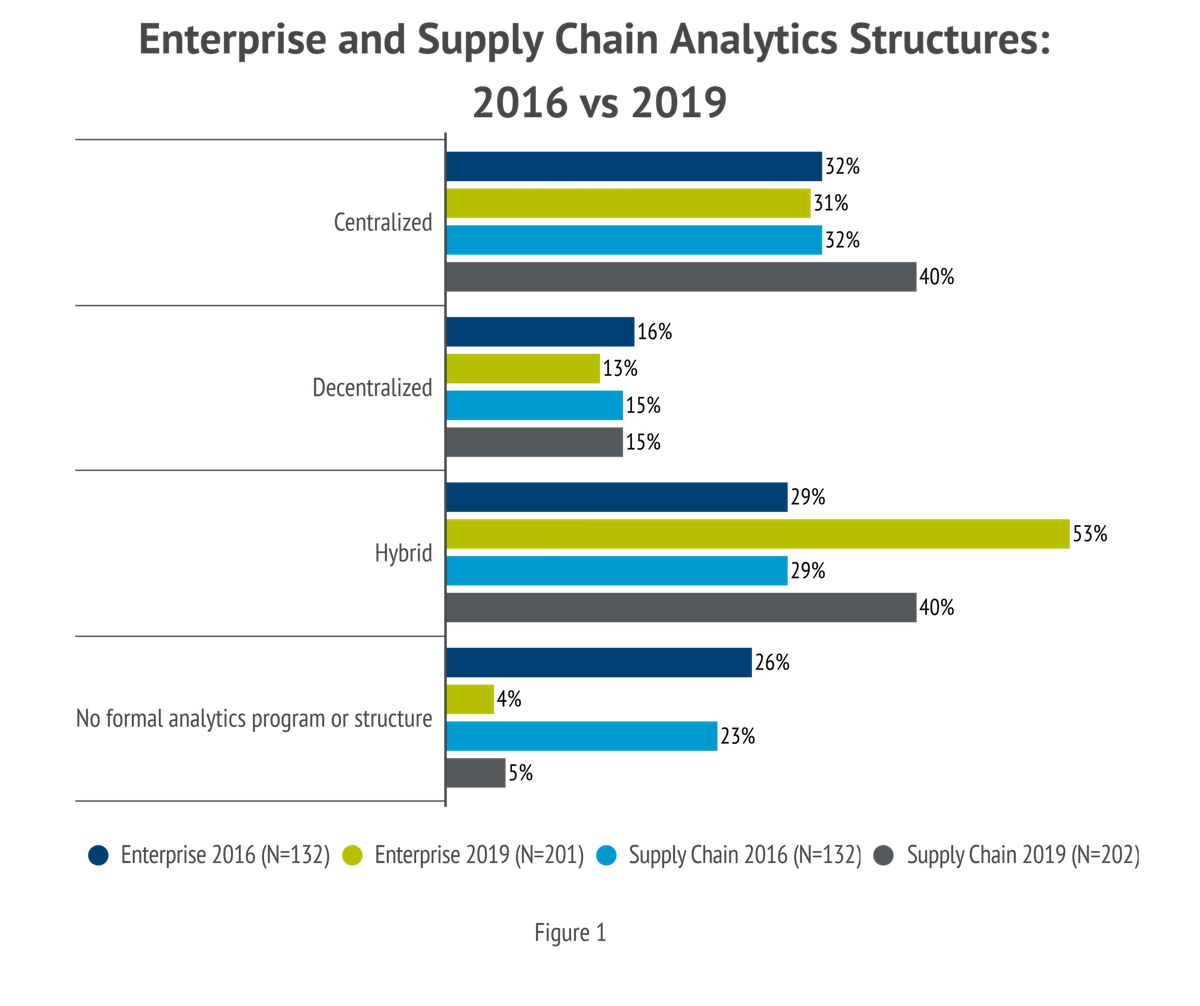
Figure 1 compares the structure of analytics programs at the enterprise and supply chain levels in 2016 and 2019. The data shows a clear decrease in organizations with no formal analytics program or structure at both the enterprise and supply chain levels, consistent with the growing popularity of analytics across organizations. Although the percentage of organizations with a decentralized structure has remained relatively static over the last three years, there has been a marked increase in organizations using a hybrid structure at both the enterprise and supply chain levels.

While there is no one-size-fits all approach for an analytics program structure, APQC has found several reasons why organizations increasingly find the hybrid model attractive. Centralized governance provides better strategic alignment, accountability, consistent communication, and implementation planning. Decentralized implementation teams, meanwhile, create accountability within each location or business unit for the adoption of new technologies, responsibilities, and behaviors. These decentralized teams also help ensure that analytics projects meet each location’s or unit’s unique needs and integrate subject matter expertise as needed. In this way, hybrid structures help organizations combine a holistic perspective and centralized guidance with the flexibility and insights into business needs provided by decentralized implementation.

At the supply chain level in 2019, the same percentage of organizations opted either for a hybrid structure or centralized structure. These results indicate that in the supply chain, organizations see value in both centralized guidance and the hybrid approach.

One trend that has remained constant is that a majority of supply chain professionals in both 2016 and 2019 indicated that their organizations had increased investments in analytics over the prior three years. With increased investment and a greater adoption of more advanced types of analytics, organizations’ analytics programs have become more successful and more mature over the last three years. In 2016, only 33 percent of organizations considered their analytics programs to be very effective or effective in solving strategic challenges. By 2019, more than 66 percent of respondents rated their organization as effective or very effective.

While it is impossible to say what the next three years will bring, one thing APQC knows for sure is the importance of data and analytics for supply chains moving forward. No longer a competitive differentiator, a strong data and analytics program is increasingly a necessity for supply chains in a volatile, chaotic, uncertain, and ambiguous world. Given the current ubiquity of big data and analytics, supply chains that lack effective analytics capabilities within the next three years will likely find themselves scrambling to catch up.

APQC helps organizations work smarter, faster, and with greater confidence. It is the world’s foremost authority in benchmarking, best practices, process and performance improvement, and knowledge management.         

Share197Tweet123
usiscc

usiscc

  • Trending
  • Comments
  • Latest
Escape From Tarkov – How to Rotate Items

Escape From Tarkov – How to Rotate Items

February 5, 2020
Supply chain examination: Planning for vulnerabilities you can’t control

Supply chain examination: Planning for vulnerabilities you can’t control

December 7, 2019
Procurement Project Manager job with Camden London Borough Council

Procurement Project Manager job with Camden London Borough Council

February 17, 2020
Art Battle Wichita Falls III at The Warehouse, 1401 Lamar.

Art Battle Wichita Falls III at The Warehouse, 1401 Lamar.

0
Global Industry Analysis, Size, Share, Growth, Trends, and Forecasts 2016–2024 – ZMR News Reports

Global Industry Analysis, Size, Share, Growth, Trends, and Forecasts 2016–2024 – ZMR News Reports

0
PHOTOS: Ottawa firefighters respond to warehouse fire

PHOTOS: Ottawa firefighters respond to warehouse fire

0
Last Mile Delivery Market Worth Observing Growth | UPS, FedEx, SF Express

Last Mile Delivery Market Worth Observing Growth | UPS, FedEx, SF Express

April 23, 2024
Top 5 Spend Analysis Software ranked in 2024

Top 5 Spend Analysis Software ranked in 2024

March 1, 2024
How Tesla And BMW Are Leading A Supply Chain Renaissance With Blockchain

How Tesla And BMW Are Leading A Supply Chain Renaissance With Blockchain

January 19, 2024
  • Privacy Policy
  • Terms of Use
  • Disclaimer
  • DMCA
  • Contact Us

Copyright © 2024 United States International Supply Chain Commission (usiscc.org)

This website uses cookies to improve your experience. We'll assume you're ok with this, but you can opt-out if you wish. Cookie settingsACCEPT
Privacy & Cookies Policy

Privacy Overview

This website uses cookies to improve your experience while you navigate through the website. Out of these cookies, the cookies that are categorized as necessary are stored on your browser as they are essential for the working of basic functionalities of the website. We also use third-party cookies that help us analyze and understand how you use this website. These cookies will be stored in your browser only with your consent. You also have the option to opt-out of these cookies. But opting out of some of these cookies may have an effect on your browsing experience.
Necessary
Always Enabled

Necessary cookies are absolutely essential for the website to function properly. This category only includes cookies that ensures basic functionalities and security features of the website. These cookies do not store any personal information.

Non-necessary

Any cookies that may not be particularly necessary for the website to function and is used specifically to collect user personal data via analytics, ads, other embedded contents are termed as non-necessary cookies. It is mandatory to procure user consent prior to running these cookies on your website.

SAVE & ACCEPT
No Result
View All Result
  • Supply Chain
  • Logistics
  • Warehousing
  • Procurement
  • Shipping
  • More
    • Strategic Sourcing
    • Spend Analysis
    • Inventory
    • Contact Us

Copyright © 2024 United States International Supply Chain Commission (usiscc.org)







