









The parent company of the Fatburger franchise is planning on buying a new chain of restaurants, and … [+]
Rizwan Tabassum/ AFP via Getty Images
Fatburger just got a little more juicy thanks to a historic $39.7 million capital infusion that not only involved securities issued on ethereum, but marks the first time investment ratings giant DBRS Morningstar rated securities issued on a blockchain. While the rating itself is on a traditional paper debt security that closed on Friday, Morningstar cited faster access to data about the securities as a result of the increased transparency from using ethereum in its rating document, paving the way for a more pure class of crypto-assets native to the blockchain.
While the investment in Fatburger parent company Fat Brands (Nasdaq: FAT) isn’t huge in terms of total dollars, the firm that structured the investment has several more projects in the pipeline, with the goal of raising a total of $500 million by the end of 2020, in a total debt securities market estimated to be $117 trillion. “It’ll be a transformative event for Fat Brands,” says the company’s president and CEO, Andrew Wiederhorn. “And I’m certain that there will be a number of smaller franchise companies or restaurant companies that want to access the whole business securitization market to access capital rather than term loans from lenders.”
In total, $20 million worth of Class A notes were rated BB by DBRS Morningstar and another $19.7 million in Class B notes were rated B. The fixed rate notes averaging 7.75% per year, are backed by the royalties and initial upfront fees charged to Fat Brands franchisees, including Fatburger, Buffalo’s wings and Ponderosa Steakhouse. In total, 400 stores are contracted to pay these fees, according to the rating, with 200 more scheduled to open. Wiederhorn says $25 million of the debt security will be used to refinance existing debt at a rate he believes will save the company $2 million annually, with the remaining funds being used to acquire additional restaurant brands in the second quarter of this year. “We’re buying a couple brands a year that are primarily franchise brands, adding them to our portfolio and combining the back offices.”
Notably, the Morningstar rating specifically mentions a “shorter forecast performance period and higher visibility into the viability of brands,” as a factor in the rating, something Wiederhorn credits to the tokens issued on the ethereum blockchain. While the rating goes onto specifically mention that the structuring consultant, New York-based Cadence, would issue security tokens to all investors and record the transactions on ethereum, it added a caveat that the security tokens are only “digital representations” of ownership and that the use of blockchain “will only occur outside of and parallel to this transaction and will not govern actual ownership of the notes.”
However, the blockchain does play a crucial role in the actual investment process and distribution. On Friday, the trustee distributed a “waterfall” of payments to investor wallets on the ethereum blockchain, with quarterly payments to come, according to Cadence founder and CEO Nelson Chu. In total the waterfall includes three different ERC-20 tokens issued on the ethereum blockchain, one set of tokens representing each of the tranches and another, called a stablecoin, pegged to the U.S. dollar.
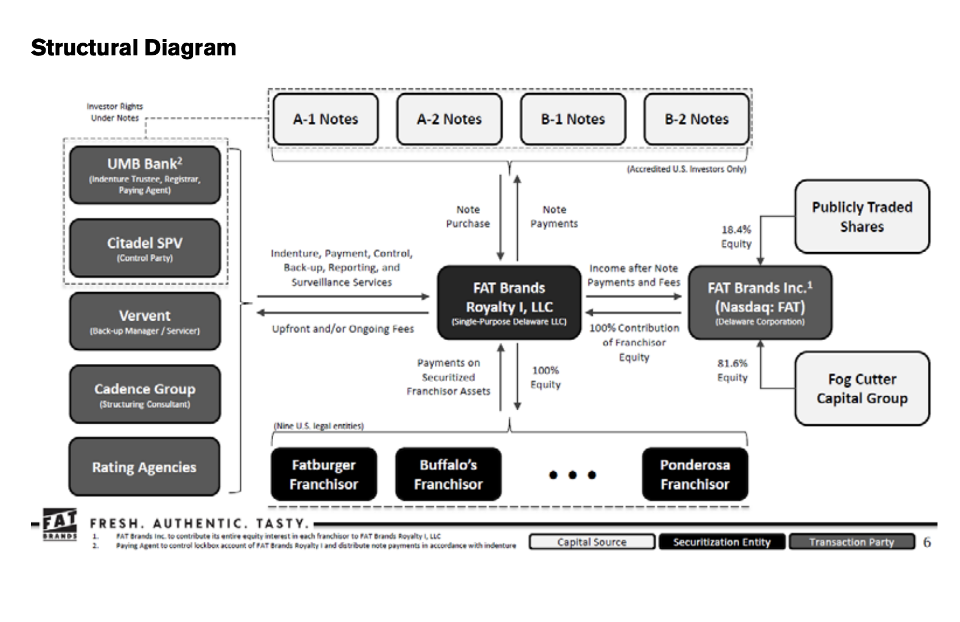
A screenshot from the Fat Brands pre-sale report, issued by DBRS Morningstar.
Cadence
Nearly $40 million worth of stablecoins, called $CDG were transferred to trustee UMB Bank’s wallet, and the issuer, FAT Brands, held approximately 20 million tokens for each of the two tranches in their wallet. When the trade settled, the approximately 80 million tokens were transferred to the respective transaction parties as outlined in the code, also called a smart contract, until all the ownership stakes and all the investment dollars were in the right wallets. In total, there will be 26 steps, all visible to via ethereum block explorers like Etherscan, which similar to what Google search does for the internet, lets anyone search publicly available ethereum information.
“You’ll see when the money that came in, when it went out and how that whole waterfall works,” says Chu. “It’s definitely the first rated securitization with a digital asset element, and we’re using it the way it was intended: to provide that level of transparency.” A pre-sale report prepared by Morningstar goes a step further than just describing some of the potential benefits, providing a definition for blockchain and its potential to improve the debt securities market:
Blockchains digitally record information in a continuous manner and data is stored using distributed ledger technology (DLT). DLT decentralizes and encrypts the storage of information, making manipulation by third parties difficult, which ultimately reduces the potential for fraud.
Fat Brands started working with Cadence in September 2019, shortly after ratings agency Morningstar purchased then-competitor DBRS for $669 million. According to Wiederhorn the merger delayed the ratings process, which ended up taking three months, during which the ratings agency came into his offices to “kick the tires and open the hood,” he says. Then, the official rating was discreetly published in January and after finding the right investors and negotiating the final transaction a week ago, the investment finally closed on Friday. In addition to logging potentially valuable data about how cash flows, including average unit volume (AUV), royalty rate, external party fees, management fees, and other expenses, move from the trustee, UMB Bank, to the backup manager Vervent, the control party, Citadel, and to others, the public ethereum blockchain shows that a single individual bought into the debt instrument, with even more transparency to come.
“If you look up on the Bloomberg terminal, for example, who are the holders of the company’s securities, you can tell in two seconds, right?” Wiederhorn ways. “Anybody who’s got a material position in the company, they’re required to file it and list it in this way.” Cadence CEO Nelson Chu added: “What we’re doing is laying the foundation for a future where securitization will be on-chain from start to finish.”
So far, Cadence has issued 65 smaller, unrated securitizations on the ethereum blockchain, from 12 originators, generating $1 million in interest for investors, with 40 more originators in the pipeline. Similar to the larger, rated securitizations, each of these smaller investments is also searchable on any ethereum block explorer. Chu says the number of new investors has been increasing at a rate of 30% a month for the past few months.
Those investors typically start making the $500 minimum investment, before upping the stakes, to an average investment of about $25,000, he says. Since launching in July 2019, the company has facilitated $70 million in investments, with the goal of about $250 million in investments this year using the smaller service, and another $250 million in total rated issuances on the institutional platform, also this year. “People are getting comfortable with the platform,” says Chu. Cadence charges a 1% annualized fee for its retail platform notes, but doesn’t reveal the fees for the institutional securitizations, which vary per deal.
When an investor signs up for the platform, Cadence automatically gives them a wallet address. Then, when the investment opportunity goes out to market, the company creates a temporary contract that is a placeholder for when the deal actually closes. Finally, when the deal does close, an ethereum token that complies with the ERC-20 token standard is minted for every dollar raised and dispersed, or “airdropped,” as it’s called in the blockchain world, to the appropriate wallet.
For users who are looking for more detailed, traditional access to the data, Cadence submits the contract addresses to Bloomberg, where the debt instruments address, notes section and term sheet are among the very first crypto-assets available on the terminal. “It’s because our assets look and feel like commercial paper that they fit very nicely into Bloomberg ontology,” says Chu. “It’s all kind of tied together.”
However, the blockchain component here is more of an additional value Cadence hopes will attract investors by showing who has invested in what, and what else they have invested in. The actual securitization has an underlying paper contract behind it, Chu explains, adding that the extra step, though more complicated, is crucial in attracting new users. “This takes no adoption from anybody,” he says. “The ability to actually click into the contract, see who’s invested, see how much they put money for, see how often they transact and for how much, is incredibly valuable.” Even the ethereum fees, called gas, automatically changed every time an ethereum transaction is conducted, is paid for by Cadence. “We pay for it as a cost of providing that level of transparency, that we’re hoping to be the foundation for the future,” says Chu.
Prior to founding Cadence, from 2008 to 2012, Chu worked as an analyst at Merrill Lynch, Bank of America, and then BlackRock. In 2013 he founded Lumenary, a consultancy that helped founders who were also early employees of companies with successful exits. He helped the elite demographic raise a total of $300 million by guiding them through product decisions and helping craft pitch decks and other early stage processes. One of those companies was New York-based BlockFi, which makes loans in cryptocurrency, triggering Chu’s interested in other ways the technology made popular by bitcoin could improve traditional finance.
In mid-2018, after seeing a dearth of blockchain companies that met Lumenary’s criteria, Chu and a group of the company’s early employees decided to wind-down operations and start a blockchain business of their own. Briefly, Chu considered issuing shares of real-estate on a blockchain, or helping startups raise capital through initial coin offerings, before settling on debt-issuances, which he says are optimal for using blockchain. The typical small businesses Cadence is courting are expecting a 50% to 60% profit for work done for a larger business, but end up having to wait months for the payment. With such a large margin, the companies can instead pay for the debt security and get paid in a few weeks or days, while only losing a small percent of the profit.
“You have very repeatable, very standardized, very normalized processes,” says Chu. “So they’ll gladly take a loss of 8% just be able to get paid on time in a more prompt manner.” The typical lender, on the other hand, is a high-net worth, accredited investor who traditionally doesn’t have access to this kind of debt, Chu says, which is uncorrelated to a traditional equities portfolio. Chu says most investors get started with a small investment, and increase the amount after a few successful rounds. “This is just an opportunistic way for them to diversify,” says Chu.
In January 2019 Cadence raised a $2 million pre-seed round from insurance company Argo, cryptocurrency exchange Coinbase, Fantail Ventures, INBlockchain, a group of Chinese bitcoin whales, and a “multi-billion dollar Chinese family office who has ties to several of the largest asset managers in the industry,” according to Chu. An unannounced seed-round has also just closed. While the retail platform is designed for smaller debt issuances, the Fat Brands deal is the first to use Cadence’s term securitization business, for debt issuances of between $30 million and $75 million. Institutions like credit funds, insurance companies and pension funds are able to buy these securities, which are expected to be rated DBRS-Morningstar.
Chu says the actual act of creating the debt issuance for Fat Brand taught Cadence how to do it again for other companies, adding that two retail partners in the pipeline, are ready to “graduate” to the larger term securitization service by the end of this year. “We know how to create a structure, who to talk to, how to make it all work,” says Chu. “And so we have several originators in our retail platform today that are going to be graduating to this second pillar, that terms securitization side of the market, in the coming months. Now that Chu has mapped out how both retail and institutional debt securities can be coded into smart contracts, he says he’s got his sights on a third source of revenue, software-as-a-service, that is currently in the works. “If we play our cards right in 2020,” ways Chu, “we’ll have set the foundation for the future.”










