




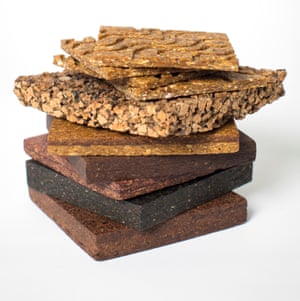
Cocoa husks, dried orange peel, ground blue pea flowers: the ingredients read like a tasting menu. They are, in fact, waste products that are used to make Orb – a sustainable building material that is carbon neutral. It’s versatile enough to be used for furniture or as a substitute for a wood-based sheet material
Orb is produced by Biohm, a startup founded in 2016 by Ehab Sayed. Sayed grew up in Doha, Qatar, and says his home town is one of the “biggest motivators” for him to inspire change. “Although it is the richest country in the world, it is likely one of the least sustainable and a contributor to the climate crisis,” he says. “Growing up in this environment resulted in a resentment towards the impact we are having on our planet.”
Sayed studied design engineering and graduated from Brunel University with an MSc in integrated product design. “I have always been shocked at how manufacturers and material developers don’t extend their responsibility to their product’s end of life and how inefficient our waste management processes are. The concept of waste has never made sense to me,” he says. “It is a human construct that has resulted in major problem.”
During his studies, he conducted two research projects. The first explored which industries caused hazardous levels of waste in the UK. “Everything pointed towards construction,” he says. The second looked at the environmental impact of those waste materials. “That was even more shocking,” he says. Sayed decided that the way to tackle this is to create buildings from natural materials. “I started exploring what could be used, knowing that I absolutely had to find a solution for structural materials, insulation and sheet materials.”
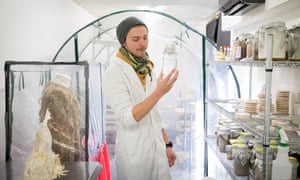
Sayed’s “material development journey” led him to Open Cell, a community of biotech startups based in shipping containers behind Shepherd’s Bush market in west London. With a small team of designers, engineers and scientists, he has developed two materials: Orb, made out of food or agricultural waste, and mycelium insulation, made by feeding waste to the root system of mushrooms.
“The aim is to replace every harmful construction material with something sustainable and higher performing,” Sayed explains. Sheet material and insulation are just two of the products being manufactured: plant-based concrete is in development. So far, mycelium insulation outperforms almost everything on the market. According to Sayed: “The only thing it doesn’t outperform is polystyrene, which is flammable and there are specks of it all over the place.”
The waste used by Biohm comes straight from industry, rather than via a waste management company. Orange peels collected from the staff canteen of a tech giant (a staggering three tonnes of which are produced each week) and the grass cuttings collected from a London airport (up to 47 tonnes per week) are just two of the localised waste streams that go into producing Orb. The orange peel board – which is cork-like in texture and varies in tone from warm honey to rich brown, depending on how long the peel has dried for – is then sold to the company in the form of panels, tiles and risers.
Mycelium insulation can be grown from more toxic byproducts because it can break down petrochemicals and other substances into harmless hydrocarbons, which are then absorbed into the material. Biohm’s researchers discovered this by accident at the beginning of last year when they were developing a strain of mycelium in the lab that slowly grew out of its jar and consumed a nearby plastic sponge. “When we cut the mycelium open, there were absolutely no remnants of the sponge at all,” Sayed explains, “just a small square where it had been.”
Biohm has two labs at Open Cell: one dirty and one clean. “Because we’re working with natural living organisms that do most of the work, there is very little machinery involved,” Sayed says. The equipment set up in the “dirty” lab has been adapted from the food and agriculture industry. There is what looks like a huge bread mixer and a standing press for moulding the boards. There is a sample of Orb: a deep brown square of textured material, that has been dyed with discarding cocoa husks. “It smells like a cereal bar, right?” says Sayed. “It is completely edible: that’s how natural it is.”
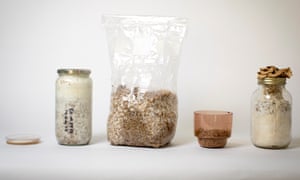
In the “clean” lab, things look a little less familiar. There is a particularly sensitive piece of mycelium growing – a lumpen, organic shape slowly expanding into one corner of the shipping container. Along one wall are jars of mycelium covered in foil lids. Sayed explains that there are up to 5m species of mycelium in the world. Biohm is developing around 300 strains that have been gathered by hand from forests and gardens. They begin the growing process by feeding the mycelium with a nutrient-rich food source, such as grain. This is then mixed with a substrate (the waste product), to see how well it grows. Those that perform well are cloned and developed further by Biohm’s biotechnology engineer.
Because it involves so little machinery, products have high profit margins and a double revenue stream: Biohm is paid to collect waste and can sell on the material created from it. As a result, Sayed claims its products can compete with everything in the market. Customers are contractually bound to return any materials to Biohm at end of life – they are collected free of charge (the cost of this is built in). “This is how far the manufacturer’s responsibility should extend,” insists Sayed. The aim is to challenge the stigma around sustainable materials, making them the affordable norm, as opposed to a rarefied, premium product.
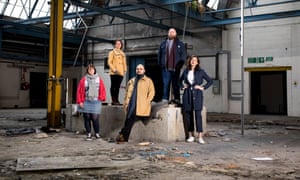
This month, Biohm will open its first mycelium production facility outside London, in a disused paper mill. “We’ve always wanted to have social impact embedded in our business model – we just didn’t know exactly how we were going to do that,” says Sayed. In its second year, Biohm was contacted by the Onion Collective. Based in Watchet, West Somerset. The all-female community business was looking for a pioneering biotech company with global ambitions to replace the 175 jobs that were lost when the town’s paper mill closed in 2015.
“Context is everything,” explains Sally Lowndes, director of the Onion Collective. “When the mill closed, it was completely devastating. It had been operating for 250 years. It was the beating heart of our economy here in Watchet, providing both jobs and our sense of identity.” After the closure of the mill, 20% of the working population lost their jobs. “Watchet is a beautiful place to live, with a strong sense of community, but we have the lowest social mobility in the entire country. We also have one of the oldest populations in the country and the lowest income. We’re a coastal community, one and a half hours from the nearest city. The current economic system doesn’t work for places like ours.” The Onion Collective works to create a new model of local economics and Biohm is at the centre of that plan.
At the old paper mill, 3,000 sq m of mycelium insulation will be produced per month – enough to sequester 16 tonnes of carbon. (“Just by creating the material, we’re having a positive impact,” says Sayed.) The facility will employ 14 local people in the first year, with the aim of rising to 200 over five years. The revenue generated by the facility – estimated at £3m-5m per annum in three years’ time – will provide a profit share that will be retained locally. “This will be a community industry and a beautiful continuation of what was on this site before,” says Lowndes. “We’re thinking deeply about how to counter gentrification and the ways we can bring the whole community along for the ride.”
By partnering with social enterprises, Biohm is able to raise grants to pay for setup costs, employ a local workforce and use local waste streams. A similar project is planned with the YMCA in Newcastle this summer, in which Biohm will provide six-month employment schemes for disadvantaged young people. Governments in Portugal, Germany and the Netherlands have approached Biohm to set up facilities in towns in need of regeneration and there is talk of a facility in Mumbai. “We are both trying to change the world, really,” says Lowndes in summation. Together, they appear to have all the right ingredients.