







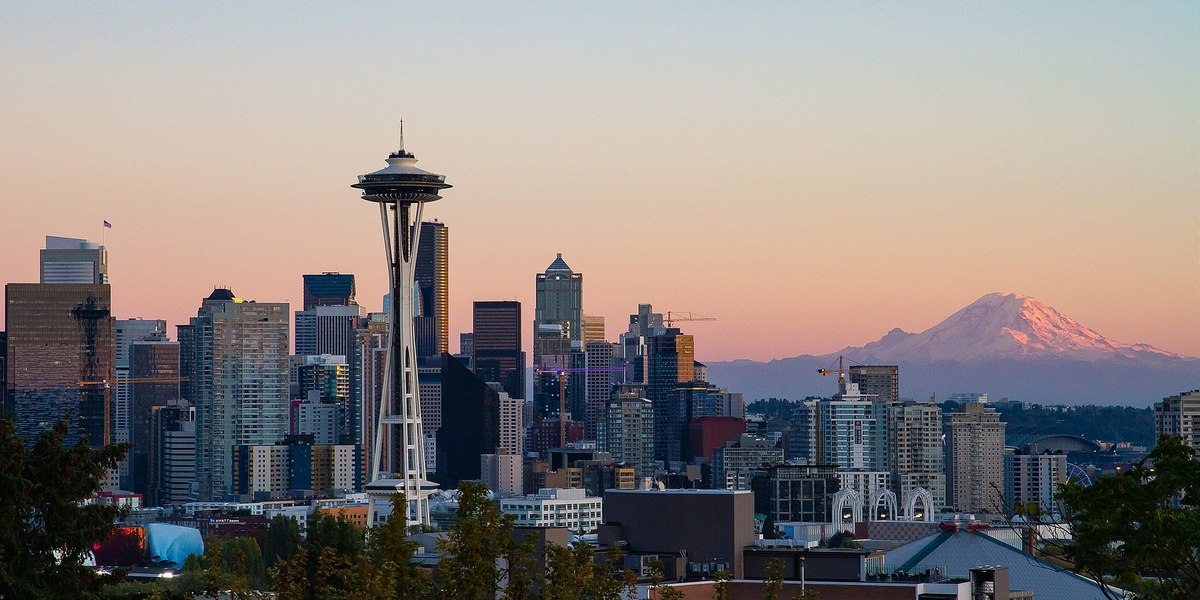
Photograph Source: CommunistSquared – CC0
I am in Seattle for an academic conference, having last been here about ten years ago.
Seattle is a beguiling place, as most who have visited it will know. Since I was born with an aversion to sightseeing and what’s called “tourism”, it is the intertwining of politics and business (capitalism, really) that interests me when I visit a place.
Here Seattle does not disappoint. It is home to Amazon (approx. 25,000 employees), Microsoft (approx. 42,000 employees), Boeing (approx. 80,000 employees), and its other big employers are Joint Base Lewis-McChord (approx. 56,000 employees, both civilian and military), and the University of Washington (approx. 25,000 employees).
In addition, Fortune 500 companies headquartered in the Seattle metropolitan area are Starbucks (#131), Nordstrom (#188), freight-forwarder Expeditors International of Washington (#429) and the timber products company Weyerhaeuser (#341).
All have benefitted from political largesse at the local, state, and federal level, including the University of Washington, which became an internationally-renowned research university in the 60s and 70s thanks in part to the huge amounts of “pork” the powerful senator Scoop Jackson– a Democrat and notorious Cold War hawk– was able to acquire for Washington state.
Seattle is also the fourth-largest container-port in North America.
This intertwining of business and local politics can be problematic.
The late Paul Allen, co-founder of Microsoft and owner of the Seattle Seahawks football franchise (as well as the Portland Trailblazers basketball franchise), while noted for his philanthropy, paid to put the construction of a new stadium for his football franchise to a referendum in order to set-up a public-private partnership that would pay for the construction cost of $430m. The vote went in Allen’s favour, the partnership was set-up, and it required Allen (estimated worth $16 billion) to contribute a mere $130 million of the project’s cost, while the city (i.e. Seattle taxpayers) coughed-up the remaining $300 million. Local media report that some taxpayers consider themselves to have been stiffed by this deal.
Allen also donated $100,000 to defeat the I-1098 Tax the Rich statewide initiative in 2010.
I-1098 would impose an income tax on individuals making over $200,000 a year ($400,000 for a couple) to pay for health care and education.
At that time (2010) Washington state had the most regressive tax structure in the country. The poor paid 17.3% of their income in taxes while the rich paid only 2.6% percent of their income in taxes.
The latest figures (2018) show that Washington is still the most tax-regressive state in the country– the poorest fifth of residents pay 17.8%, the top 1% only pay about 3% of their income in taxes.
Allen is not alone in using money to exert a disproportionate influence on local politics.
A record $4 million was spent on last year’s city council elections, $1.5 of this coming from Amazon. Last week Seattle city Council moved on legislation, almost certainly to be challenged in court, to limit corporate contributions in city elections.
The legislation would limit all contributions to the political-action committees (PACs) that corporations, unions, and other entities use when spending money on elections.
Campaign financing is a legal minefield, so the strategy espoused by the Seattle Council is to align its own legislation with the federal law banning foreign influence in elections.
The Council would ban contributions from corporations with a single non-American investor having at least 1% ownership, two or more non-American investors owning at least 5%, or a non-American investor taking part in decision-making concerning American political activities.
Amazon would fall within the scope of this legislation once it is enacted, but has so far not commented on it.
The target in election spending by Seattle-based corporations has been the independent socialist council member Kshama Sawant, who led a grassroots campaign for an “Amazon Tax”, which was passed unanimously and then repealed a month later.
Jeff Bezos, certainly in the top echelon of those seemingly reluctant to pay even a penny of tax, made strenuous efforts to block this tax. He halted construction on a new skyscraper in an attempt to put economic pressure on the City Council. His other move was to contribute $350,000 to the 2017 election campaign of the mayor Jenny Durkan. Durkan orchestrated the repeal of the Amazon Tax when she won that election.
Sawant—whose campaign slogan is “Who runs Seattle –- Amazon and big business, or working people?”– survived the machinations of the corporations, and won her election.
The legislation limiting campaign contributions may provide politicians of Sawant’s persuasion with better protection from fat-cat adversaries like Jeff Bezos.
The other big item of news in Seattle while I was there concerned the release of internal documents from Boeing to a Congressional investigation regarding the construction and design of the now-grounded Boeing 737-MAX aircraft.
The investigation comes after 2 crashes in which 346 people died, with the blame focused on the aircraft’s flight-control software meant to prevent stalling.
The scandal-ridden Boeing’s contribution to the US economy is massive. The US’s largest export manufacturer, Boeing supports 8,000 suppliers across the US and its troubles have an effect on the economic fortunes of the entire country.
For instance, on Friday last week the aircraft parts manufacturer Spirit AeroSystems announced it was laying off 2,800 workers at its facility in Wichita, Kansas, due to the grounding of the MAX. According to the Council of Economic Advisers, Boeing’s troubles in 2019 cut gross domestic product from March through June by 0.4%.
The released employee documents are shocking– not just for the often ribald language in trash-talking emails which mocked the Federal Aviation Administration (FAA), overseas aviation regulators, the supplier of the MAX simulator, airline customers, and colleagues– but for the widespread culture of deceit within Boeing. To quote The Seattle Times:
“While some of the more memorable quotes may be dismissed as bravado — nothing more than hard-charging guys who “blew off steam” after work, as the lawyer for the lead pilot put it — other, more sober internal emails reveal the pressures the pilots were under from the MAX program leadership. They suggest a troubling Boeing culture that prioritized costs over safety.
All the messages from the leaders of the MAX program “are about meeting schedule, not delivering quality,” one employee laments in a 2018 email”.
One email said the MAX had been “designed by clowns”. Cost-cutting was the primary consideration, as Boeing’s own software designers were replaced by much lower-paid sub-contractors whose credentials were not scrutinized properly (proper scrutiny would have added to costs).
Another cost-cutting measure was flight-simulator training on operating the new flight-control software, which could have prevented the 2 crashes. However, training on simulators costs money.
The released documents show how Boeing made concerted efforts to block any regulatory necessity for airlines to train their pilots in a simulator on the differences between the MAX and its predecessor the 737 NG.
Boeing insisted, falsely, that the MAX and the NG were so similar that experienced pilots could be trained on their differences in a 1-hour session on an iPad—and of course avoiding training on a simulator saved yet more money.
The released documents also show Boeing executives ridiculing the FAA, which, to an alarming degree, allowed Boeing to do its own safety checks during the certification process. One Boeing pilot who gave a presentation to FAA officials during the certification process mocked their poor technical knowledge: “It was like dogs watching TV”.
Boeing sacked Dennis Muilenberg, its CEO, last month, allowing him to walk away with a $62.2 million golden parachute. Sacking him, and hauling a few rogue employees over the coals, is not going to resolve the shambles that is Boeing today.
Making heads roll and holding people accountable is necessary, of course, but Boeing has given little sign that from now on safety is going to be more important than profit margins.
The culture of deception and duplicity fostered in Boeing also arose in a political context that made lax oversight the norm.
Here the omens are not propitious– Donald Trump has used 2 executive orders to reduce regulatory supervision and hand more of that task over to corporations.
The administration’s 2019 budget proposed an 18% cut to the transportation department.
Those airline passengers who fly regularly (as I do) will probably have one piece of advice for the airlines which transport us: for the foreseeable future, buy Airbus instead of Boeing.
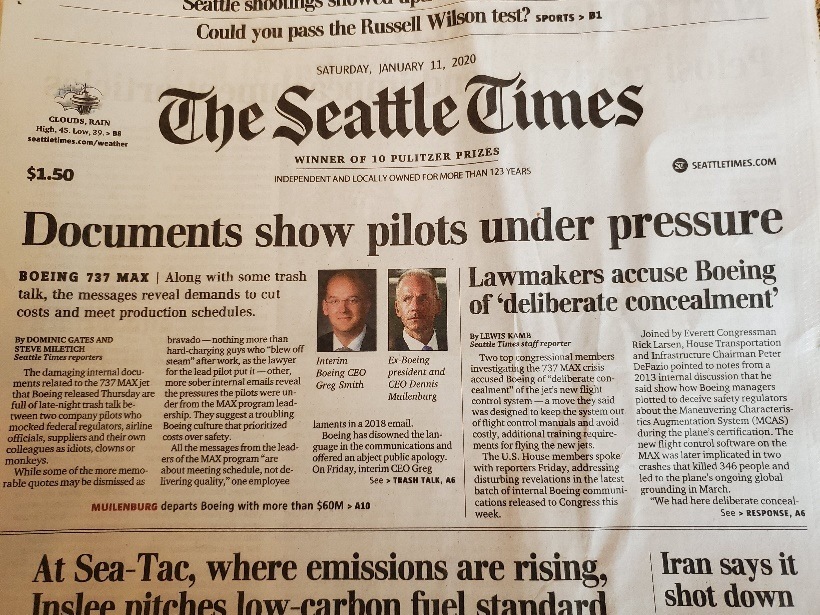
Front page of The Seattle Times (January 11, 2020). Photo: Kenneth Surin.










