






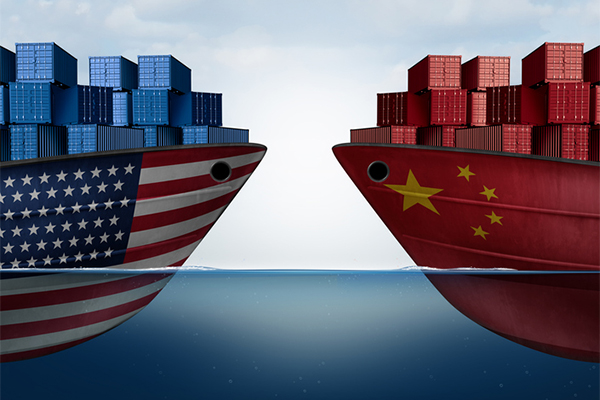
With “Phase One” of the United States-China trade agreement expected to be inked on January 15, there are more than a few moving parts for supply chain stakeholders to keep a close eye one. Logistics Management Group News Editor Jeff Berman recently caught up with Ben Bidwell, Director of U.S. Customs for Minneapolis, Minn.-based global logistics services provider and freight forwarder, to get an up-to-date snapshot of what shippers need to be aware of and watch out for, with the Phase One signing nearly here. A transcript of their conversation follows below.
Logistics Management: What shippers can do to prepare for changes and shifts in tariffs with the Phase One Deal, given the fair amount of uncertainty that has come with tariffs and U.S.-China trade tension?
Ben Bidwell: First and foremost, shippers do need do need to be confident that they are working with a knowledgeable and trusted partner in their Customs broker. There are a number of different things they can do to prepare, whether that is ensuring they are using the proper harmonized tariff number or making sure their Customs bond is sufficient with all the increases in tariffs, which is often overlooked. Those are things that a trusted Customs broker will be looking out for and providing proactive communication with importers to ensure that those things are in order and correct.
LM: What about some other things they can do?
Bidwell: There are also a number of mitigation strategies, so whether it is looking at alternative sourcing locations, the use of Foreign Trade Zones for duty deferment, or drawbacks, which is something a lot of shippers have historically shied away from, because the effective duty rate has been so low over the years that a drawback may not have been a great option. The shipper may not have had a ton of money that was there paid into Customs that they can get back. But now that we are seeing some of these percentages—25%, 15%, 7.5%, etc.—it is certainly starting to look a lot more attractive to individuals.
LM: Looking at supply chain sourcing strategies, there have been some changes related to tariffs with non-China nations like Vietnam, Malaysia, and others seeing gains in import numbers to the U.S. What type of guidance, or a roadmap, do you offer up to shippers, in terms of what they needs to be focused on?
Bidwell: These sourcing changes certainly don’t happen overnight, and they typically involve a rather significant investment. If a shipper is looking to make that change, they need to make sure that it is long-term and sustainable. The last thing you want to do is change a sourcing location with the intent of for the sake of it. There are very few commodities that would allow you to do that. What we have seen are the shippers that have and continue to move away from China…that trend is going to continue. We certainly have some promise with this Phase One trade deal, but it remains to be formally signed. It is important to remember it does not affect List 1, 2, or 3 tariffs, which definitely has a sizable impact to a large number of shippers. I think you are going to continue to see that trend of moving away [sourcing] to a certain extent.
LM: When talking about the sizable investments required for sourcing shifts, what are they geared towards specifically?
Bidwell: It relates to many different components like labor and shipping. The other big one is just the ability of those manufacturers to eat the volume that they had out of China. Are those manufacturers in Vietnam and other areas of the world able to keep up with that same supply and produce the amount of quantity that shippers were getting out of China?
LM: With the Phase One agreement soon to be signed, what advice do you give shippers for how to handle things. There has been a fair amount of “pull forward” with imports to get in front of tariff hikes. Does this result in that decreasing?
Bidwell: I would tell you that absolutely everything is on the table. The resounding answer has been to prepare for uncertainty. Yes, we have a Phase One deal, but we have some other promising and positive steps in the past that have not necessarily come to fruition. With the initial announcement of the Phase One deal, there has certainly been a lot of positive reaction. But as shippers took a step back and really understood what that meant, I think that lessens to a certain extent.
LM: Are your shipper customers, in certain sectors, facing more challenges than those in others? Or has it been more “uniform” regardless of sector?
Bidwell: It has largely been across the board. We have certainly got List 1, 2, and 3, which are in effect, and List 4 really targets different commodities, with a lot of retail goods like footwear and apparel, etc. But really going back to the uncertainty, are we going to see more tariffs, or are some of the existing tariffs going to be reduced or eliminated? Everybody is in the same boat, and we need to prepare for anything that could happen. It is not just looking at China anymore. From a global stage, we are now seeing tariffs in the EU, and we had an incident in 2019 where tariffs were threatened for Mexico. So it is really preparing for anything and having options.
LM: What is your take on the USMCA deal, in terms of if shippers look at is as a positive or an improvement over NAFTA?
Bidwell: Purely from a shipper perspective, there are certainly some very positive things in the agreement. When you look at trade facilitation, that is what I would really focus on [chapter 7 of the USMCA]. There are a lot of positive things in that chapter looking at Customs brokers in Mexico and some of those limitations around brokers. There are also different things around fairness and making sure that all countries have certain things available online, whether it is how to import/export, tariff schedules. There are some things in chapter 7 that if and when implemented will help trade facilitation within the countries.
LM: What would be an ideal scenario for the next three-to-six months, if things go smoothly on the global trade front?
Bidwell: There is a lot of uncertainty out there. For shippers, I would really stress that anything that would give them certainty for things like how to prepare for an increase in tariffs, a reduction in tariffs, or an elimination in tariffs….something to give shippers some certainty on how to plan for whatever is going to happen. The other issue is the timeliness of things. Look at the List 4B tariffs that were supposed to go into effect on December 15. The announcement of that elimination came two days prior. Anything that would give shippers the ability to plan ahead of time would be ideal.
About the Author

Jeff Berman, Group News Editor
Jeff Berman is Group News Editor for Logistics Management, Modern Materials Handling, and Supply Chain Management Review. Jeff works and lives in Cape Elizabeth, Maine, where he covers all aspects of the supply chain, logistics, freight transportation, and materials handling sectors on a daily basis. Contact Jeff Berman










