






Falling commodity prices makes recycling a money-losing operation for Wilmington-area governments
As late as April 2018, SONOCO Recycling LLC was writing checks to New Hanover County to pay for materials recycled by county and Wilmington residents and businesses.
Those materials, including glass and co-mingled items such as plastics and paper, were, for the most part, sent overseas to be sorted and recycled into new products.
Then the bottom suddenly dropped out of the market.
“Starting in early 2018, East Asian governments began banning, limiting or more heavily regulating U.S. recyclable exports,” according to the “The State of Recycling In North Carolina” from U.S. PIRG Education Fund and Environment North Carolina.
In December, New Hanover County paid SONOCO $9,382 to take those same recyclable materials off its hands. The county then billed the city for its share of the cost.
The PIRG report essentially lays the blame for the sudden shift of recycling costs on what it says is the United States becoming dependent on exporting its recyclables.
“The United States failed to curb the rise of plastic, failed to build domestic demand for recycled material, and failed to ensure that product designers considered the end life of their products,” the report states.
Shared blame
Joe Suleyman, environmental management director for New Hanover County, said individuals also share in the responsibility for the situation.
“Let’s not forget that consumers have a big role in that, too, in their choice of products they choose to purchase or not purchase,” he said.
Some recyclable materials, especially plastics, that once were sold to overseas markets are now more likely to be dumped in landfills.
The PIRG report says that in fiscal year 2016-2017, North Carolina landfilled more than 9.7 million tons of waste and recovered 1.7 million tons for a recovery rate of 14.9 percent, which the report described as low.
Micki Bozeman, Brunswick County’s solid waste and recycling coordinator, said the report’s weight of landfilled materials encompasses more than the usual household recyclables and includes such things as compostable materials and tires.
North Carolina has a very strong infrastructure for recycling, Bozeman said.
“We have 15 MRFs (materials recovery facilities) in the state that do the sorting for us, over 60 manufacturers that need the materials – 640 recycling companies throughout the state,” Bozeman said. “We are standing strong on that aspect.”
Falling recycling rates
But the report says since 2017, “it appears that North Carolina’s recycling system has declined.”
“In response to international waste trade restrictions, municipalities across the state have scaled back the list of recyclable materials they will accept, including glass and some plastics,” the report states.
New Hanover County is no exception.
“For the last almost two years now there has been no market for plastics 3 through 7, which has caused that stuff to go to landfill” along with mixed papers, Suleyman said.
Common household goods made from those plastics include food wrappings, many toys, grocery bags, disposable diapers, take-out food containers, plastic cutlery, baby bottles and sippy cups.
But the markets remain healthy for plastics 1 — which includes water bottles — and 2 aluminum, he added.
How New Hanover recycles
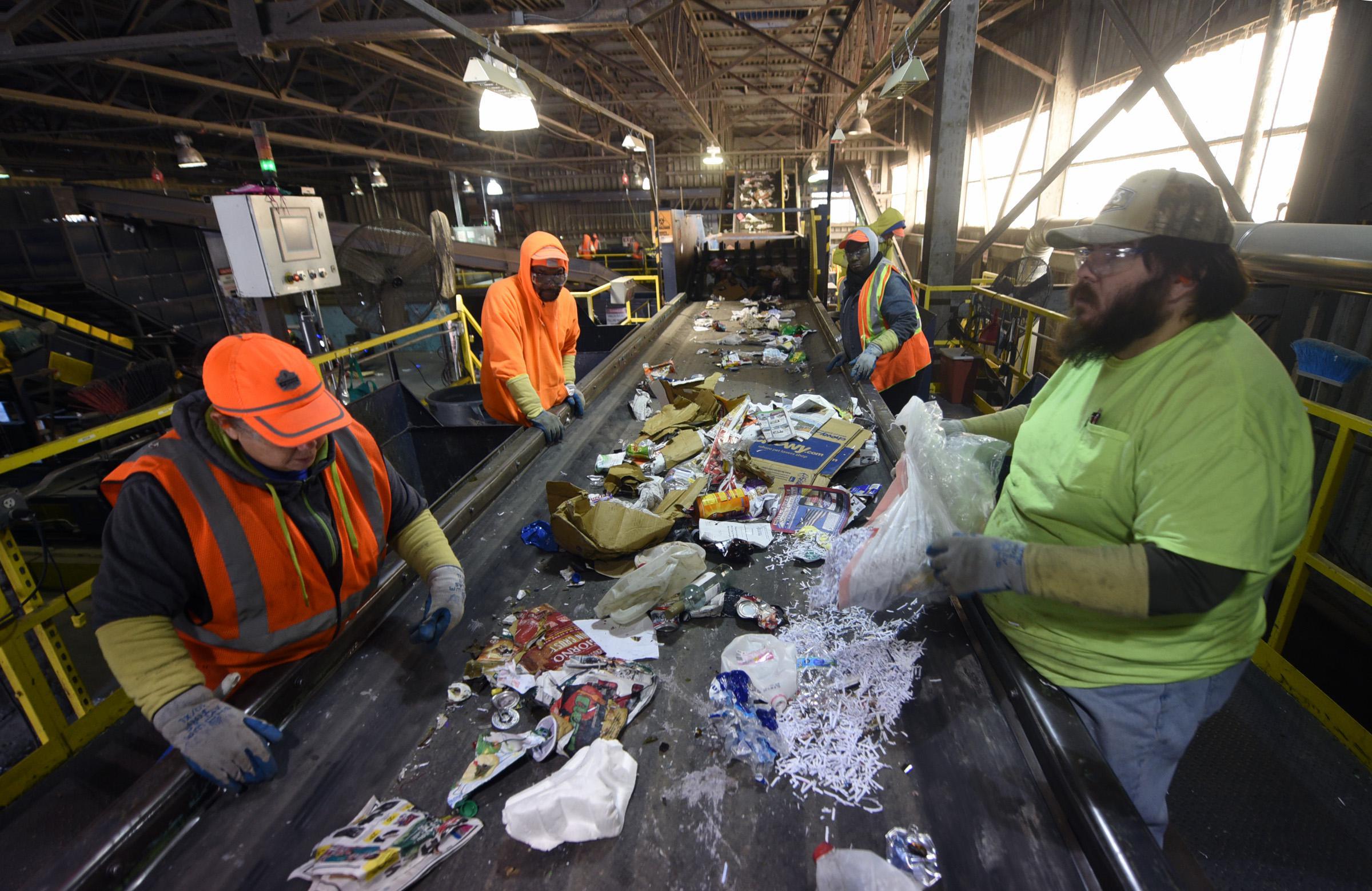
“We operate eight drop-off sites located throughout the county that are available to the public 24/7,” Suleyman said. County drivers collect the recycling containers from those drop-off sites and truck them to SONOCO on U.S. 421 North, he said.
The county itself makes up a very small percentage of the overall volume of recycled materials accepted by the SONOCO materials recycling center or MRF, Suleyman said.
“It’s a 25,000-ton-a-year MRF and a good 7,000 tons of that is what’s collected by the city of Wilmington, which does do its own curbside collection,” he said.
Private waste haulers who serve the county’s unincorporated areas and industrial and commercial locations, makes up another third of the material accepted at the materials recycling center, Suleyman said.
“The balance of that is material that is brought to us from outside of New Hanover County,” he said. “We get material from Pender, from Brunswick, from Columbus. You can call it a regional MRF, because it is.”
New Hanover County doesn’t have curbside recycling.
About 11 percent of the people in New Hanover County outside of the city of Wilmington recycle, Suleyman said. That percentage is calculated using a formula based on the weight of materials deposited at drop-off recycling sites and county household population statistics, he said.
Suleyman said he would like to see that participation grow to 35 or 40 percent.
Part of the problem is that even though plastic bottles and cans are banned from the waste stream in North Carolina, he said, there is no enforcement mechanism in that ban.
Enacting statewide enforcement of recycling laws and implementing deposits on glass cans and bottles would go a long way toward reducing the waste stream and boosting recycling percentages, Suleyman said. Bans on such items as cardboard and glass would reap additional benefits, he said.
The material recycling center is owned by New Hanover County, which has a contract with SONOCO to operate it, Suleyman said. SONOCO’s employees operate the facility and the company owns the equipment within the center, he said.
“The best way to describe it is we’re the landlords,” Suleyman said.
Paying to recycle
The county’s contract with SONOCO uses a formula called the weighted average price to determine whether the company pays the county a rebate, they break even, or the county pays the company to handle recycled materials, he said.
The weighted average price is determined by auditing incoming material once a month based on weight. Glass is a certain percent, mixed paper is a certain percent, etc., Suleyman said.
“Based on that weighting, they multiply that by the market price they get for those materials to come up with the weighted average price,” he said.
New Hanover County has been paying SONOCO to take recyclable materials for the past six to eight months, Suleyman said.
“Before that, we were getting paid for the material,” he said.
Brunswick, Pender also pay more
Brunswick County contracts with Waste Industries to do curbside garbage collection and manage recycling drop-off sites, Bozeman said. Waste Industries, in turn, contracts with SONOCO to receive collected recyclable materials.
She said Brunswick County projected an increase of $85,000 this year in its recycling costs, but so far was below that number.
Kenny Keel, Pender County’s director of utilities and solid waste, said the county so far has been able to absorb the increased costs to dispose of recyclable materials and send them to the SONOCO recycling center.
Pender County’s costs to handle recyclables increased by about $4,500 a month as of March, Keel said.
As Pender County enters its budget planning for next year, it will be reassessing whether it can continue to absorb the price increases for the handling of recyclables or whether a change is needed in the price structure.
As with Brunswick, Pender County contracts with Waste Industries to collect and transport its recyclables to the SONOCO materials recovery center.
Why oil prices matter
The change in the profitability of recycling is a result of more than just the sharp decline in demand from Asian markets, Suleyman said.
“It’s that plus the price of oil is so depressed right now,” he said. “Because oil makes up the cost of plastics, as the oil prices drop, the value of recovered plastics from the waste stream also drops.”
Bozeman said the Asian cutbacks in the long run will benefit U.S. recycling efforts.
“I think what we’re trying to do now is re-educate everyone on recycling — clear messaging out there, cut back on the materials that are accepted so that we are providing things that can be recycled,” she said. “And, in the long run, we are building our domestic markets here and creating jobs here in North Carolina.”
Contact the newsroom at 910-343-2384 or [email protected].










