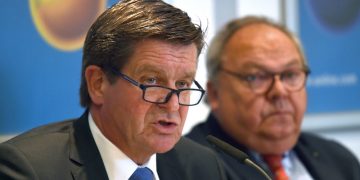








As one of the most well-known figures in the European plastics machinery industry, Ulrich Reifenhäuser had a triple role to play at K 2019. He is not only the chief sales officer of Reifenhäuser Group, he is also the chairman of the VDMA Plastics and Rubber Machinery Association and chairman of the Exhibitor Advisory Board at K.
In all three capacities, he noted, he is grappling with the same issue: The urgent need for a more circular plastics economy, and how to achieve this.
At the show this year, it seems that everyone jumped on the circular bandwagon. The question is, can it solve the plastics industry’s woes?
Not one to beat about the bush, Reifenhäuser jumped to the heart of the discussion in wholly unambiguous terms.
“Why do we need the circular economy? We have a truly enormous waste problem,” he said, “and it’s harming nature. We need to do something for us now, and for the future of our children.
“Second, our image is suffering. I don’t like that. We need to do something. And third, the tendency to replace plastics with other materials — paper, wood, whatever — is strong. This is not good for our industry, and especially not good for selling machines,” he said.
And of course, developing, producing and selling high-performance quality plastics machinery is what the Reifenhäuser group does. Although founded in 1911, the company later moved into plastics machinery, delivering its first extruder in 1947.
Hans Reifenhäuser, the son of the original founder of the company, was a talented engineer — “one of the brains in the industry”— according to his son, Ulrich. The current management is the third generation of the Reifenhäuser family to lead the company. This generation grew the company into a leading player in the extrusion world that today produces between 125 and 140 extrusion lines — big and small — each year.
“I started my career when I was straight out of university in the financial department of Krupp. I studied economics and worked as a controller,” Reifenhäuser said.
At a certain moment, his father summoned him to come work with him in the family business, which, from that point on, he did.
Although not an engineer, selling extrusion systems meant that he also had to gain a knowledge of the technology involved.
“It’s not like selling a mobile. You have to know and understand the product,” he explained. “I talk to customers, understand the requirements, talk to the technicians and build up strong and durable relationships with our customers. I often tell people that I’m the foreign minister of Reifenhäuser.”
Q: What do you think are the major issues in the extrusion industry right now?
Reifenhäuser: In the extrusion industry, as well as in injection molding, the main issue is the circular economy. But for a circular economy to be possible, the products we produce must be recyclable. Some are, some are not. Our approach is, we identify a problem, study it and then compare it with our technology. We often then find that, yes, we may have a solution for that specific problem. So, it starts with an idea, then we do the R&D and we find a solution.
Q: So, you consider plastic waste to be the problem?
Reifenhäuser: No, it’s not the waste, it’s the handling of that waste. But that is the difficult part for consumers.
We, in the plastics industry, have been extremely successful in developing products whose functionality is perfect. In addition, these products are extremely affordable. What we failed to bring into the equation was that these products should also be recyclable. For a long time, recycling wasn’t a relevant issue. As a result, it was neglected. But today, we need recyclability. To reach that, we need a new resin design, where functionality is not superb, but instead is “good enough.” We can find solutions between good enough and perfect.
The second issue is pricing — products will become more costly. However, the “competitiveness” of plastic compared to other materials is so good that even adding 30 percent to the cost will not hurt its position.
Q: Reifenhäuser Group doesn’t design resins. Does this mean you develop technologies with other players?
Reifenhäuser: Yes. We normally start with a converter, to set up a pilot to try an idea out. Then we need to find a resin producer who can develop the resin we need to change technologies.
A good example are the new all (polyethylene) stand-up pouches we developed which are 100 percent recyclable and offer excellent barrier properties. We developed and patented a technology called Reifenhäuser EVO Ultra Stretch unit that makes a monomaterial solution possible, using polyethylene instead of the PET/PE that is normally used to produce these pouches. The PET provides stability and barrier properties. But stretched PE produced with the technology can fully replace PET with no loss of quality.
Another example that we are showing are the heavy duty Exxon bags, produced on a 5-layer line. The outer layers are made from virgin material — but the middle layer is recyclate. Again, it is a multi-layer-monomaterial solution. These bags are cut and laid, then collected and sent to the recycler and the recyclate can be reused to make new bags. We know what the ink is, what resin has been used. At our stand, we are showing bags that have been through five such cycles without losing any of their properties. It’s a nice clean, pure waste stream, very much like the PET bottle stream. Completely identifiable.
That example also shows how the use of recyclate in performance products is starting to become more common. In fact, right now, we’re seeing the price of recyclate climbing higher than that of virgin resin.
Yes, and why is that? There is a shortage. So where does that come from? The availability is there. But plastic waste from consumers can be compared to, say, fruit salad: colorful and mixed. Asking consumers to sort their waste is far too difficult. We need to educate them, get them to throw their plastics waste in the bin but then develop a highly sensitive sorting system that is automated.
In fact, we’re looking at a system that could do that — a cloud-based solution from the meat industry. In Germany, a sausage is completely traceable, from the cow to the packaging. All the ingredients are known. The field the cow grazed in is known.
We asked ourselves: Can we set up some kind of same system for plastics? It’s functional. It’s proven. Using high-tech sensing technology, the waste could be fully sorted into the different fractions, perhaps using a marking technology of some kind.
The start is our machines. The material could be marked on the big roll with a barcode, for example.
I was fascinated by this system. But obviously, it is not something Reifenhäuser can do alone.
Q: What do you see as the next big thing in extrusion?
Reifenhäuser: That would be all the things we are working on. New processes, new designs, and no more not multilayers that can’t be recycled.
If we make products that are recyclable and develop the sorting systems we need, we’re halfway there already. They are the key to open the circular economy door.
One new development is for example the Ultra-Stretch technology I talked about earlier, and another — this is really brand-new — is EVO Ultra Flat, a laser measuring system for extremely flat film.
It detects the film topography to ensure extremely flat film. The system measures film flatness online in a closed loop and continuously adjusts to fluctuations to optimize production parameters to increase efficiency and quality. We couldn’t show it here, but it can be seen during the open house at the Reifenhäuser Technology Center at the Troisdorf location.










