


• Latest
  • Trending
  • All
Report: Autonomous shipping adoption to take ‘decades’

Report: Autonomous shipping adoption to take ‘decades’

November 27, 2019
Last Mile Delivery Market Worth Observing Growth | UPS, FedEx, SF Express

Last Mile Delivery Market Worth Observing Growth | UPS, FedEx, SF Express

April 23, 2024
Top 5 Spend Analysis Software ranked in 2024

Top 5 Spend Analysis Software ranked in 2024

March 1, 2024
How Tesla And BMW Are Leading A Supply Chain Renaissance With Blockchain

How Tesla And BMW Are Leading A Supply Chain Renaissance With Blockchain

January 19, 2024
LATAM Cargo strengthens European cargo links

LATAM Cargo strengthens European cargo links

April 14, 2020
Ford making reusable hospital gowns from airbag materials as efforts against coronavirus expand

Ford making reusable hospital gowns from airbag materials as efforts against coronavirus expand

April 14, 2020
Don’t Sweat NBC’s Decision to Cut Back on Television Ad Inventory

Don’t Sweat NBC’s Decision to Cut Back on Television Ad Inventory

April 14, 2020
Software firms sharpen focus on AI, big data as IT spending drops

Software firms sharpen focus on AI, big data as IT spending drops

April 14, 2020
Navigating turbulent times in your supply chain (TL:DR version)

Navigating turbulent times in your supply chain (TL:DR version)

April 14, 2020
Last Mile Delivery by Drones Market is Booming Worldwide

Last Mile Delivery by Drones Market is Booming Worldwide

April 14, 2020
AIR CARGO MARKET SIZE, SHARE, DEMAND, TREND, LATEST INNOVATIONS & APPLICATION ANALYSIS AND INDUSTRY GROWTH FORECAST 2027 – Science In Me

AIR CARGO MARKET SIZE, SHARE, DEMAND, TREND, LATEST INNOVATIONS & APPLICATION ANALYSIS AND INDUSTRY GROWTH FORECAST 2027 – Science In Me

April 14, 2020
Wheat procurement in Patiala: 6,500 coupons issued to farmers – cities

Wheat procurement in Patiala: 6,500 coupons issued to farmers – cities

April 14, 2020
Pandemic, Plastics And The Continuing Quest For Sustainability

Pandemic, Plastics And The Continuing Quest For Sustainability

April 14, 2020
  • Supply Chain
  • Logistics
  • Warehousing
  • Procurement
  • Shipping
  • More
    • Strategic Sourcing
    • Spend Analysis
    • Inventory
    • Contact Us
No Result
View All Result
United States International Supply Chain Commission
Home Logistics

Report: Autonomous shipping adoption to take ‘decades’

by usiscc
November 27, 2019
in Logistics
0
Report: Autonomous shipping adoption to take ‘decades’
492
SHARES
1.4k
VIEWS
Share on FacebookShare on Twitter

Autonomous shipping is repeatedly touted as the future of the maritime industry and development of these technologies continues. Despite this, a new report by Kennedys law firm has suggested that the adoption of fully automated shipping will take decades.

Polling 6,000 people across six territories (United Kingdom,
United States, Australia, China, Singapore and Hong Kong) showed that Hong Kong
had the least level of public comfort for autonomous shipping, at 17%, compared
with China at 48%.

A company release on the report highlighted the UK’s response to the study noting that fewer than one-fifth of respondents, 18%, said that they were comfortable with the idea of autonomous vessels.

The general pattern is reflected in people’s broader opinion
towards autonomous vehicles, ground and air, in which 48% in the UK support
partially autonomous vehicles, and only 28% support full autonomy.

According to Kennedys, the main reason for their concern is
safety at 67%, with respondents specifically placing trust in human judgement
over computers at 63%.

Kennedys also noted that there are some challenges being faced in the autonomous adoption including the International Maritime Organisation’s (IMO) regulatory standards and those of the Flag State where the ships are registered.

Specifically, these challenges will present themselves when connecting ships to shore, particularly of the original equipment manufacturers (OEMs).

There are of course numerous benefits to introducing autonomy
into shipping.

Michael Biltoo, Partner at Kennedys, noted, “The benefits
are clear and, ultimately, crucial: if shipping is to achieve the
ever-tightening environmental standards set by a range of regulatory bodies, a
far more data-driven approach to maritime logistics is absolutely necessary.

“Furthermore, the opportunity to reduce time in dry-dock
repairs offers a clear long-term financial incentive to market participants.
Greater automation in the sector is inevitable: there now needs to be a clear
call-to-action on governments to create modern legal frameworks providing
appropriate protocols on the behaviours of vehicle technology.”

Numerous OEMs are continuing the pursuit of unmanned
shipping technologies including One Sea, part of the DIMECC group, which plans
to have the world’s ‘first’ autonomous maritime system in operation by 2025.

‘There is a clear path towards autonomy,’ said Päivi Haikkola, Ecosystems Lead at One Sea, speaking at Port Technology International’s Smart Digital Ports of the Future Conference in Rotterdam on 5 November.

Haikkola noted that are many ‘things we can do today’
regarding the technology needed for autonomous shipping.

During her presentation, Haikkola outlined some recent developments towards One Sea’s 2025 goal, including the first Maritime Autonomous Surface Ships (MASS) trial performed in accordance with the IMO’s Interim Guidelines in September 2019.

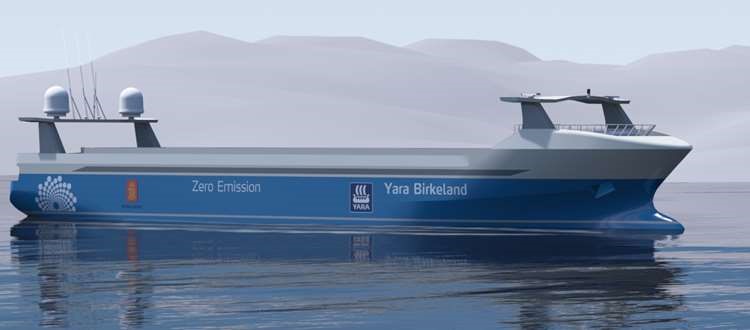
One Sea also plans the launch of a new zero-emission cargo ship in 2020 (pictured).

The IMO’s Maritime Safety Committee (MSC), 101 session, in
June 2019 approved the interim guidelines for MASS trials.

It has been noted by the IMO that most predictions are that
autonomous or semi-autonomous operation would be limited to short voyages, for
example from one specific port to another, across a short distance.

Typically unmanned vehicles are suited to ‘dull dirty
dangerous’ work and a report by BMT published in January 2019 suggests feasible
roles for complete unmanned operations include small open data gathering, MCM
vessels and hydrographic survey. Meanwhile, short sea freight and offshore
supply vessels would have reduced manning but not be fully autonomous.

Meanwhile, fishing vessels and cruise ships are likely to maintain a high level of human involvement onboard for the foreseeable future.

Other uses of autonomy, noted by Kennedys, look at ship
design. The IMO’s anti-pollution measures and energy efficiency standards can
be met through step-change in ship design with growing use of data-driven
autonomous and connected vehicle technology.

Autonomous vehicle technology can also help the gathering of additional data on engine performance, enabling ship owners to identify parts that may need repairing or replacing before they fail. This helps reduce time in dry-docks while improving performance and safety levels.


Share197Tweet123
usiscc

usiscc

  • Trending
  • Comments
  • Latest
Escape From Tarkov – How to Rotate Items

Escape From Tarkov – How to Rotate Items

February 5, 2020
Supply chain examination: Planning for vulnerabilities you can’t control

Supply chain examination: Planning for vulnerabilities you can’t control

December 7, 2019
Procurement Project Manager job with Camden London Borough Council

Procurement Project Manager job with Camden London Borough Council

February 17, 2020
Art Battle Wichita Falls III at The Warehouse, 1401 Lamar.

Art Battle Wichita Falls III at The Warehouse, 1401 Lamar.

0
Global Industry Analysis, Size, Share, Growth, Trends, and Forecasts 2016–2024 – ZMR News Reports

Global Industry Analysis, Size, Share, Growth, Trends, and Forecasts 2016–2024 – ZMR News Reports

0
PHOTOS: Ottawa firefighters respond to warehouse fire

PHOTOS: Ottawa firefighters respond to warehouse fire

0
Last Mile Delivery Market Worth Observing Growth | UPS, FedEx, SF Express

Last Mile Delivery Market Worth Observing Growth | UPS, FedEx, SF Express

April 23, 2024
Top 5 Spend Analysis Software ranked in 2024

Top 5 Spend Analysis Software ranked in 2024

March 1, 2024
How Tesla And BMW Are Leading A Supply Chain Renaissance With Blockchain

How Tesla And BMW Are Leading A Supply Chain Renaissance With Blockchain

January 19, 2024
  • Privacy Policy
  • Terms of Use
  • Disclaimer
  • DMCA
  • Contact Us

Copyright © 2024 United States International Supply Chain Commission (usiscc.org)

This website uses cookies to improve your experience. We'll assume you're ok with this, but you can opt-out if you wish. Cookie settingsACCEPT
Privacy & Cookies Policy

Privacy Overview

This website uses cookies to improve your experience while you navigate through the website. Out of these cookies, the cookies that are categorized as necessary are stored on your browser as they are essential for the working of basic functionalities of the website. We also use third-party cookies that help us analyze and understand how you use this website. These cookies will be stored in your browser only with your consent. You also have the option to opt-out of these cookies. But opting out of some of these cookies may have an effect on your browsing experience.
Necessary
Always Enabled

Necessary cookies are absolutely essential for the website to function properly. This category only includes cookies that ensures basic functionalities and security features of the website. These cookies do not store any personal information.

Non-necessary

Any cookies that may not be particularly necessary for the website to function and is used specifically to collect user personal data via analytics, ads, other embedded contents are termed as non-necessary cookies. It is mandatory to procure user consent prior to running these cookies on your website.

SAVE & ACCEPT
No Result
View All Result
  • Supply Chain
  • Logistics
  • Warehousing
  • Procurement
  • Shipping
  • More
    • Strategic Sourcing
    • Spend Analysis
    • Inventory
    • Contact Us

Copyright © 2024 United States International Supply Chain Commission (usiscc.org)






