






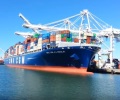
Trade conflicts and geopolitical risks are driving sentiment on ocean shipping rates, particularly in the container market.
In liquefied gas sectors, propane transport to Asia is looking increasingly vibrant after a multi-year malaise, while natural gas transport appears to be coming out of its recent doldrums, with hopes for a major revival.
Despite the hype, rates for crude tankers remain unimpressive, and rates for dry bulk shipping are still ominously low.
Containers
The big question in the container-shipping industry is whether U.S. President Donald Trump’s threat to impose tariffs on an additional $300 billion of Chinese exports will lead to accelerated import activity, and thus an increase in the per-box freight rate in the near-term – or, alternatively, a downturn in both volumes and rates. In 2018, U.S. imports surged as companies raced to beat the tariff increase on the initial $200 billion slate of Chinese products.
At least so far, there’s no evidence of another rate increase. President Trump’s initial tweets that alerted the market to increased trade tensions occurred on Sunday, May 5. The Freightos Baltic Daily Index for China to the West Coast of North America has declined by 14 percent since then.
According to Henry Byers, maritime market expert at FreightWaves, this does not mean the race to beat shipments won’t occur. “You have to remember that in order for U.S. supply chains to move their goods early, it requires a great deal of effort from all parties involved – including suppliers, warehouses and logistics providers,” he explained.
“I expect to see the first wave of tariff-driven containers coming in at the end of this week, and hitting the U.S. roads and railways next week [the week of May 27-31],” he said. “I also expect that June 1 will mark the beginning of an upward trend in rates from China to the U.S. West Coast that will continue through the end of November.”
LNG
Spot rates for liquefied natural gas (LNG) carriers hit an all-time high of around $200,000 per day in November 2018. That kind of cash flow, if sustained, quickly pays back your purchase price on a ship – but alas, it usually doesn’t last, and it didn’t. Rates summarily collapsed back to around the break-even level of $40,000 per day in February-April 2019.
Rates are now back in the mid- to upper-$50,000 range per day, up around 40 percent over the past three weeks off a low base. A number of large-scale LNG export projects are about to come online, so the upward trend should continue.
Project debuts bolster spot rates in two ways. First, by bringing more volume to the water. Second, by reducing the number of ships available for spot employment. Often, LNG export projects start-ups are delayed. If ships ordered to service those projects via long-term time charters are delivered by the shipyards before project construction is finished, the ships temporarily move into the spot market, weighing down rates. When the ships begin their normal long-term service, spot rate pressure subsides.
LNG spot rates are still relatively low, more ‘not bad’ than good. It’s too early to say whether they can attain last year’s peak, and there’s still a fair amount of skepticism about 2019 – and even more concerns about the years ahead as more newbuilding vessels enter the market.
LPG
One of the few bright spots for vessel owners in 2019 has been the revival of rates for very large gas carriers (VLGCs), a sector that had sunk below break-even for a dangerously long stretch and that desperately needed a breather.
VLGCs have the capacity to carry around 82,000 cubic meters of liquefied petroleum gas (LPG) – largely propane and butane. These vessels primarily transport LPG from the U.S. Gulf to Asia via the Panama Canal, and from the Middle East to Asia.
VLGC rates were mired in the $10,000-$30,000 per day range throughout 2018 and into early 2019. Then they began their ascent. They hit a recent high of around $50,000 per day in April, and are now slightly lower, at around $42,000 per day, representing a sharp year-on-year increase.
VLGC rates have been largely flat over the past week, but U.S. LPG prices have fallen and Far East prices have kept steady, a positive for the economics of the trade. The wider the spread between U.S. and Asia commodity pricing, the greater the arbitrage profit for traders, the more VLGCs are booked on this long-haul route, and the higher spot rates should go.
Tankers
There’s a great deal of talk about a recovery in rates for very large crude carriers (VLCCs) – tankers that each have a carrying capacity of about two million barrels of crude oil. The theory is that a future slowdown of newbuilding deliveries will coincide with an increase in shipping demand in the second half of 2019. Investors have been betting on this – several crude tanker stocks are now flirting with 52-week highs.
And yet, actual spot rates are still unexceptional – at around $12,200 per day. While this is up 82 percent year-on-year (from almost all-time lows in 2018), it’s down 28 percent month-on-month. Optimism for a second-half recovery may be high, but optimism has been high before and dashed repeatedly.
“The current market is pretty soft,” acknowledged Ben Nolan, shipping analyst at investment bank Stifel, who added, “Hope springs eternal in the crude tanker market.” He noted that weak rates are to be expected now, for seasonal reasons, but stock pricing clearly shows “an expectation for a sharp recovery in the very near future.”
Bulkers
If you listen to investment bankers, dry bulk is a market that was supposed to have recovered by now. Rates remains stubbornly very weak. That’s good news for shippers of iron ore, coal, grain and other dry cargo commodities, and bad news for buyers of dry bulk shipping stocks who listened to their investment bankers.
Rates for larger Capesize vessels – ships that have a carrying capacity of over 100,000 deadweight tons (DWT), usually around 180,000 DWT – continue to improve, but not exceptionally so. The rates are currently at around $11,900 per day, up 2.5 percent week-on-week.
The expected rate recovery in 2019 was wiped out, in part, by the Brazilian dam accident in January, which curtailed iron ore exports to China by mining giant Vale. Brazil-China iron ore shipments have an outsized effect on Capesize rates because the voyage is three times as long as the trip from Australia to China, soaking up three times the vessel capacity.
The Baltic Capesize Index hit an all-time low on April 2. It is almost 10 times higher today than it was then. But to put this improvement in perspective, it’s still just 40 percent of its August 2018 level, around one-third of its level in December 2017, and less than one-eighth of its all-time high in the mid-2000s.
“It seems the troubles being faced by the dry bulk market are not over just yet,” lamented George Lazaridis, analyst at Greece’s Allied Shipbroking. “Although some improvement has been noted since the start of April, there are increased risks that the summer period will continue to be volatile, and trading, on average, will be below what was witnessed in 2018.”
Source: Freight Waves










