








Supply chain certifications can raise an employee’s standing at work and lead to a salary increase. Just as the business world evolves, associations offering supply chain certifications continually revamp them to include relevant content and update learning systems and testing methods to match candidate needs.
The top three supply chain associations, the Council of Supply Chain Management Professionals (CSCMP), the Institute for Supply Management (ISM) and the Association for Supply Chain Management (ASCM), made significant changes in their certification programs in the last few years, with more scheduled for 2020.
“Every rigorous certification program goes through an update every three to five years,” Nichole Mumford, vice president of marketing, engagement and education at CSCMP, told Supply Chain Dive. “Given the big changes in technology, the expansion of global enterprise, changes in the last decade are no surprise.”
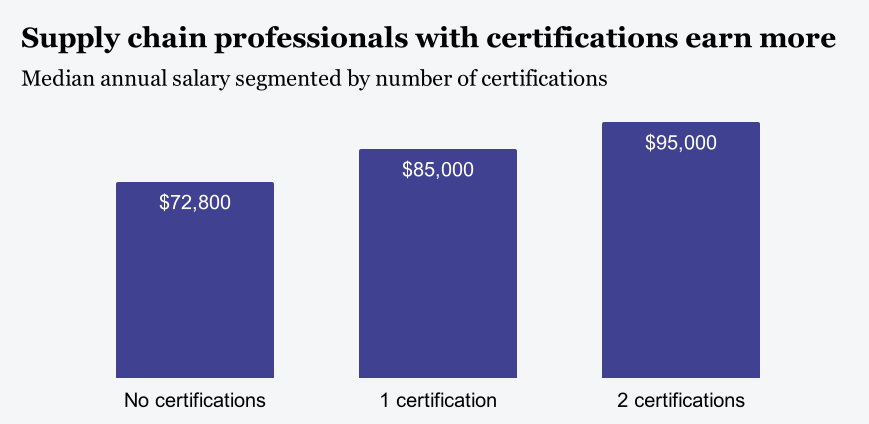
The bars represent annual salaries for the 50th percentile.
Shefali Kapadia / Supply Chain Dive, data from ASCM
ISM
Focusing on procurement and sourcing, ISM updated the Certified Professional in Supply Management (CPSM) designation and made recertification changes.
CPSM test preparation and curriculum
The big change for CPSM is the online learning system, introduced in 2018. The prior version for those not taking a classroom course included a stack of books or an e-book. A practice exam revealed the candidate’s weaker areas, but the individual had to read everything or cherry pick content.
The newer CPSM learning system allows individuals to take an initial assessment; the algorithm determines the candidate’s strengths and weaknesses in each subject.
The candidate chooses a test date, and the system provides a study schedule with the number of hours or days per week to prepare and what material to cover. The system offers milestones achievements, using game theory, with small rewards for completing tasks like flash cards, to make preparation more engaging.
Restructuring the materials helps instructors in classroom and online instructor-led programs, by giving them better organized materials to reference with their students, said Nora Neibergall, senior vice president for ISM, overseeing certification.
“Given the big changes in technology, the expansion of global enterprise, changes in the last decade are no surprise.”

Nichole Mumford
VP of Marketing, Engagement and Education, CSCMP
ISM updates specific items as it publishes new forms of the exam. In 2020, the institute will include new Incoterms (International Chamber of Commerce terms) which change each decade in January. These determine the buyer and seller international trade responsibilities for delivering goods under sales contracts and are updated every decade.
This year, ISM will start preliminary research for future content changes. The 2018 update was significant, Neibergall said, enhancing category management content, expanding supply chain strategy and sales and operations sections and updating technology and supply chain risk coverage. ISM won’t know the extent of future updates until completing market research, which includes job analyses for thousands of professionals. It is also updating the Chinese and Korean translated versions of the CPSM exam.
CPSD
In 2020, the ISM will update the study prep and exams for the Certified Professional in Supplier Diversity (CPSD) designation, which focuses on how supplier diversity can improve profits, increase efficiency and provide exposure to new customers.
Recertification
Both designations still require recertification every three years, with 60 continuing education hours. ISM is trying to make the recertification process more intuitive and easier, with webinars exclusive to ISM members. “The world is changing, and we want people to continue to learn and grow in their careers,” Neibergall said.
CSCMP
CSCMP, aligned with the transportation industry, made a number of changes and additions to its certification programs.
SCPro test preparation
In 2017, CSCMP introduced an updated approach to study and preparation, helping students focus on areas needing more attention. “It takes a lot of the guesswork and stress out of the preparation,” Mumford said. It improves self-study options, with a mobile-friendly system.
CSCMP also relaunched its SCPro designation in March 2017 after determining the test pass rate was too low. A certification committee looked at whether study materials lined up with test questions, and potential question bias. With the relaunch, the council also stepped away from requiring candidates to travel to testing centers. The candidates can use their own locations with an online testing platform and virtual proctor.
SCPro curriculum changes
SCPro has a four-tiered certification approach, including a Fundamentals program introduced in 2017, and SCPro Levels 1, 2 and 3 introduced in 2012.
Fundamentals: In a collaboration, Broward College developed the Fundamentals content, and CSCMP developed the certification exam. The program, with eight independent learning blocks and certifications, includes verticals like transportation management and inventory management.
“Taking all eight doesn’t equal SCPro certification,” said Mumford. The material is presented at a 12th grade level. Each exam is 90 minutes. CSCMP will likely do a “facelift” on Fundamentals ever two or three years, Mumford said, and it will be updated soon.
| Fundamentals certification areas |
|---|
| Supply chain management principles |
| Customer service operations |
| Transportation operations |
| Warehousing operations |
| Demand planning |
| Inventory management |
| Manufacturing and service operations |
| Supply management and procurement |
CSCMP
Level 1: This comprehensive end-to-end certification received annual updates the last few years. In 2017, CSCMP revamped the study content and test questions, ensuring test questions matched the study material content, and removing or rewording questions with two technically correct answers.
In 2018, the council launched a bridge exam, an abbreviated Level 1 test for those with masters degrees or other supply chain certifications. This fast track qualified candidates for Level 2 certification. The content and study materials are the same, but the exam is 90 minutes with 60 questions, instead of the traditional exam’s four hours and 160 questions.
In 2019, CSCMP revised and republished Level 1 study materials, as requiring eight textbooks was dated, Mumford said. It partnered with University of Tennessee for the revisions, publishing a digital book with a study plan/roadmap, so candidates don’t have to read all 600 pages.
Level 2: Candidates are given a case study and four hours to write four essay answers demonstrating understanding. Level 2 moves into knowledge application, strategy and design of supply chain networks. It focuses more on the movement of goods through the supply chain, and candidates must demonstrate how changes in one vertical affect other verticals.
Level 3: In 2020, the organization will revise Level 3, introduced in 2012, but never getting traction. “No one has successfully finished [Level 3],” Mumford said. This level is customized, involving an individual project, a CSCMP mentor and an evaluation committee. “When they launched it, it was more of an idea. I don’t think they had the proper foundation in place,” she said. It wasn’t scalable, and the committee members are all volunteers, with turnover resulting in loss of institutional knowledge.
ASCM
ASCM’s APICS certifications draw interest from professionals in manufacturing. It made a number of changes in certifications and endorsements in the past few years.
CPIM test preparation
The Certified in Production and Inventory Management (CPIM) exam changed in 2017, from five exams to two. “The primary reason was there are very few certifications that are more than two exams,” said Bob Collins, senior director of learning and development at ASCM. “We wanted to help the potential candidates get through the process more quickly,” he told Supply Chain Dive.
The same body of knowledge is now covered in two preparation courses. Part two incorporates four of the original modules, which makes it more challenging because it covers a wider body of knowledge. “We’re seeing more people completing their certifications.” Working professionals are also completing it more quickly, an average of nine months for both exams, versus an average of 12 to 18 months before.
“Those who don’t stay current will have a hard time staying on top of the profession.”
CPIM adopted the learning system that Certified Supply Chain Professional (CSCP) and Certified in Logistics, Transportation and Distribution (CLTD) use, with digital or print books and a considerable amount of supporting online material, including learning activities, videos, quizzes and a mock test.
“It’s much more encompassing and much less dependent on an instructor,” Collins said, compared to the prior learning system which was more book heavy. About half of CPIM candidates choose self-study, due to travel or family responsibilities. “We suspect these are folks we would not have captured otherwise” Collins said. The rest use the same material in face-to-face classroom or instructor-led webinar courses.
CLTD
ASCM released version 2.0 of CLTD in November 2019. Every three to five years, ASCM surveys thousands of supply chain professionals internationally with a job task analysis, to determine needed changes to the certifications. The latest survey resulted in this CLTD update, which expanded the inventory and warehouse management sections and added a subsection on reengineering and continuous improvement.
New endorsements
ASCM just released its Digital Capabilities Model for Supply Networks (DCM), a revised SCOR model, which expands into digital supply chain areas missing from the original SCOR model. The model includes synchronized planning, connected customer, smart operations, intelligent supply, digital development and dynamic fulfillment. The original SCOR model will be available to members for several years, as many companies still use that model. The original looks at the supply chain literally, said Collins, while DCM looks at supply chain as a web of connected hubs.
APICS will introduce Supply Chain Project Leader (SCPL) this year to replace the SCOR Professional Endorsement (SCOR-P). SCPL will be model agnostic. “Now we’ve got three potential models that companies can use to improve their supply chains,” Collins said. Endorsements are not the same rigor as the certifications, he said.
No matter which certification supply chain professionals want, they can expect it to undergo regular updates. Partly that’s due to the changing global economy. Technology and its impact are another factor. “It’s important that they continue to learn,” said Neibergall. “Those who don’t stay current will have a hard time staying on top of the profession.”










