







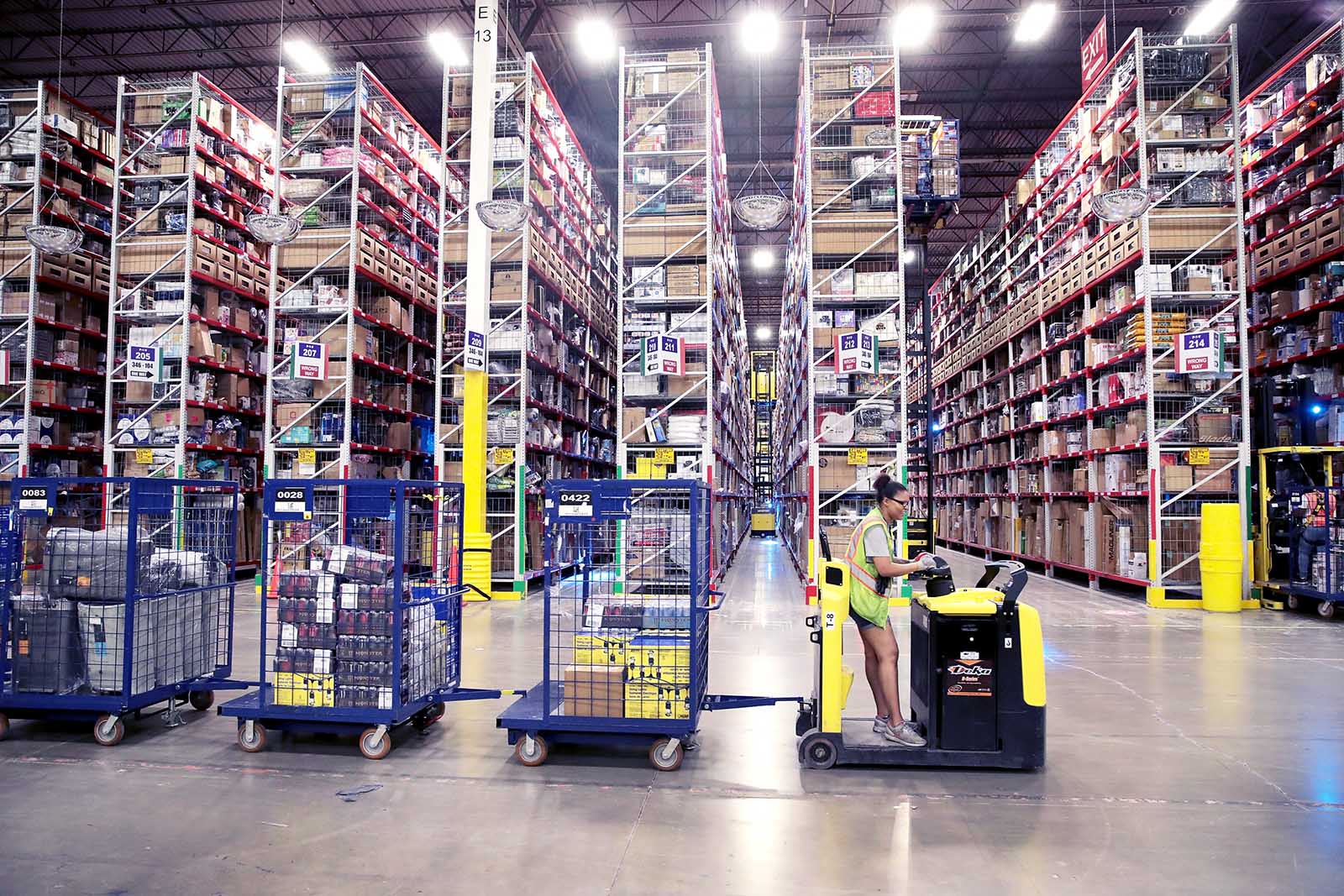
Workers pack and ship customer orders in a warehouse in Illinois. Manufacturing organizations will face an unprecedented array of risks to their supply chains in the next few years.
Photo: Scott Olson/Getty Images
Manufacturing organizations are facing an unprecedented array of risks to their supply chains in the next few years. If not managed well, these risks may result in severe supply chain disruptions and delivery failures, with consequences for both manufacturers and customers.
There are five key risks to supply chains, especially in manufacturing industries: shortages of raw materials, tougher regulatory regimes, armed conflict, natural disasters and IT breakdowns and cybercrime.
Raw Materials Shortages
Consumption of raw materials, parts and finished goods is rising at a steady pace, even with limited natural resources. Despite efforts to reduce, reuse and recycle materials via technology, such efforts have failed to keep up with rising consumption.
For example, the supply of copper is limited and unstable. Copper is a key component for electric motors, and it cannot be easily replaced by other materials. Such raw materials shortages can have multiple implications, ranging from cost increases in the final product to the inability to fulfill customer orders — and ultimately to armed conflict.
Tougher Regulations
Globally, regulations will generally continue to toughen for the foreseeable future. And it is expected that regulatory enforcement in emerging markets will gain momentum. Regulations — ranging from environmental rules and directives to food safety measures — can have a huge impact on the supply chain.
In addition to regulatory regimes, government actions also present supply chain risks. For example, EU and U.S. trade sanctions against Russia and vice versa as a reaction to the Ukrainian crisis have disrupted supply chains, as have the U.S.–China tariff wars. Brexit is just one of many examples of the increasing pressure that is currently put on multilateralism.
Armed Conflicts
The number and the intensity of interstate, intrastate and non-state armed conflicts around the globe are on the rise. The Middle East and Northern Africa, once regarded as promising markets, are today plagued by war and terrorism, with disastrous economic effects. These conflicts have a negative impact on sales and also disrupt the supply of raw materials and transport routes.
Companies are forced to invest in security measures, resulting in higher logistics costs, or even to completely pull out of certain countries. More importantly, armed conflict has negative consequences across regions, as conflict often does not stop at country borders.
Natural Disasters
Due to climate change, the number and the intensity of major adverse weather events – including earthquakes, hurricanes, flooding, droughts, and tsunamis – are increasing, a trend that is likely to continue unless companies and governments take drastic measures.
Supply chains will be affected by, among other things, recurrent shortages, particularly of agricultural products. In addition, public and private infrastructure in certain locations is more likely to get damaged or destroyed, disrupting supply chains unless redundancy arrangements are in place.
Effective supply chain management requires insight, analysis, action and watchfulness.
IT Breakdowns and Cybercrime
As the world economy grows increasingly connected and reliant on technology, it also becomes ever more vulnerable to IT breakdowns. The sources of such failures run the gamut, from technical glitches to malicious cyberattacks. Reports on these new assaults are in the news almost daily; in recent months, manufacturers have been attacked more often and more severely than ever before.
Managing Risks
An effective risk management system needs to prevent damage from risks, but also manage crises or near misses when they occur. Such a system requires a qualified team, equipped with suitable processes, governance and tools. Most importantly, this team needs to be embedded centrally within the organization with communication channels to relevant decision-makers and stakeholder groups, so that decisions can be quickly made and acted upon. Successful risk management needs to follow a four-step approach:
Understand the types and location of risks along the supply chain. Typically, risks lie on various levels of the value chain. Delivery delays of a tier-one supplier are a typical risk, but the root cause of the problem may lie at another stage. Hence, it is important to look at the entire value chain, starting with the bill of materials of the end product. For example, tantalum is a critical component for electric motors. However, a large portion of its production comes from the Democratic Republic of the Congo, which is plagued by rebel groups and diseases, among other things, causing significant supply risks. Looking beyond pure commercial terms is key to understanding the root causes.
Prioritize identified risks according to probability and impact. Evaluate the relevance of internal and external risk hotspots — such as distinct parts or certain countries or suppliers. In many cases, a qualitative approximation of risks based on a set of criteria is sufficiently accurate as a basis for decision-making.
Compile a list of possible mitigation levers, such as adjusting inventory levels, altering the supplier and customer base or carrying out sustainability measures. It’s important to analyze impact and develop risk-mitigation scenarios. This defines a realistic risk landscape with a detailed description of measures and their financial implications. Subsequently, this landscape should be the basis for the recommendation of measures to take.
Set up a monitoring framework along the lines of process, key performance indicators and tools. First, set up rules, responsibilities and targets. Second, build up a KPI pyramid to measure performance. Finally, set up a “watch tower” for ongoing monitoring. This watch tower might include the implementation of risk surveillance tools.
When Crises Occur, Risk Management Must Start Early
Set up an interdisciplinary team with representatives from relevant departments — such as supply chain, manufacturing, procurement, finance, communications and sales, in addition to risk management — depending on the type of crisis. Allowing this team to report directly to the board enables swift and effective action.
Crisis and business continuity activities should be carried out with the same measures as risk prevention — identification, evaluation, mitigation and monitoring. Create visibility along the supply chain to fully understand root causes and effects. Possible countermeasures need to be evaluated based on a cost-benefit calculation.
To prevent crises from recurring, ensure that root causes and countermeasures and their impact are well-documented. Relevant staff (not only from risk management but from all affected departments) need to be properly trained and taught about previous crises.
Companies are increasingly dependent on their supply chains. Effective supply chain management requires insight, analysis, action and watchfulness. Risk — like opportunity — is not static but constantly evolving. Understanding that quality and acting on it will be key to managing the key supply chain management threats in the next few years.










