








The way instructors discover textbooks and the way students purchase them has changed rapidly over the past five years.
Today, the textbook industry is at an inflection point, according to a new survey on educational resources by Bay View Analytics, formerly the Babson Survey Research Group.
“The whole market has changed,” said Jeff Seaman, director of Bay View Analytics. The most recent data from the company suggest there is growing acceptance of digital materials over print among faculty. The survey of 4,339 faculty members and 1,431 chairpersons also finds that professors, college leaders and even entire college systems are increasingly concerned about how much students must pay for course materials.
The open educational resources movement, which supports the creation and dissemination of freely accessible and openly copyrighted course materials, has played a huge role in driving the conversation about textbook affordability, Seaman said.
While OER adoptions and awareness continue to grow, Seaman suggests the movement may need to alter its messaging to fend off competition from new publisher distribution models such as inclusive access, where institutions can automatically bill students for their course materials after negotiating a bulk discount.
“Five years ago, instructors were choosing between OER and physical publisher textbooks. Now, the entire decision process has changed,” Seaman said. “Publishers are promoting affordable and accessible options, too.”
This year for the first time, the majority of faculty surveyed reported that they are aware of OER. Faculty who had adopted OER rated its quality as equal to that of commercial alternatives. But the report notes that “many faculty remain unfamiliar with the licensing or how to use these materials, and current rates of growth will not change this for many years.”
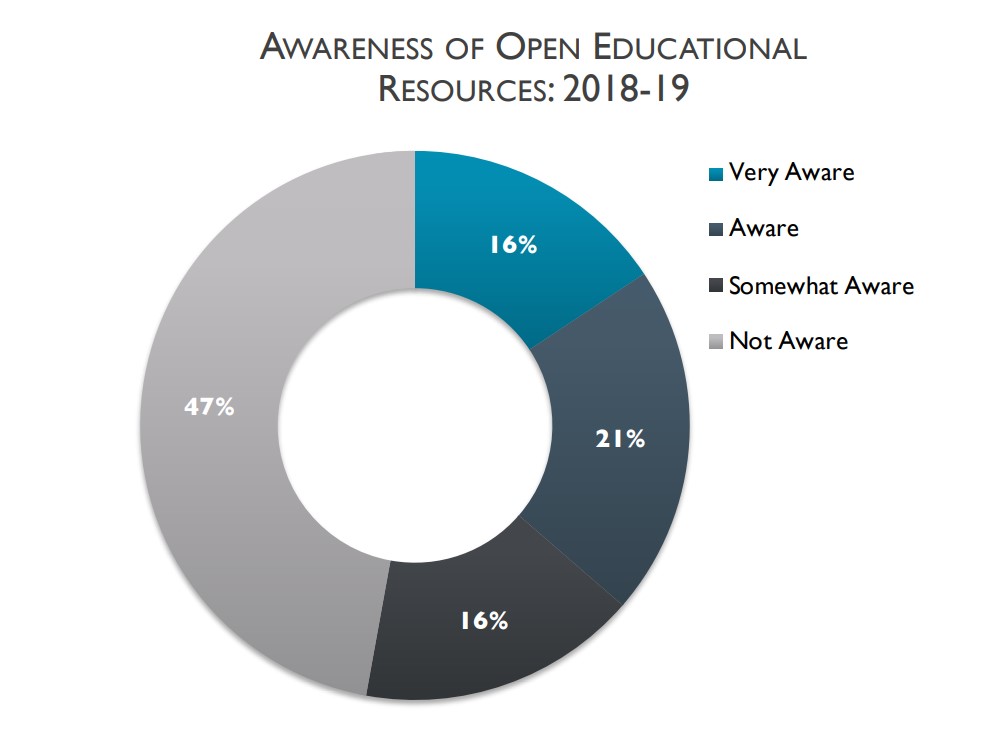 The inclusive-access model resonates with faculty because it addresses their concerns about the high cost of course materials, the large number of students who choose not to buy required materials and frustration many faculty feel about historic publisher practices such as unnecessary new textbook editions, the report said.
Most faculty have not yet used inclusive-access programs but are open to the idea, the survey found. Over time, faculty’s opinion of the inclusive-access model will likely change, the report says. While some faculty comments praised the inclusive-access model, others expressed concern about students’ ability to opt out. Some faculty said students may not understand that they are leasing access to digital materials on a temporary basis.
“Big publishers, often in conjunction with bookstores, are pushing inclusive access or opt-out billing solutions as hard as they possibly can,” said Alastair Adam, co-CEO of FlatWorld, a digital textbook publisher that has resisted the inclusive-access trend. “That’s because they see it as a way to grow their take from each class, while squeezing out the competition from used books.”
FlatWorld used to be an OER publisher but could not make the model financially sustainable, Adam said. Now the publisher charges $40 or less for its ebook titles. While the OER movement has shone a spotlight on publisher pricing, Adam said most publishers don’t see OER as a major threat to their business.
“What we see, reinforced by what we hear reported by faculty that have tried OER and have chosen to switch to one of our titles, is that in the absence of funding, compromises inevitably have to be made,” Adam said. “Whether it is the curation and quality control or missing supplemental components, such as a robust homework solution, when corners are cut, the workload and burden shifts to the faculty using the book.”
It is not unusual for commercial publishers to take aim at the quality of OER, said Lisa Petrides, founder and CEO of the Institute for the Study of Knowledge Management in Education, which manages the OER Commons, a public OER library. She said numerous studies have debunked this claim.
While OER’s messaging has long centered on affordability, the movement has always been about more than just the cost of materials, Petrides said. “There is a lot of really good writing about the impact on teaching and learning,” she said.
The OER movement has been “up against commercial publishing since day one” and continues to grow, Petrides said. Inclusive-access models may pose a new challenge to OER, but not one that is insurmountable. “We’re seeing a lot of consolidation in the industry, this idea that there is a one-size-fits-all model that works for everyone. OER is the opposite of that — it’s all about academic freedom.”
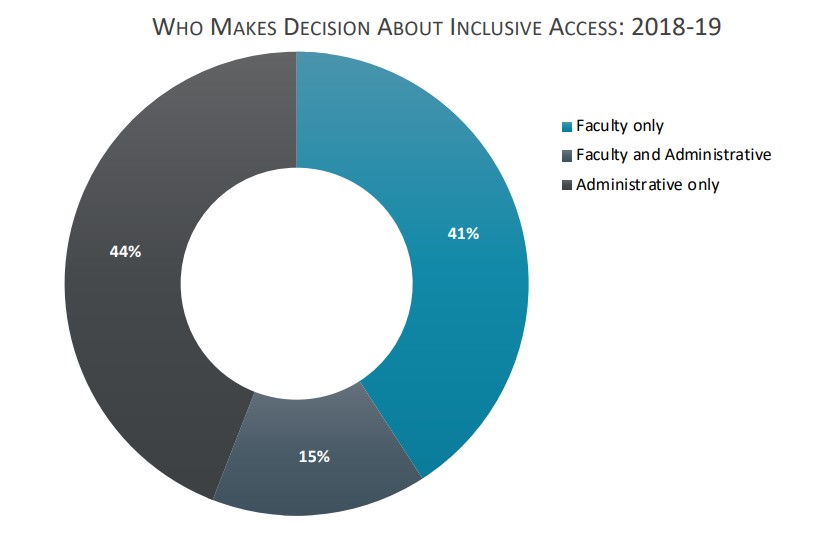
Administrators are significantly involved in decisions to choose inclusive-access programs, the survey found. While 41 percent of faculty reported that they alone selected inclusive access materials, 44 percent said administrators were involved. Another 15 percent of the decisions were made by administrators only.
Administrators may become more and more involved in course material decisions as the inclusive-access model takes off, Seaman said. “It’s potentially a real dark cloud on the horizon for academic freedom,” he said.
The OER movement has changed the conversation about affordability and access. Now its challenge is to stop institutions from “trading one broken model for another,” said Nicole Allen, director of open education at SPARC, which advocates for the use of OER.
“The inclusive-access model is a real threat to a lot of progress that has been made,” Allen said. “OER has an important opportunity to keep driving the conversation to make course materials better and ensure access to course materials is sustainable in the long run.”










