






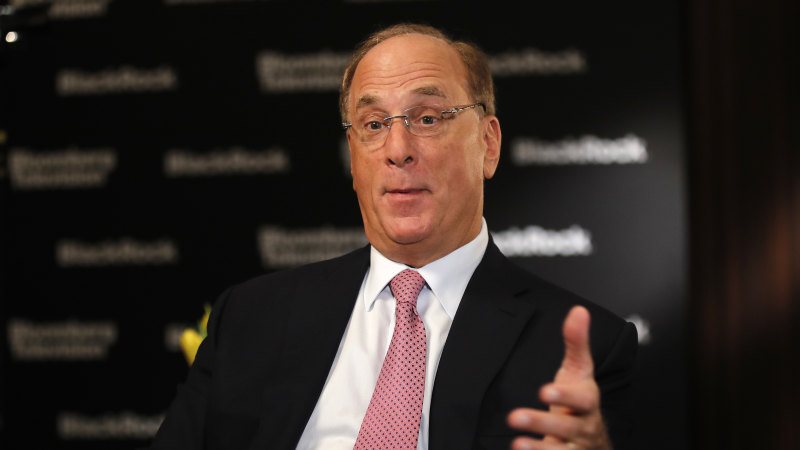
Fink had come to the view that climate risk and financial risk had “converged”. In a world where one of the basic financial building blocks was the 30-year mortgage decisions being made now, they had to be balanced against the risks that could be anticipated in the world of 2050.
The financial risks of climate change, in other words, are no longer hypothetical, and no longer those of the future – they are material and immediate. Companies that profit from emission-intensive operations should not presume they will be allowed to keep doing so for much longer.
Or, as he put it in his letter: “Because capital markets pull future risk forward we will see changes in capital allocation more quickly than we see changes to the climate itself. In the near future – and sooner than most anticipate – there will be a significant reallocation of capital.”
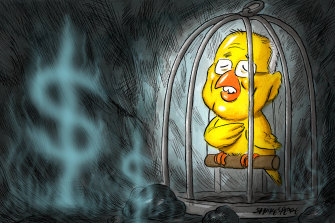
Illustration: John ShakespeareCredit:
On Wall Street, BlackRock’s founder is famous for a handful of traits – the strength of his views, the bluntness of his language and his obsessive attention to risk chief among them.
Fink has effectively had two financial careers, the first of which ended in humiliation. In his 20s in the early 1980s, working for the investment bank First Boston, Fink was one of the financiers who helped create the market in mortgage-backed securities – the slicing and dicing and resale of millions of home and car loans that would culminate in the 2008 global financial crisis when so many of them turned out to be worthless.
Loading
Well before then, though, just as he was becoming a star of the new sector in 1986, Fink’s department at First Boston lost $US100 million due to his prediction that interest rates were about to rise. Two years later Fink was forced out in what was described in a lengthy 2010 Vanity Fair profile as “one of the more spectacular and humiliating ‘flameouts’” on Wall Street.
Fink explained to Vanity Fair that in his view the losses at First Boston were born of the fact that no one really understood the risk, in part because the tools it used – the computer systems and their programs and algorithms – were not up to the task.
“We built this giant machine, and it was making a lot of money – until it didn’t’,” he said. “We didn’t know why we were making so much money. We didn’t have the risk tools to understand that risk. It’s what I tell everybody today: you should analyse your portfolio just as much when you are making money, because you could be taking on too much risk.”
In rebuilding his career, Fink “vowed never again to be in a position where he did not fully understand the risks he was taking in the market. What Fink had also come to see during his years at First Boston was how little his clients – pension funds, corporations, state and local governments – understood about the risks they were taking … And so he decided to build a company that would not only invest money for clients but offer them sophisticated risk management too.”
That company is BlackRock and the very heart of its business model is its risk analysis. To that end BlackRock relies heavily upon its proprietary risk-management platform, Aladdin, a vast artificial intelligence machine designed to simulate and stress test against any conceivable financial threat.
Loading
So trusted did BlackRock become in the field that, in the wake of the GFC, it was the outfit most relied upon by the US Federal Reserve to assess the risk to the $700 billion it poured into bailouts to rescue the US economy.
There has been some legitimately sceptical analysis of Fink’s apparently Damascene change of heart on climate change. It has been pointed out that BlackRock is only dumping coal stock from its $US1.8 trillion in actively managed funds, rather than from the $US5.2 trillion it manages in funds that passively track markets. Others have noted that Fink did not even mention climate change in his last letter a year ago. One of America’s leading environmental group’s, the Sierra Club, said BlackRock had a history of voting against environmental changes foisted upon companies by shareholder activists. And further, it noted, Blackrock would remain a major shareholder of the world’s largest resources companies.
But Fink has signalled that BlackRock’s voting patterns would change, writing in his latest letter: “Each year we refresh our engagement priorities and voting guidelines. This year, we will be mapping our engagement priorities to specific UN Sustainable Development Goals.”
And as Geraldine Buckingham told me, while BlackRock’s passive funds might remain invested in coal, its “investor stewardship team” – the biggest in the business – will be in the ears of corporate chiefs, prosecuting the case for climate reform. BlackRock will also double the number of passive sustainable funds it offers to investors and increase such holdings from $90 billion to $1 trillion within a decade
BlackRock is not the only institution on the face of this wave. On Friday morning, Australian time, Microsoft announced a plan to not only reduce its carbon emissions but to actively remove carbon from the atmosphere – going “carbon negative” by 2030. It pledged that by 2050 it will “remove from the environment all the carbon the company has emitted either directly or by electrical consumption since it was founded in 1975”.
Even elements of the mining sector are demanding reform. The Sydney Morning Herald and The Age revealed this week that the chief executive of mining giant Rio Tinto has pressured the leadership of the Business Council of Australia to step up its climate change advocacy.
The $100 billion miner joins Westpac and telecommunications company Telstra as flagship members willing to question the council’s climate change policies, with Telstra threatening to rescind its membership of the BCA unless it shifts.
And while BlackRock’s moves on climate change might be pragmatically motivated, the ethical and moral movement to divest from coal, oil and gas driven by shareholder activism is also gaining pace. The Institutional Investors Group on Climate Change now has a combined $24 trillion in assets under management, and is developing “a practical and useable framework for investors to be able to understand what it would mean for a pension fund to align with the goals of the Paris Agreement”.
Loading
Given all this movement, Scott Morrison’s response to BlackRock’s news might be considered tepid at best. He reminded reporters in Canberra that coal was worth $70 billion to Australia in export earnings, mouthed the government’s newly minted platitude about plans “to meet and beat emissions reductions targets”, and he mentioned taxes and power prices, balance and regional communities.
In other words, he made it clear that as global capital is withdrawing from coal, the Australian government is not.
It is not hard to see why this is the case. While BlackRock’s Aladdin is designed to consider millions upon millions of variables of risk, our major political parties are conditioned to consider the singular risk of losing a handful of seats in NSW and Queensland in three years.
Morrison is right to be concerned about the livelihood of the communities in those seats and – the workforces of those companies that mine coal in them – but the world is telling us now that those groups would be better served by a government willing to plan for an orderly transition from coal rather than continue its blinkered support for it.
For all of Fink’s global heft and famed bluntness, it was perhaps an Australian who put it best this week.
Discussing BlackRock’s move with the Herald and The Age, John Hempton, co-founder of Bronte Capital hedge fund said: “It’s not about the ethics. I have no problem with unethical investments, I just have a problem with stupid ones. On a 30-year time frame, most carbon-intensive industries will be stupid investments.”
Nick O’Malley is a senior writer and a former US correspondent for The Sydney Morning Herald and The Age.
Most Viewed in Environment
Loading










