






TAIPEI — For Toshio Nakama, the battle between China and the U.S. for global tech supremacy has been a boon.
Last year S2C, the chip design tools company that he co-founded 16 years ago in Silicon Valley and later moved to Shanghai, was bought by SMIT Holding, a Chinese group backed by Beijing’s China Integrated Circuit Industry Investment Fund, nicknamed the “Big Fund.”
“Previously I had to spend a lot of time caring about operations and finding new investors,” Nakama, the CEO of S2C, told the Nikkei Asian Review. “Now I can dedicate most of my time and effort to research and development.”
Nakama’s good fortune — he has nearly doubled S2C’s team of sales and engineering staff to 100, and plans to double it again next year — is due to Beijing’s aggressive quest for technological self-sufficiency, in which companies like his play a crucial if little-known role.
S2C provides electronic design automation — otherwise known as chip design tools — to Intel, Samsung and some 400 other semiconductor companies. These tools produce the software and hardware that in turn design the integrated circuits that actually make computer chips work.
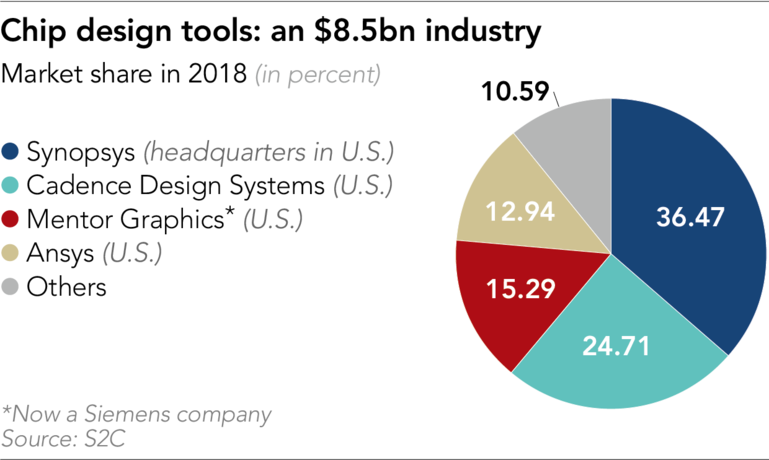
Without them, China will never be able to develop its own tech supply chains. Moreover, as the chip design tools industry is dominated by just four U.S.-based companies — Synopsys, Cadence Design System, Mentor Graphics, and Ansys control 90% of the world market — it has extra strategic significance to Beijing.
“It’s the first time in my career that chip design tools have been getting so much attention, and it is due to these [geopolitical] uncertainties,” Nakama said. “The number of chip design companies in China has soared to over 1,600, but they rely almost entirely on foreign tools. With the escalating global tech war, many Chinese companies are in need of alternative tools from local providers. The golden age of Chinese homegrown [chip design tools] is coming.”
Nakama’s company is a prime example of China’s nationwide campaign to cut dependence on U.S. technology in the wake of Washington’s crackdown on flagship companies such as Huawei, the world’s biggest telecom provider and second-largest smartphone company, and Hikvision, the world’s biggest surveillance camera manufacturer.
Faced with U.S. export bans on key technological inputs, Beijing’s goal is now no less than to create national champions in every segment of its tech supply chains — from electronics assembly, to chipmaking, and to chip design as well.
Empyrean Software, another Beijing-sponsored chip design toolmaker, has even said that its goal is “to help the country get rid of its dependence on foreign companies” by 2030.
The scope of Beijing’s drive is wide-ranging, and well-funded. Beijing has launched a $204 billion yuan ($29.1 billion) second phase of the Big Fund to develop China’s national semiconductor industry, as well as a new 147.2 billion yuan program to upgrade national manufacturing capability. The government introduced its first chip industry seed fund of 138.7 billion yuan back in 2014.
Even local capital markets have been recruited. Last year, China introduced the Star Market tech board, a local version of Nasdaq, to provide easier access to capital to homegrown tech startups. This year alone, companies have raised around 64.3 billion yuan on Star, according to research agency Wind.
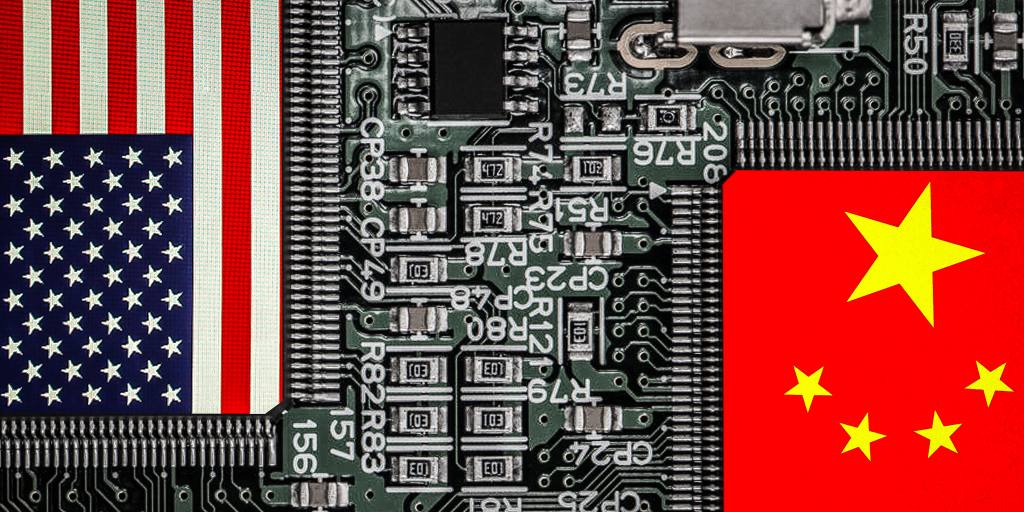
Each of these moves are part of an ongoing trend that will see the world’s two biggest economies increasingly decouple — especially in technology — despite any interim wins such as the first-phase trade deal that Beijing and Washington agreed to this month.
“China’s urgency to build a competitive semiconductor industry as well as tech subsectors is not because it wants to fight the U.S., but because offense is the best defense,” said Wang Lin, a partner in Walden International, a leading venture capital outfit that has investments in China’s top drone-maker DJI as well as the country’s biggest contract chipmaker, Semiconductor Manufacturing International Co.
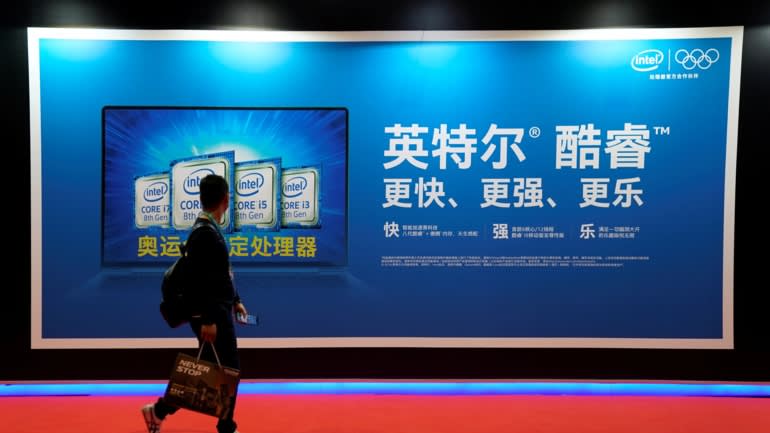
Intel is one of the world’s leading semiconductor makers, but Chinese rivals are hoping to one day catch up.
© Reuters
The great decoupling began with the election of Donald Trump to the U.S. presidency in 2016. Throughout his campaign, Trump repeatedly criticized China for taking American jobs, causing trade deficits and conducting unfair trade practices such as stealing intellectual property.
The decoupling got fully underway in 2018 after the Trump administration slapped billions of dollars of tariffs on Chinese goods. Foreign companies that relied on Chinese manufacturing were suddenly forced to shift production elsewhere.
But the real hammer blow came shortly afterward, when Washington also cracked down on Huawei, alleging national security concerns. For many, it was this attack on a Chinese national champion that forced everyone to accept that decoupling was a reality here to stay.
“The core of the U.S.-China trade war is Washington’s all-out efforts to stop China from rising quickly in advanced technologies,” said Y. W. Sun, CEO of China Fortune-Tech Capital, an investment arm of SMIC. “Never harbor any illusion that things will go back to the good old days.”
Tech executives — in the U.S., in China, and in places such as Taiwan, Japan and South Korea — say they have never before encountered so much geopolitical-generated uncertainty. The examples are legion, and encompass every aspect and subsector of tech supply chains.
Start with the first-round effects of the tech rift.
In May, U.S. chipmaker Advanced Micro Devices told Nikkei that it had stopped issuing technology licenses to its Chinese state-controlled joint venture partner, Tianjin Haiguang Advanced Technology Investment Co. The next month, it was added to Washington’s blacklist that banned the Chinese company from receiving key U.S. technology.
Google, meanwhile, was banned by Washington from supplying Huawei’s smartphones with its popular Google Mobile Services — including Gmail, YouTube, and Google Maps. Huawei said the ban would cause it to fall short of its sales goal by $10 billion, mainly due to the impact on its smartphone business.
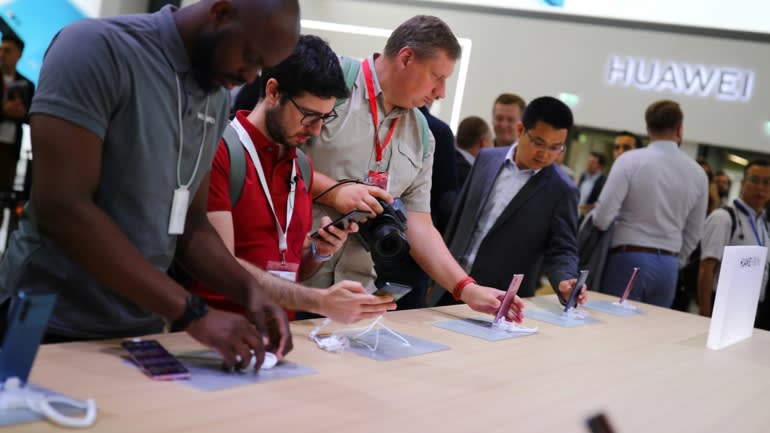
Huawei’s push into overseas markets like Europe has taken a hit from U.S. sanctions.
© Reuters
European companies have been drawn into the row, too. ASML, Europe’s largest manufacturer of semiconductor-making machines, which China needs to make its own next-generation chips, delayed shipment of a key piece of equipment to SMIC pending regulatory review, Nikkei reported in November.
For mainstream U.S. consumer companies such as Apple, though, the tech tensions are an especially heavy blow.
Not only is China a major manufacturer of Apple goods, it is also a valuable market, accounting for a fifth of the company’s sales. San Diego-based Qualcomm, the world’s biggest mobile chip developer, meanwhile derives 60% of its sales from China. Micron, the biggest U.S. memory chip maker, gets half its sales there.
Combined with the inflationary effect of U.S. tariffs on imported goods, any slowdown in sales or profitability by these leading U.S. companies could have knock-on effects on the broader U.S. economy.
“We think U.S. growth will fall to around only 1% next year,” said Erik Norland, senior economist at CME Group. “China will slow down too but it’s still one of the most rapidly growing countries in the world.”
Then there are the second-round effects of the tech war.
For one, it has seen tech companies from places other than the U.S. and China mobilize fast to take advantage of opportunities created by the dispute.
Taiwan-based Foxconn, formally traded as Hon Hai Precision Industry, counts the world’s largest companies that contract out electronics manufacturing among its clients, including Apple, Google and Cisco. Foxconn has raced to expand manufacturing capacity in Taiwan, Vietnam and India, where exports do not face the same U.S. tariffs.
Quanta Computer and Compal Electronics, the world’s largest and second-largest notebook computer makers, have also increased investment in Taiwan, Thailand and Vietnam.
It has also left U.S. companies scrabbling to lobby Washington about the importance of keeping business relationships with China intact.
In August, Donald Trump said Tim Cook, Apple’s CEO, had called to tell him that any additional tariffs would unfairly hurt Apple against its archrival Samsung Electronics, which does most of its smartphone manufacturing out of South Korea.
Whatever may happen to trade relations, though, Washington is likely to remain hawkish when it comes to Chinese technology, especially its expanding reach overseas.
Only last month, America’s Federal Communications Commission voted to block rural carriers from the government funding they had used to buy broadband kit from Huawei and ZTE, another Chinese telecom equipment manufacturer.
Citing security threats, the FCC even demanded that local operators rip out any extant equipment from their networks, despite replacement costs that the FCC estimates will reach almost $2 billion.
© Reuters
The U.S. government has also lobbied international allies to ban the use of Chinese 5G telecom equipment. This month U.K. Prime Minister Boris Johnson, after meeting in London with Trump, vowed not to involve Huawei in Britain’s 5G telecommunications networks if it compromised the country’s ability to work with close security allies such as the U.S.
China’s response has been just as unequivocal.
Its latest move has been to eliminate foreign-made computers and software from all government offices within three years. As many as 30 million pieces of equipment will have to be swapped out within three years, the Financial Times has reported.
“China has been pushing for self-reliance for several years,” said Joey Yen, a tech analyst at research agency IDC. “The trend may go underground to avoid irritating the U.S., but it won’t go away. Starting with government procurement is always an effective way.”
China-based Lenovo Group currently has 57% of the Chinese government procurement market, which consists of around 4 million units annually, while Shanghai-listed Founder Tech has about 15%. By contrast, HP and Dell have around 7% and 9%, respectively.
“It is going to get more challenging for foreign companies — not only American companies but also South Korean, Japanese and Taiwanese ones — to participate in Chinese government bids,” a Taiwanese computer industry executive said.
Lastly, there are the effects that the tech battle has had on Chinese companies.
Chinese companies such as smartphone makers Xiaomi and Oppo, and computer manufacturer Lenovo, can still buy certain goods such as semiconductor chips from U.S. vendors such as Qualcomm. But having seen that Washington might ban those U.S. technologies, they are moving fast to create supply chains in China instead.
For some, that is a good thing. As Eric Zhou, senior vice president of Beijing-backed mobile chip developer UNISOC Communications, said: “That creates a lot of opportunities for smaller local companies” to provide those technologies instead.
To that end, Huawei’s investment arm has poured money into several semiconductor-related companies, such as material maker SICC and power management chip provider Joulwatt. Alibaba Group Holding, the e-commerce giant, also unveiled this summer that it has built a chip platform — a set of infrastructure source codes that other developers can join to build their own chips and, from there, a new Chinese tech ecosystem.
“What they [in China] want is to build not just CPU [central processing units] and critical materials for chip-related technologies, but even downstream electronics assembly work that currently relies on Taiwanese companies,” one executive at an Apple supplier said. “Taiwanese production partners are no longer viewed as being as safe as they once were.”
Of course, building out tech supply chains from scratch is a long road. According to China Fortune-Tech Capital, an investment unit of the country’s biggest contract chipmaker SMIC, in areas such as computer and server core processors and chip design tools, China is only 1% self-sufficient.
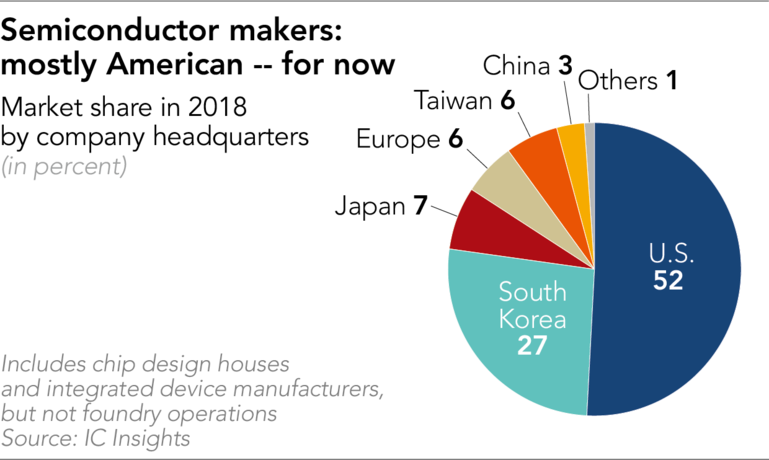
As for semiconductors, China-based companies have a world market share of only 3%, while U.S.-based chipmakers have 52%, data from IC Insights shows.
“The major challenges are that China’s own homegrown chip products still service mostly the mid-to-low-end market while Chinese-made chip products that could address the premium market are lagging,” said Wei Shaojun, dean of the department of micro-and nano-electronics at Tsinghua University.
Beijing is aware of this problem, as is Washington — which still has “nuclear options” it can use to curb China’s technological advance.
These include restricting the supply of semiconductor equipment; placing Chinese companies on stricter trade blacklists; and tightening controls by classifying some goods as related to military use. Washington is reportedly in the process of finalizing new export rules to enforce a 2018 law aimed at keeping sensitive technologies out of the hands of rival powers.
“The issue is whether the U.S. government moves controlled technology from the ‘dual-use’ list and reclassifies items as ‘military,’ under the International Traffic in Arms Regulations (ITAR) and other U.S. laws,” Alex Capri, a senior fellow at National University of Singapore Business School, said.
In this scenario, even a simple transaction between two parties would become illegal. “It would be a showstopper and essentially nullify other legal measures taken by companies to circumnavigate export controls,” Capri added.
It would also hurt U.S. companies and break up the whole global tech supply system — a catastrophic scenario.
“It’s not realistic for the U.S. and China to fully decouple from each other,” said Walden International’s Wang. “That would be a disaster and really slow down all the world’s technological development.”