







As procurement becomes more digital, data-driven and strategically important, it’s increasingly clear that organizations need a new breed of procurement professionals. Tomorrow’s procurement professionals need to be equally fluent in technology, data and relationship building. They must be able to zoom in to analyze processes and data points, and then zoom out to deliver strategic insights and collaborate with suppliers. Some of today’s professionals will need to bone up on their job-specific skills, but most will need to add new tools like business acumen, interpersonal skills and deep work (the ability to focus without distraction on cognitively demanding tasks) to their toolkits.
Related APQC Infographic: How organizations develop procurement talent
Leading organizations know that the time to close the procurement skills gap is now. To assess how well organizations are developing employees and evaluate the current state of investment in procurement talent in 2019, APQC collected responses from 204 global procurement professionals. The results indicate that while most organizations still rely on traditional talent development practices, the most effective organizations use innovative approaches to build the procurement skills of tomorrow.
Talent development is a strategic imperative
Organizations participating in APQC’s research view talent management initiatives as a top priority in procurement. Two out of three respondents strongly agree that these initiatives are a top priority for their organization. The research shows that senior leaders are on board to invest in the next generation of procurement talent. Fifty-five percent of respondents indicate that their chief procurement officer or procurement director considers providing in-depth training for procurement staff to be a high or essential priority.
APQC also found that most organizations have talent management programs for procurement professionals. Nearly 60% of those surveyed have talent management programs in procurement. Of those that do not have one in procurement, 7% have a program at the level of supply chain management, and about 18% have a program at the enterprise level.
Responsibility for talent management
Many organizations also recognize that the supply chain or procurement function must be actively involved in talent management. About two-thirds of organizations in APQC’s research involve both the supply chain and human resource functions jointly in the management of supply chain or procurement talent. About one-quarter of organizations make their supply chain or procurement function solely responsible for the management of their talent, and only 10% of organizations have the HR function solely responsible for talent management.
Organizations recognize the value of combining HR’s expertise with supply chain’s and procurement’s operational knowledge. HR can help identify skill gaps and recommend ways to support employees in their skill development. Supply chain can provide insight on the day-to-day work employees must be able to complete and help tailor development opportunities to the unique and evolving needs of the supply chain professional.
Components and approaches used
As part of this research, APQC asked organizations to describe the components of their talent development programs. Figure 1 shows the adoption rates of various components. Traditional approaches—such as formal performance management, competency models, and skills frameworks—are most widely used.
The less common components at the bottom of the list have one thing in common: They’re designed to benefit both the organization and the employee. For example, career paths illustrate how an employee can advance through the organization, while learning profiles incorporate each individual’s strengths and learning styles. Development approaches tailored to the employee typically lead to more effective and engaged staff, which in turn benefits the employer.
Approaches and formats used
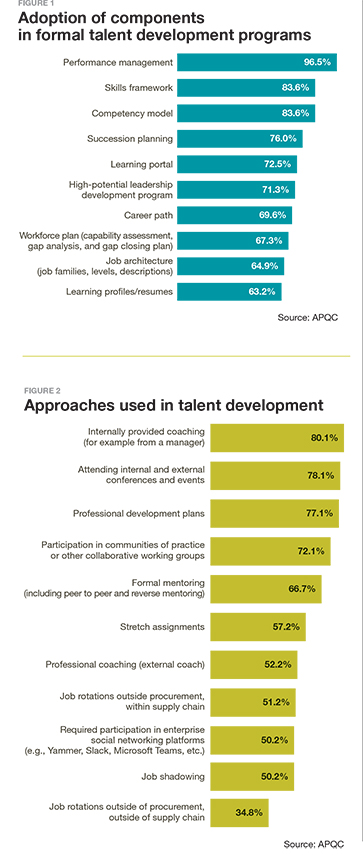 In addition to asking organizations which components they include in their talent development programs, APQC asked which approaches and formats organizations use for talent development. As shown in Figure 2, all but one of the approaches included in APQC’s research are used by at least half of organizations. However, only five are used by a solid majority of organizations.
Most of the common approaches are internally focused (e.g., internally provided coaching, professional development plans, communities of practice, formal mentoring). Less common approaches tend to extend beyond the procurement or supply chain function—or even the organization all together (e.g., job rotations outside of procurement or supply chain, professional external coaching).
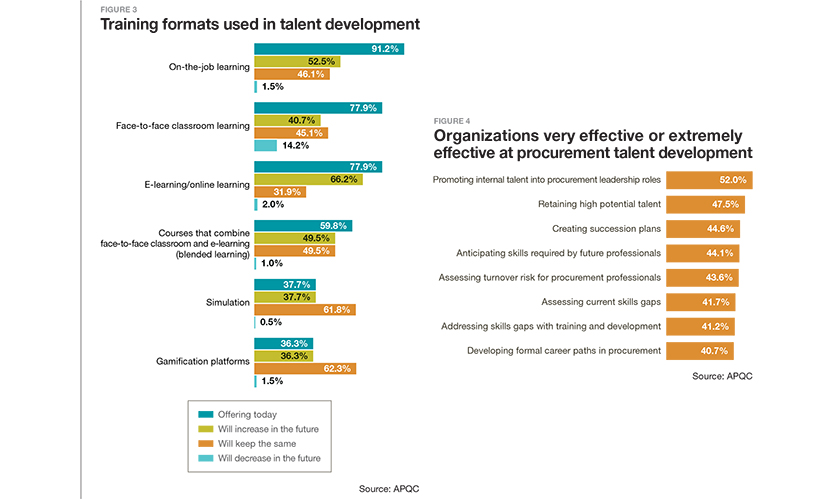
One can see the same internal focus in the formats organizations use for training procurement professionals. As shown in Figure 3, an overwhelming majority of organizations use on-the-job learning to train procurement employees. When considering development offerings in the future, more than half of the organizations in APQC’s research intend to increase on-the-job learning, and about 46% intend to keep the amount of on-the-job training the same.
Currently, the same percentage of organizations offer face-to-face classroom learning and online learning. However, two-thirds of those organizations intend to increase their offering of online learning in the future, and 14% of organizations intend to decrease the amount of classroom learning in the future. These results are indicative of the appeal of online learning, which gives employees (and their employers) flexibility to access training wherever and whenever it is convenient rather than working around the schedule of a trainer and classroom facilities.
Effectiveness of development efforts
APQC also examined how organizations rated the effectiveness of their procurement talent development approaches. Figure 4 shows the percentage of respondents who rated their organizations very or extremely effective for each aspect.
The results show that organizations are most effective at retaining high potential talent in the procurement function and promoting that talent into leadership roles. To a lesser extent, organizations are very or extremely effective at assessing current skills gaps and then closing those gaps with their training and development efforts.
APQC also examined how different program components correlated with effectiveness. Organizations with effective talent development programs tend to use career paths, workforce plans and learning profiles and resumes—all of which are less likely to be used by organizations overall. Because these components are tailored to employees, they may lead to increased effectiveness of the talent development programs.
Effective organizations use a mix of more widely adopted approaches, such as formal mentoring and stretch assignments, and less widely used formats such as required participation in enterprise social networking and job shadowing. Many effective organizations also use job rotations outside of procurement and/or supply chain as a way of developing talent. This illustrates that effective organizations are interested in adopting newer technology and that they recognize the importance of having staff learn about roles outside of supply chain to gain broader knowledge.
Consider benefits to the organization and employee
Organizations are expanding their procurement talent development programs in other ways. About 44% of organizations are increasing employees’ ability to take time away from work for development. Forty-nine percent of organizations are increasing the amount of time managers devote to supporting employee development. Although this dedication to employee development is positive, APQC recommends organizations consider how to support the impact on productivity when employees take time away from work to either participate in training or engage in other development efforts.
Of the development methods adopted by organizations, most are more traditional, such as coaching provided by other employees and sending employees to conferences. Yet the organizations that are more effective in talent development use approaches that balance the needs of both employer and employee.
APQC recommends that organizations identify the skills and training that are most beneficial to the business and its future and then make an honest comparison against the skills and training that benefit their current procurement professionals. By allowing focus on employee needs, organizations can create an environment that both attracts and retains top talent. At the same time, organizations must be aware that more talent development opportunities can lead to less time spent on the job. They must therefore plan accordingly to ensure that employees are not forced to choose between developing skills needed for the future and achieving today’s productivity goals.
About APQC
APQC helps organizations work smarter, faster and with greater confidence. It is the world’s foremost authority in benchmarking, best practices, process and performance improvement, and knowledge management. APQC’s unique structure as a member-based nonprofit makes it a differentiator in the marketplace. APQC partners with more than 500 member organizations worldwide in all industries. With more than 40 years of experience, APQC remains the world’s leader in transforming organizations. Visit us at apqc.org, and learn how you can make best practices your practices.