






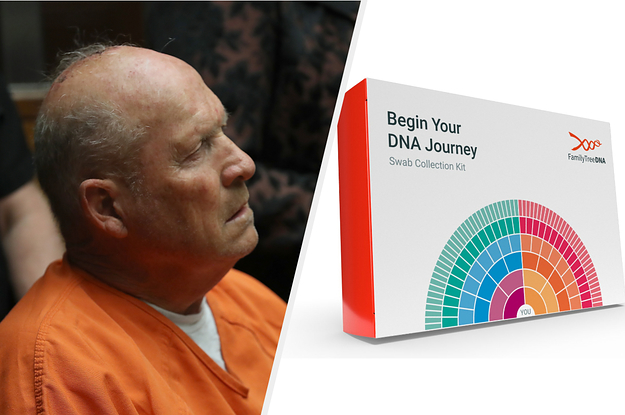
On Jan. 31, 2019, after BuzzFeed News revealed that Family Tree DNA was working with the FBI to solve murders and rapes using its DNA database, the genetic testing company put out a press release that stated: “If we can help prevent violent crimes and save lives or bring closure to families, then we’re going to do that.”
Just days later, Parabon NanoLabs, a DNA forensics company that had by then already solved nearly three dozen cases by finding suspects through their family trees, asked for permission to upload crime scene DNA profiles to Family Tree DNA’s database to search for potential matches.
The request was not granted, email correspondence obtained by BuzzFeed News under a Freedom of Information Act request to the FBI shows. “My answer is no…” Family Tree DNA CEO Bennett Greenspan wrote on Feb. 4 to Steve Kramer, a lawyer in the FBI’s Los Angeles field office, in an email in which he forwarded Parabon’s request.
Since April 2018, when the method scored its first big success with the Golden State Killer case, dozens of alleged murderers or rapists have been identified by genetic genealogy. The technique involves investigators looking for DNA profiles that partially match genetic material from crime scenes and then building family trees from these relatives to find a suspect.
The fact that cops were doing this in databases set up to allow people to research their family histories, initially without users being informed, has led to a tense debate over genetic privacy. The new emails, which BuzzFeed obtained as part of an ongoing FOIA lawsuit against the FBI, highlight another flashpoint: rivalries between companies working with cops to solve highly publicized cases.
Family Tree DNA declined to discuss Greenspan’s Feb. 4 email describing his decision not to grant Parabon’s request. A spokesperson told BuzzFeed News by email that the company had “encountered some quality control and data management issues” with sample data later provided by Parabon in March and April 2019 but was still “engaged in conversations with Parabon and evaluating the possibility of a direct business relationship.”
Parabon’s lead genealogist, CeCe Moore, declined to comment on negotiations with Family Tree DNA, but said that Parabon’s failure to gain access to the database had slowed progress in solving crimes over the past year.
“Absolutely, more cases would have been solved by now if we had an additional database,” Moore told BuzzFeed News.
The issue became more acute in May 2019, when the other leading genealogy database used to find partial matches to crime scene DNA, called GEDmatch, changed its rules to require users to explicitly opt in for searches by law enforcement. As of last month, only about one in six had done so, making it harder to solve cases.
So far, Parabon has identified more than 85 criminal suspects using genetic genealogy, according to Moore. Four involved matches obtained using Family Tree DNA’s database, after law enforcement agencies working with Parabon submitted the profiles directly — a workaround that Family Tree DNA does allow.
Genetic genealogy burst onto the scene as a crime-solving technique with the April 2018 arrest of Joseph James DeAngelo, alleged to be the Golden State Killer who is responsible for at least 13 murders and more than 50 rapes in California beginning in the 1970s.
Investigators, including Kramer’s team at the FBI working with the genealogist Barbara Rae-Venter, identified DeAngelo by tracing family trees from DNA profiles that partially matched profiles from crime scene DNA uploaded to GEDmatch, a public DNA database for genealogy enthusiasts. In the months that followed, cases were solved using GEDmatch at the rate of about one a week.
The more DNA profiles available to search, the greater the chance of finding relatives with profiles that partially match to a crime scene DNA sample. The much larger databases run by the biggest players in the industry, 23andMe and Ancestry, don’t allow users to upload DNA profiles tested by other companies. But like GEDmatch, Family Tree DNA’s database does.
Kramer’s team at the FBI had noticed this. According to an interview Family Tree CEO Greenspan later gave to the Wall Street Journal, in 2018 Kramer pressured him to work with the FBI on a regular basis, saying the alternative would be “perpetually dealing with a subpoena” to allow the FBI to upload DNA profiles and search the database. Family Tree DNA’s database, with just over a million DNA profiles, was almost as big as GEDmatch, and so its entry into the fray was a game-changer for solving cold cases.
In December 2018, Family Tree DNA quietly changed its terms and conditions, noting that law enforcement could use its services in cases involving homicide or sexual assault — or to identify dead bodies. But it didn’t inform its customers that it was already working with the FBI to do so.
When the news broke of the collaboration, there was a backlash from some customers who argued that their privacy had been breached.
Arguments between advocates for genetic privacy and those who support law enforcement access to genealogy databases have played out frequently in the media since then. Greenspan and Family Tree DNA responded by allowing customers to opt out of law enforcement searches, a change made in March 2019, while stressing the importance of getting violent criminals off the streets.
“Glad that a killer was caught yesterday. We need more,” Greenspan wrote to Kramer in a Feb. 8, 2019, email.
But the correspondence between Greenspan and Kramer, partially redacted by the FBI in the FOIA response to BuzzFeed News, also reveals tensions between companies working with law enforcement on high-profile cases.
After police in Newport Beach, California, announced that a suspect called James Neal had been arrested for the 1973 murder of 11-year-old Linda Ann O’Keefe, Greenspan wrote Kramer to vent his frustration about Family Tree DNA not getting enough credit for solving the case, according to a Feb. 20, 2019, email.
“There is no doubt in my mind this was a political move,” Greenspan wrote. “[Redacted] tells me there will be a correction of the press release, but we all know it will not be as impactful as the first hit.”
Moore and Parabon worked with the police on this case, but a key lead came after the police department uploaded a crime scene DNA profile to Family Tree DNA’s database. At the press conference to announce the arrest, the Newport Beach police chief thanked Parabon and Moore before thanking Family Tree DNA.
“After lauding [redacted] during the press conference, there was a mention by the police chief of FamilyTreeDNA,” Greenspan wrote to Kramer.
Family Tree DNA defended its CEO’s desire for recognition. “The decision to work with law enforcement was not made lightly and we wanted our customers and the public to know the positive impact this was having,” a spokesperson told BuzzFeed News by email.
Over the past year, a burgeoning business has sprung up around investigative genetic genealogy, giving Parabon some competition.
In February 2019, forensic genetics company Bode Technology launched an investigative genealogy business, working with Family Tree DNA for lab testing. In September, Family Tree DNA formed its own investigative genealogy unit, headed by Rae-Venter, who worked on the Golden State Killer and other cases with the FBI. And in December, the forensic genetics company Verogen purchased GEDmatch. It is expected to offer a service for law enforcement including DNA testing and access to the GEDmatch database.
Ryan Backmann, who formed the advocacy group Project: Cold Case, based in Jacksonville, Florida, after his father was shot dead in 2009, said he was concerned that tensions between Family Tree DNA and Parabon could get in the way of solving crimes.
“Without knowing all the details, I don’t want to take a stance against one or the other,” Backmann told BuzzFeed News. “But when we are talking about solving cold case murders or rapes, you hate to see that suffer because of disagreements or competition.”
The FBI declined to comment on Kramer’s correspondence with Greenspan.